Capt von Berlepsch of Hapag-Lloyd: we’re navigating unknown waters

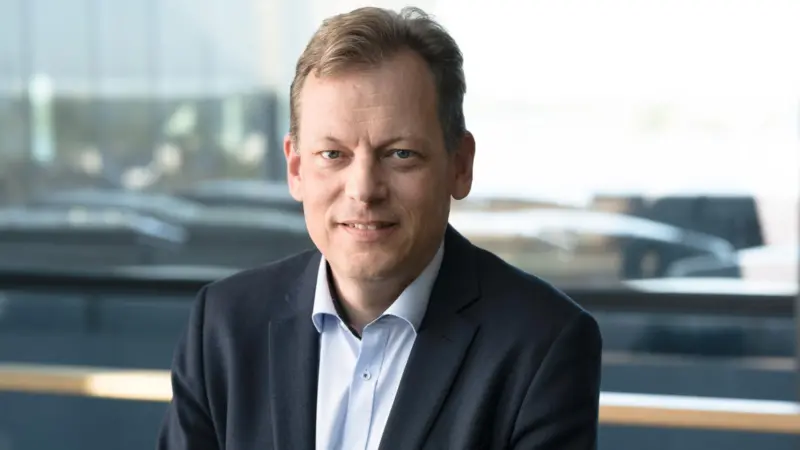
Captain Richard von Berlepsch opened his interview at the shipping liner’s Hamburg headquarters with a passionate defence of the advances made by the container industry in recent years.
Speaking shortly after the German parliamentary election in September 2021, Mr. von Berlepsch noted that although the industry’s public profile had rarely been higher, public understanding of the industry’s progress was imperfect. “We need to do a better job at reminding the public about the enormous progress we have made as an industry in lowering emissions on a tonne/mile basis,” he mused.
The wider implications of decarbonisation were also close to Mr. von Berlepsch’s thoughts. Having accepted a series of challenging decarbonisation objectives, with IMO targets for 2030 and 2050, the industry was currently confronting a number of significant challenges.
Foremost among the challenges was the choice accepting LNG as the bridging fuel for the industry between HSFO and successor fuels, or placing its faith in a number of alternative zero-carbon fuels that would not become commercially available at the scale required by commercial shipping before the early 2030s.
This choice between a net-zero carbon pathway or a zero- carbon pathway would then have significant implications for the future development of the fuel supply chain and vessel technology going forward, as the choice of fuel would shape subsequent options (path dependencies).
“Investments in different fuel types entail significant investments. So, imagine I choose to make an investment in a net-zero fuel like methanol. Once that decision is taken, if you want to subsequently change to operating on a zero carbon fuel like ammonia, this would mean a significant refit of engines, new tanks, and so on and so on.”
Mr. von Berlepsch admitted that Hapag-Lloyd so far had not made a final decision on the ideal alternative fuel of the future. That said, the company had recently made a significant investment in a series of LNG-fuelled ultra large container vessels, which will increase the proportion of its crews who are familiar with operating on LNG.
The company’s decision to switch to LNG-fuelled propulsion for its latest newbuilds was supported by advances in the availability of bio-LNG (LBG). The company was planning to drop-in a proportion of bio-LNG (LBG) into the vessels’ fuel mix as an initial step. “This is actually one of the biggest immediate benefits for LNG at the moment. While it is obviously not a pathway for the future, it would offer an immediate 25% [GHG emission reduction] benefit. We plan to do this as soon as we’re ready and we’re able to purchase it. The nice thing is that you don’t have to change anything on the vessel to switch to LBG and at a later stage you can switch to synthetic LNG (Net-Zero carbon) when that becomes available.”
The fuel is the thing
The choice of fuel was the only realistic route by which the industry could reach the decarbonisation target, Captain von Berlepsch noted. The scope for further improvements in the efficiency of existing propulsion arrangements was limited, he said, recognising the increase in engine efficiency over the past 10 years or so. “The latest most efficient two-stroke engines are already achieving efficiencies of above 50% and engine designers really only expect to see incremental increases in engine efficiency in the future”.
“Technical advances in propulsion will not get us close to the 50% emissions reductions that the industry needs to achieve.”
However, Captain von Berlepsch noted that if the industry as a whole chose to put off adoption of LNG, it was likely to face tough choices around operational speeds. “Speed limits are attractive to politicians, but our customers have expectations about delivery times. Speed limits alone do not really represent a viable solution for the container market.”
Hapag-Lloyd was continuing to look into the efficiency benefits offered by digitalisation, but the efficiency savings offered by the increased flow of data between vessels and the fleet management offices would also be insufficient to meet the targets.
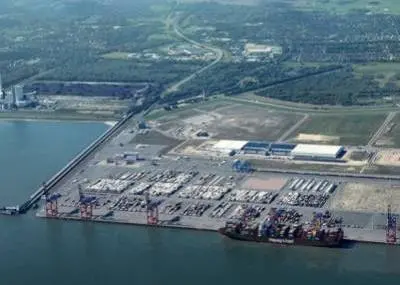
Captain von Berlepsch did note in passing that the company was “looking at all opportunities all the time” in terms of vertical integration, following the acquisition of a 30% stake in Container Terminal Wilhelmshaven (CTW) and 50% of the shares of Rail Terminal Wilhelmshaven (RTW) at JadeWeserPort Wilhelmshaven. “But we have nothing in front of us,” he added.
Barzan
A series of six 23,500+-teu dual-fuel newbuildings are destined to join the 19,900 teu Barzan (pictured) on the Asia-Europe route. (credit: Hapag-Lloyd)
Returning to his theme, Mr. von Berlepsch reiterated that the only solution that could realistically help the industry to meet the emission reductions targets was switching to alternative fuel.
In fact, the container vessel market was likely to opt for a combination of switching to different fuel types in order to meet decarbonisation objectives, combined with digitalisation solutions and speed reductions “wherever necessary to meet targets”.
The perfect is the enemy of the good
However, the choice between different fuel types was also circumscribed by regulatory preferences for zero carbon emissions. The choice was being influenced by the choice of decarbonisation objective, and the measurement method selected.
As measures of greenhouse gas emissions on a tank-to-wake basis essentially discount the upstream emissions generated during the production of fuels, this risks skewing comparisons between LNG and other alternative fuels. Hydrogen produced from natural gas had a high upstream footprint, for example.
Similar care needed to be taken with choices around decarbonisation terminology, Mr. von Berlepsch noted. Terms such as net carbon neutral or zero carbon are used so freely that the public could be easily confused.
One of the problems was the sheer diversity of different emissions reduction metrics that were published, without even touching on the longer-running problem of calculating emissions reductions using different systems.
“We know the differences between absolute emissions, transport work per transport container, or the emissions from temperature controlled cargo, for example. We understand, as experts, the difference between calculated or nominal capacity or calculated or actual carrying capacity.”
As such, Mr. von Berlepsch emphasised that the international shipping industry did have a role to play in combating erroneous public perceptions. He called for the IMO to carefully produce fuel measurement guidelines around which the industry could agree. One potential area might include clarifying whether comparisons were on a well-to-wake or tank-to-wake basis.
Mr. von Berlepsch was keen to point out that such regulatory decisions also had real world commercial implications. Turning to Hapag-Lloyd’s experience with the conversion of the Sajir, he noted that uncertainty about whether the conversion works from a regulatory point of view, as well as concerns about the financial treatment of conversion costs were the “big pain point”. Such concerns went beyond practical concerns for conversions, such as the age of the vessel, and the payback period.
EU regulation
The EU green taxonomy was not the only area where regulatory decisions affect Hapag-Lloyd’s business. The Fit for 55 package, as well as the carbon border adjustment mechanism were likely to have an effect. One recent EU regulatory initiatives that would have a direct effect upon Hapag-Lloyd’s business was the requirement for onshore power supply (OPS) connections to be connected to all container vessels operating in the EU.
Hapag-Lloyd already complied with shore power connection requirements in other parts of the world, such as parts of the US West Coast, and Hapag-Lloyd would invest to comply with whatever rules were finally introduced. However, Mr. von Berlepsch noted that the company’s US experience had taught him that it was not unknown for vessels with OPS connections on board to be unable to find compatible power connections.
There may well be some opportunity for the regulations to be amended during the next stages to better reflect the operational realities of some larger container vessels, and also to iron out any wrinkles in the interaction between the proposed OPS requirement and existing vessel safety rules.
By contrast, Mr. von Berlepsch was more resigned about the likely impact of the extension of the EU Emissions Trading System (ETS) to cover shipping. “I am absolutely certain that this will go ahead,” Mr. von Berlepsch said, adding “although I expect the elements covering the transport of goods from third countries to the EU to be debated with trading partners.” This was the case in aviation, when the EU sought to extend the ETS to cover the international legs of travel between the EU and third countries.