



Carbon capture ready to come of age
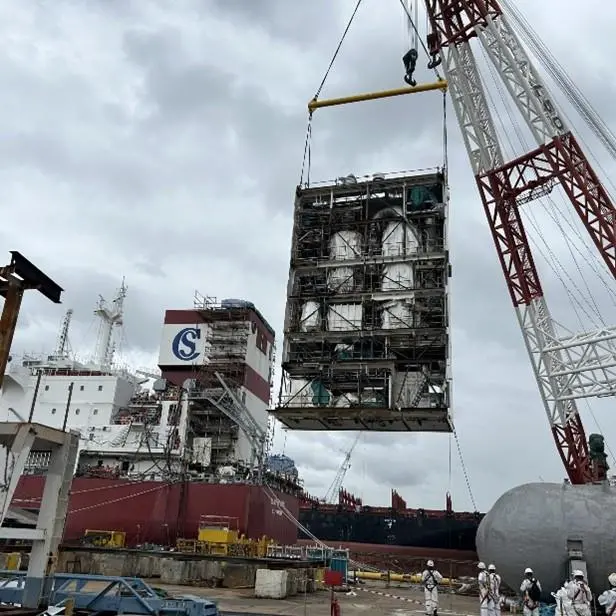
There are multiple reasons why carbon capture onboard ships should never have been thought possible, let alone desirable, but the shipping industry being steered on a voyage to net zero is a powerful reason why it may become not just desirable but essential.
The big questions are, will the advent of emission charging make CCS an acceptable money saving possibility now that the IMO is looking to set rules? and what are the limitations for different ship types and modes of operation?
The cost argument
At some point fuels such as ammonia and hydrogen will allow for almost carbon-free operation – with ammonia some small amount of conventional fuel is need as a pilot for combustion – or e-fuels and biofuels that do produce carbon but maybe considered as net zero will be available in quantity.
Until then, operators need to balance practical and environmental concerns. Economics will be the biggest driver with the EU already having implemented emission charging for some ships and the IMO meeting imminently to discuss a possible charging framework for the industry as a whole.
The EU ETS scheme covering ships over 5,000GT will charge 100 % of emissions within EU waters and 50 % of emissions on inbound/outbound voyages. At around €70 per tonne of CO2 and assuming a medium size ship that emits 10,000 tons CO₂/year, it would be around €700,000 annually.
At MEPC 83 the adoption of a global charge of $100 per tonne of CO2 was proposed to be decided at a special meeting held in mid-October. As this is written that is still in the future and the outcome uncertain. If adopted, it would mean an effective hike in bunker prices of around $300-$350 per tonne depending upon fuel type. Furthermore, the proposal is that cost would escalate over time as the industry moves towards the IMO’s 2050 net zero target.
Those costs alone might be sufficient to tempt many owners to look at carbon-capture systems but there could even be a bonus from doing so. Despite its evil reputation as the prime cause of climate change, CO2 is a gas much in demand across many industries being used in food and beverage production, refrigeration, fire-fighting systems, horticulture and many more. Rather than sequestering the CO2 produced by ships, there is interest in commercialising the captured CO2 and marketing it as a new source of supply.
Overcoming operational obstacles
For most ship types, profitable spot market operation is all about maximising cargo intake while at the same time managing bunker consumption so as to get the fuel at the lowest price and with few bunkering calls. Ships operating on lines can be less constrained because of the predictability of calls and rarely operating at maximum deadweight.
The biggest factor against carbon capture is the impact it has on a ship’s cargo carrying capacity. Minimising the amount of fuel that needs to be carried in order to get the most cargo on board, is a skill that successful operators have always needed to acquire, but carbon capture adds another variable into the equation. When burning any fuel that contains carbon, the chemistry of combustion means that the carbon in the fuel will combine with oxygen from the charge air and form carbon dioxide.
The result of that process is that because of the combined oxygen, the weight of CO2 produced is around 3.25 times the weight of the original fuel when burning oil. Other fuels such as LNG or methanol produce slightly less CO2 but still in significant amounts. Assuming a carbon capture system captures all the CO2 – most do not, ranging only from 65% to 90% – a voyage which would need say 1,000 tonnes of fuel will result in over 3,000 tonnes of CO2 needing to be stored.
Effectively that means that 2,000 tonnes less of cargo could be accommodated although in practice, the reduced cargo capacity would likely be more because the weight of the carbon capture system itself and the fuel needed to run it would also need to be accounted for.
The additional weight of captured CO2 is not the only consideration as there also needs to be space to store it. As a gas, CO2 has a density of approximately 1.9 kg/m3 at atmospheric pressure and +15 °C which equates to around 526m3 per tonne. Put another way, a ship burning 20 tonnes of fuel per day will produce over 34,000 m3 of CO2 gas. That is an impossible capacity for a ship to accommodate under normal operating conditions so the gas will need to be compressed into a liquid or stored in some alternative form.
Making capture practical
Carbon capture will allow a ship to continue to operate on any fuel type and if combined with a SOx scrubbing system as is the case with some of the systems on the market including those from Dutch-based Value Maritime and Finland’s, the ship could operate mostly on high-sulphur fuels which are readily available and the cheapest. Only in territorial waters where scrubber operation is not permitted would the ship have to use VLSFO or distillates but even here the carbon capture element could still be used, and with some scrubbers particulate matter removal is another benefit.
In both systems and in others combining CCS and scrubbing, the SOx is first removed in the scrubber and the exhaust gas then cooled and passed into a liquid amine solvent solution that absorbs the CO2. In the Wärtsilä system this is done in a tower system whereas the Value Maritime system uses a rotating packed bed centrifugal system. Proponents of the centrifugal system including other makers such as Carbon Ridge, claim that it can be made more compact than a tower system and is more efficient. With so far limited experience in maritime, all claims are yet to be proven.
While the CO2 is absorbed by the solvent, the remaining exhaust gases continue to the funnel to be vented into the atmosphere. At the next stage the solvent is heated to release the CO2 and returned to the system for reuse. The CO2 is then compressed and stored in liquid form tanks or bottles for later delivery ashore.
First references gather support
The onboard CCS is yet in its infancy, but those pioneers have that have experimented with it are generally pleased and are ordering more systems. Edvin Endresen, CEO of Norwegian gas carrier operator Edvin Endresen told Motorship, that in addition to the initial Wartsila CCS system fitted on the 21,289m3 LPG carrier Clipper Eris at the end of 2024, seven more newbuilds have been readied to install systems although actual installation will depend upon there being global emission regulations in place and also CO2 discharge hubs established around the globe.
Clipper Eris is equipped with deck mounted CO2 storage tanks and for the vessel which burns around 21 tonnes HFO daily, the tanks are sufficient to store around 20 days of compressed CO2 at a capture rate of 70%. Endresen said that in fact, the capture rate has actually been higher than 70% in practice.
Value Maritime has so far installed more than 60 of its Filtree scrubbing systems, several of which also feature carbon capture capability. The modular system is designed for engines in the 3-20MW range and can capture up to 75% of CO2 depending on fuel type. Early movers in fitting the system were the Dutch feeder specialist BG Freight Line which announced in 2022 that it would be utilising the system. Early last year, two 1,380teu vessels BG Green and BG Orange were delivered with the systems installed. Value Maritime has said it is expanding its technology to capture CO₂ from non-sulphur fuels such as methanol and LNG, supported by the Dutch Maritime Masterplan subsidy scheme.
Two newcomers joined the ranks of operational systems this year when Houston-based Carbon Ridge initiated a pilot project on Scorpio Tankers’ LR2 tanker STI Spiga and UK-based Seabound installed its system on the UBC Cork, a 5,700 GT cement carrier owned by Hartmann in Germany.
The Seabound system is quite different from the others mentioned in that it uses slaked lime – calcium hydroxide, one of the world’s most common chemical ingredients – to absorb CO2 and convert it into limestone which is the main feedstock for the cement industry. The limestone will be discharged at a special facility in Brevik, Norway designed to produce carbon-captured cement.
Whether carbon capture does become a mainstream technology for the maritime industry will depend upon how the CO2 emission regulations evolve, but some enterprising owners may just decide that it can be a useful contributor to operational revenue and opt to install it regardless.
Related Articles
 CARBON CAPTURE
 CARBON CAPTURE
 ALTERNATIVE FUELS & LUBRICANTS