



Carbon-recycled methane is zero-emission
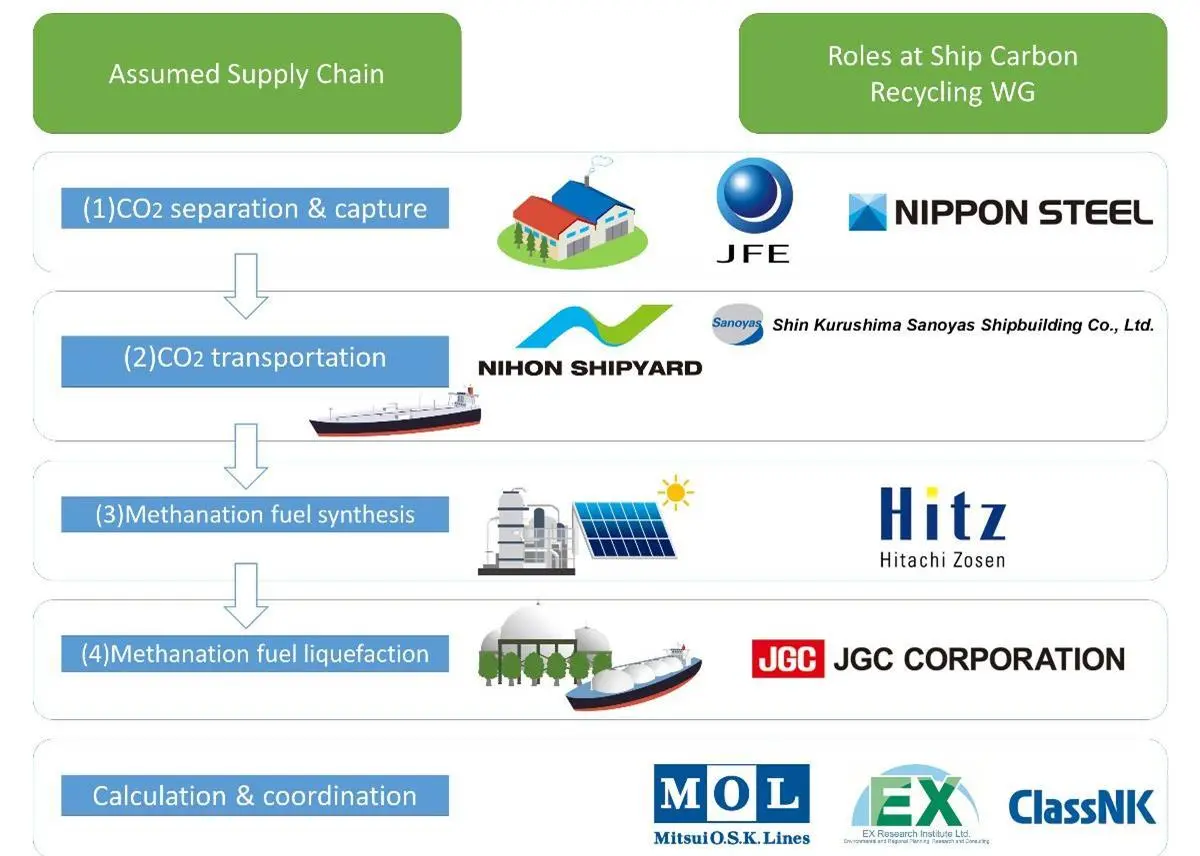
Methanation is a technology for synthesising methane by causing a chemical reaction between hydrogen and CO2 in a reactor vessel filled with a catalyst. A technical paper describing how the WG reached its decision has been published in the journal of Japan Institute of Marine Engineering.
The WG was formed to explore the feasibility of the concept in July 2020, first working on evaluating carbon-recycled methane as a potential zero emission ship fuel.
The WG has assumed and evaluated four processes as the supply chain for carbon-recycled methane fuel – CO2 separation and capture, CO2 transportation, methanation fuel synthesis, and methanation fuel liquefaction. As a result, the CO2 emission per unit calorific value of carbon-recycled methane fuel by methanation was calculated as approximately 27-gCO2/MJ (regarded as well to propeller).
This figure is comparable to other potential alternatives generally recognised as zero-emission fuels, confirming that carbon-recycled methane can indeed be classed as zero-emission. Improving the efficiency of the technology further together with using electricity produced from renewables is expected to reduce emissions further to approximately 20-gCO2/MJ.
The WG will continue to work on issues such as CO2 transportation by large-scale liquefied CO2 carrier vessels, supply of hydrogen from renewable energy, prevention of methane slip, supply infrastructure of liquefied methanation fuel and economic viability.
Related Articles
 ALTERNATIVE FUELS & LUBRICANTS
 ALTERNATIVE FUELS & LUBRICANTS
 ALTERNATIVE FUELS & LUBRICANTS