



Cat and Svitzer take next steps on methanol adoption
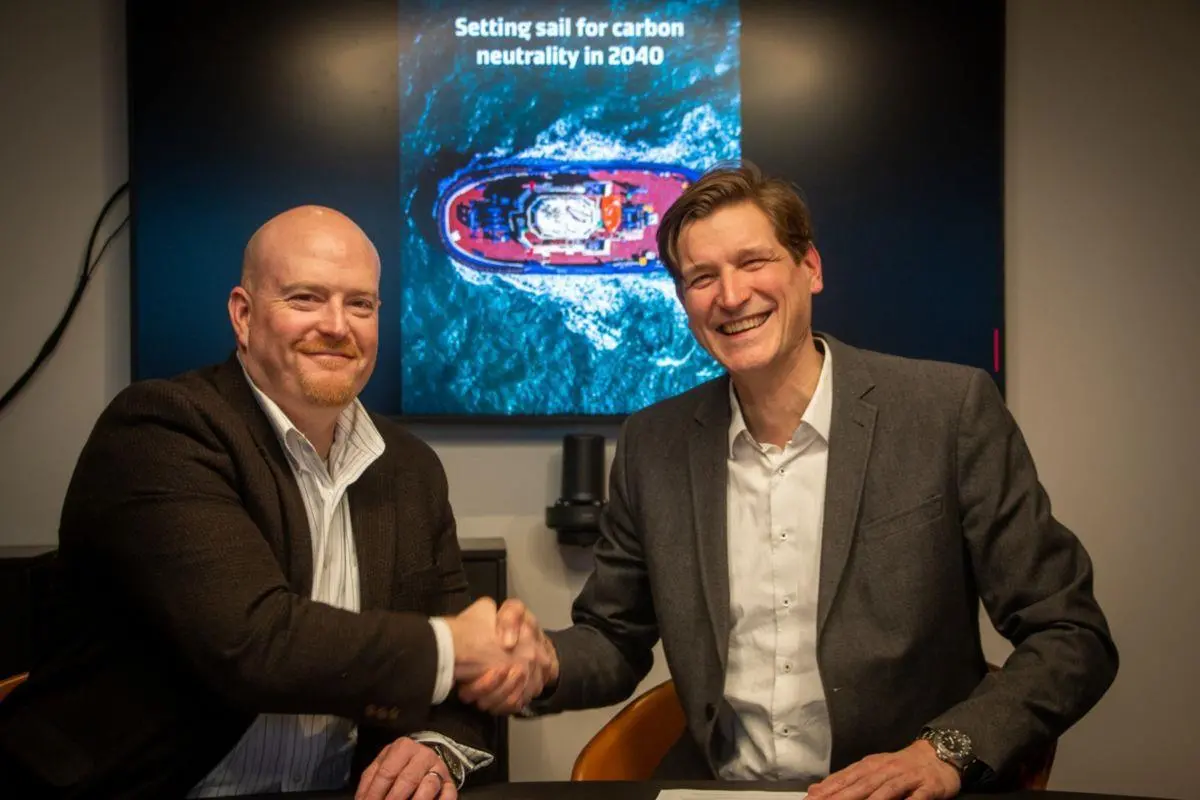
The MoU formalises a collaboration underway to deploy engine technologies that enable Svitzer to use green methanol. The adoption of Caterpillar’s dual-fuel methanol engines focuses on new tugs as well as conversions of existing Cat® powered tugs, which comprise the majority of Svitzer’s fleet.
“The focus of our collaboration is two-fold,” says Andres Perez, global tug segment manager, Caterpillar Marine. “We are supporting Svitzer to enable tugs to operate on methanol with diesel-like performance while providing fuel flexibility which is key to enabling operators to lower their carbon intensity via green methanol as availability increases. Additionally, we’re taking full advantage of the learnings to provide conversion solutions for the existing fleet. This is a critical aspect to reach the level of methanol adoption that Svitzer seeks to fulfill their goals.”
“Given the size and complexity of our fleet and the ambitious target we have set of becoming carbon neutral in 2040, it is critical to take a holistic approach to reducing our CO2 emissions. While we seek to mature and utilize new technologies, fuel types and operational approaches for new vessels, we also have to find solutions that help reduce the emissions from our existing fleet. The support Caterpillar provides in finding ways of converting our equipment to methanol usage plays a key role in this,” says Gareth Prowse, head of decarbonisation for Svitzer.
Svitzer’s newbuild plans
The MoU follows Svitzer’s November 2021 announcement of an agreement with Robert Allan Ltd. for a new generation of methanol fuel cell tug. The goal is to design the world’s first fuel cell tug for harbour operations, running on green methanol. Using a combination of fuel cells, batteries, and electric propulsion in a new and unique towing configuration, the new tug will serve as a pilot project for future Svitzer newbuilds.
The 80 tons bollard pull newbuild tug with escort notation will come with a hybrid electrical propulsion system solution where fuel cells can be dimensioned to deliver a specific amount of sustained bollard pull using fuel cells alone, adding additional power from the batteries during the short but often frequent peaks that characterises towage.
The first vessel is planned to be put into operation within the Svitzer Europe region by Q1 2024.
Svitzer and Maersk are jointly exploring the combination of methanol fuel cells and batteries to apply knowledge and operational experience of methanol feasibility from the near shore small scale tug sector onto larger ocean-going container vessels.
Caterpillar builds its methanol portfolio
Meanwhile, Caterpillar has announced that its Cat® 3500E-series marine engines can be modified to run as dual fuel methanol in the future. Upgrade solutions to support fleets operating other 3500 series engines will also be available in the future. Caterpillar experts are working with key customers and the industry to ensure the proper power ratings and applications are covered to meet their expectations.
Beyond Svitzer, it is also entering other partnerships. In November 2022, Caterpillar signed an MoU with Damen Shipyards Group aimed at developing methanol powered vessels. Under the MoU, Damen Shipyards will collaborate with a team of experts from Caterpillar and the Cat® Dealer, Pon Power, to learn how to adopt methanol as a fuel in marine applications, including aspects related to bunkering, storage, management, and conversion. Caterpillar will develop and provide the methanol power train to be integrated into a Damen designed and built methanol capable vessel. For tugs, Damen’s strategy is to offer fully-electric models offering bollard pulls of 40, 60 and 80 tonnes respectively and methanol-fueled models with 60, 80 and 100 tonnes bollard pull.
Also last year, Caterpillar signed an Mou with Brazilian shipping company Wilson Sons on the adoption of reduced emissions tugboat and offshore vessel powertrain technologies. Together with Cat® dealer, Sotreq, Caterpillar will oversee the implementation of retrofits and upgrades to reduce the environmental impact of Wilson Sons’ existing fleet, technology-enabled services for emissions monitoring, and the usage of low or no carbon fuels, including methanol, in their fleet.
“Improving sustainability in maritime operations requires us to not only address building new, more efficient ships that use low carbon fuels, but also understand how we can reduce the impact from existing fleets,” said Brad Johnson, vice president and general manager, Caterpillar Marine.
Related Articles
 2-STROKE & 4-STROKE
 2-STROKE & 4-STROKE
 2-STROKE & 4-STROKE