



CHANGING FORTUNES, NEW DIRECTIONS FOR US YARDS
Confirmation that another two merchant navy training vessels will be constructed by Philly Shipyard is a considerable boost to US shipbuilding and the allied sectors against the backcloth of a depressed ‘Jones Act’ market.
The recent transaction covering third and fourth newbuilds under the National Security Multi-Mission Vessel (NSMV) programme, following the initial two-ship contract in April 2020, extends the value of the orderbook at Philadelphia beyond US$1.2 billion and yields fresh business across the US, for steelmakers, machinery and equipment suppliers. NSMV constitutes a home-grown, versatile class designed to offer a disaster response and humanitarian assistance capability as well as fulfilling a mainstream role in cadet training.
A fifth unit is in the frame, currently held as an option by Philly from contractual party TOTE Services of Jacksonville, acting as construction manager on behalf of the US Maritime Administration(MARAD). Steel cutting for the lead ship began in December, with commissioning and allocation to the State University of New York(SUNY) Maritime College expected by the spring of 2023. She will take over from the time-served, steam turbine-powered Empire State VI. The NSMV series as a whole will replace the existing MARAD-owned training ships assigned to the six maritime academies in California, Maine, Massachusetts, Michigan, New York and Texas.
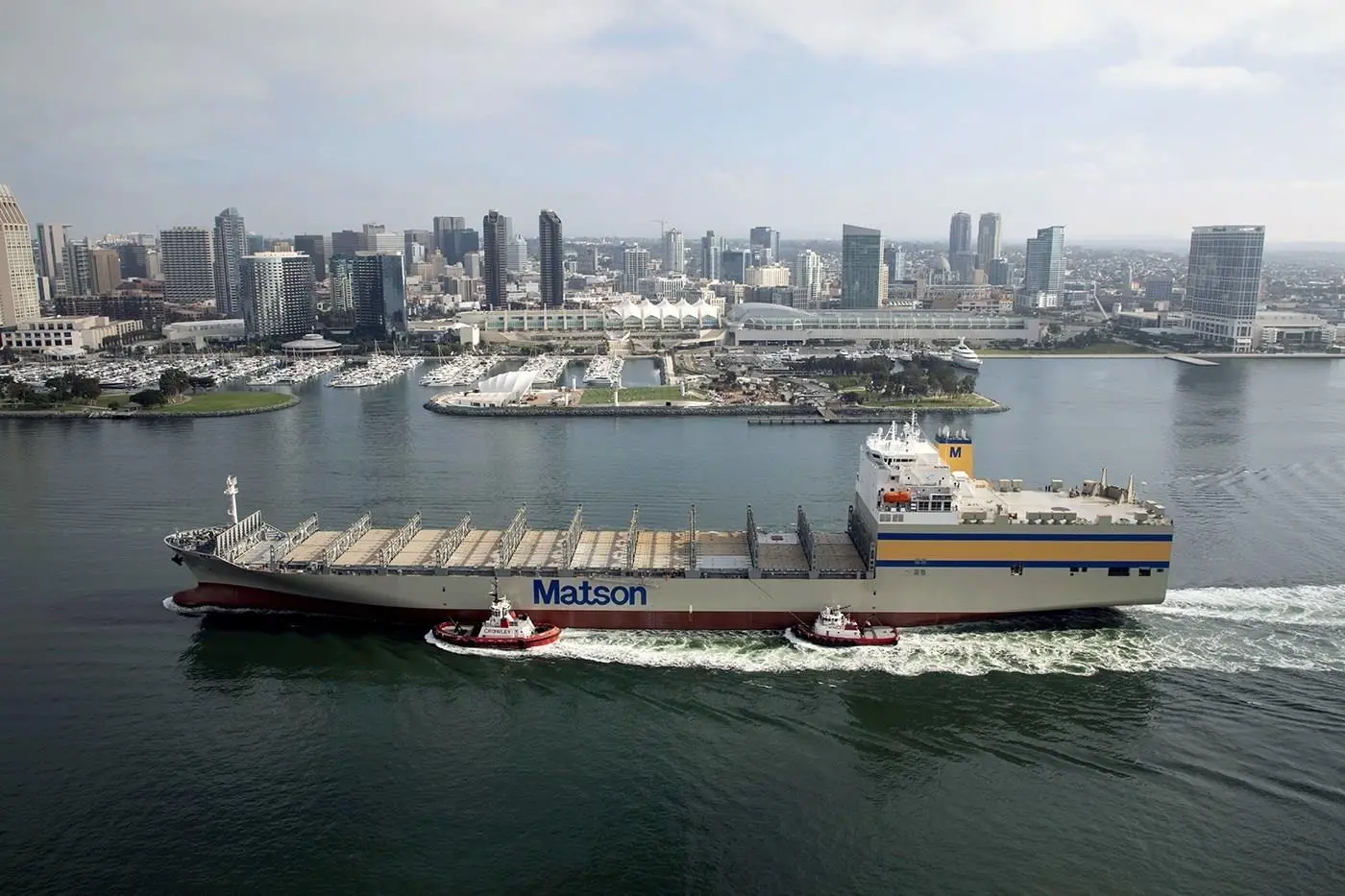
There had been intense lobbying of government by local interests and trade unions to go the way of Philly Shipyard, so as to safeguard the yard’s future and retain the skills base, following the hiatus in shipbuilding production at the yard since the March 2019 completion of the second of two 3,600TEU container vessels for Matson Navigation.
As one example of the economic generator effect of the new work, the first pair of diesel-electric NSMV newbuilds resulted in an order for eight medium-speed main engines to be manufactured by Wabtec Corporation at its Grove City plant in western Pennsylvania. Full implementation of the five-ship programme holds out the prospect of a 20-unit batch output of the GE-originated V250 engine design, in its 16-cylinder MDC version.
Despite its detractors both within and outside the US maritime community, the Jones Act’s continuation beyond its 2020 centenary year has now been assured. Incoming President Joe Biden signed an executive order in January 2021 affirming his administration’s support for the regulation. The move and the Jones Act principles chime with the ‘Made in America’ policy which the new incumbent is championing. Furthermore, the Biden commitment to a ‘clean’ energy future for the USA means that the Act could have wider relevance in relation to investment in specialised vessels for an emergent offshore renewable energy sector.
Within the compass of the Jones Act, one of the few large mercantile vessel contracts in hand is distinguished by being the first in nearly 40 years from a Great Lakes yard for Great Lakes trade. The 28,000dwt self-unloading bulker ordered by Interstate Steamship Co at Fincantieri Bay Shipbuilding’s Wisconsin facilities at Sturgeon Bay is due to be handed over in mid 2022.
The highly automated newbuild will transport salt, stone, iron ore and other bulk materials, using a deck boom conveyor some 76m in length to discharge cargo well beyond the quayline if required. The design is also conducive to stows of steel products, long-length items of freight and project cargoes.
Fincantieri Bay’s workload otherwise includes a 5,400m3 LNG bunker barge, due for service entry with Polaris New Energy towards the end of 2021 on the US east coast. To be paired with an existing ocean tug to form an articulated tug/barge (ATB) unit, it incorporates four 1,350m3 IMO Type C tanks manufactured in China.
General Dynamics’ NASSCO yard at San Diego, California, has been central to the past decade’s Jones Act trading fleet revitalisation, but the December 2020 delivery of the second of two 3,500TEU con-ros for Matson Navigation signified the completion of the commercial vessel workload. The production focus has now switched to the contract for six US Navy fleet replenishment tankers, the first of which was launched in January this year.
A new chapter in US shipbuilding is starting through the implementation of a project for the first-ever Jones Act wind farm service operation vessel (WSOV). The newbuild scheme is the outcome of a long-term charter agreement between diversified US company Edison Chouest Offshore (ECO), Danish group Orsted, and US energy firm Eversource, relating to the provision of an SOV for planned wind farms off the north eastern seaboard. The 80m vessel, accommodating up to 70 technicians and other personnel, will be utilised for operation and maintenance activities.
ECO has been in the vanguard of initiatives in the deepwater Gulf of Mexico and Brazilian offshore markets and has grown its shipbuilding network in the USA and beyond. The SOV will therefore not only be run within the ECO fleet but also constructed by the group, utilising the combined resources of yards in Florida, Louisiana and Mississippi. The newbuild will have a diesel-electric installation meeting EPA Tier 4 emission standards and will feature the proprietary ECO variable frequency drive system.
Another milestone was signified by the laying of the keel of a wind turbine installation vessel (WTIV) for Dominion Energy at the Brownsville, Texas, yard of Keppel AmFELS during December. The 144m jack-up type newbuild, the first Jones Act-compliant WTIV in the USA, will carry a 2,200t lift-capacity crane.
Having finally responded to the fleet enhancements effected and planned by potential adversaries, the US acted on its icebreaker renewal strategy by entrusting a US$746 million contract for a 140m polar security cutter to VT Halter Marine. If options on second and third ships are exercised, the cumulative value of the deal would reach US$1.94 billion.
The technological intensity of the project surpasses that of most mercantile vessel projects, and will provide benefits across homeland industry. To be handed over to the US Coast Guard by 2024, the lead polar cutter has been specified with a diesel-electric power and propulsion plant of some 33,700kW, the capability to navigate through ice of 1.8-2.4m, 90 days’ endurance, and accommodation for up to 186 persons.
In addition to design consultancy Technology Associates Inc (TAI), VT Halter has partnered in the project with ABB/Trident Marine for the adoption of an Azipod propulsion system, Caterpillar for the main engines, Raytheon for command and control system integration, Bronswerk for the heating, ventilation and air conditioning (HVAC), and Jamestown Metal Marine for the joinery package.
The American icebreaker fleet is in a parlous state, with only two polar vessels operational. More than 10 years ago, the High Latitude Mission Analysis Report had identified the need for six new polar icebreakers to cover year-round missions in the Arctic and support the US Antarctic Program.
In April 2020, VT Halter attracted a US$1.7 million grant for a press brake at its Pascagoula yard in Mississippi. The machine will be brought to bear on the polar icebreaker contract, in the plate shaping phases. Recently completed investments have included robotic welding plant and a PythonX plasma cutter. Furthermore, by July 2021, the shipbuilder aims to complete upgrades to the launchway area on which the polar cutter will be laid down.
The paucity of commercial vessel work for the larger yards tends to overshadow the industrial and economic contribution made by, and the challenges facing, the country’s extensive network of enterprises catering to the small-ship end of the market. However, MARAD demonstrated its commitment to continuing a line of support to that sector in January this year through a new tranche of Federal funding under the Small Shipyard Grant Program. Awards under the further US$19.6 million available for yard improvement schemes are to be made by the end of April.
First introduced in 2008, the grants cover capital expenditure and equipment upgrades related to vessel construction, repair and reconfiguration, and to training in technical skills leading to improved efficiency and productivity. Allocations are limited to 75% of estimated costs, and to yards with fewer than 1,200 production employees.
The industry sustains a vigorous and targeted, collaborative R&D agenda through the National Shipbuilding Research Program (NSRP). The cooperation provides a framework to manage, develop and share R&D initiatives and leverage best practices in shipbuilding and shiprepair, through projects typically of 12-month duration. The NSRP schemes are co-funded by 11 yards owned by the eight shipbuilding groups involved together with the US Navy, as the undertaking’s ultimate mission is to reduce total ownership costs and raise the performance of both US-flag commercial ships and US government vessels.
The awards approved by the NSRP’s executive award towards the end of last year spanned 17 projects valued at approximately US$2.5 million, to be undertaken by research consortia encompassing partners from the wider industry as well as NSRP members. The financial allocations by NSRP in each case are relatively modest, in the order of $150,000 per project in the latest schemes.
The broad swathe of practical topics addressed under the latest round included the use of single-pass, buried arc welding to reduce time and costs associated with welding single-sided joints, utilisation of 3D ship model data for corrosion control and coatings, and development of a visual guide for non-ferrous and stainless steel surface preparation. Other research assignments concern automated label plate generation from 3D design models, the evaluation of fusion spliced fibre optic connectors in ship construction, additive manufacturing of seawater heat exchangers, double electrode processes for precision fillet welding, and digital tooling for cable routing and installation.
While heavy reliance on naval construction will remain the industry’s bedrock business, yards are acting on opportunities for specialised civilian projects and emergent sectors within the captive US market.
Related Articles
 PROPULSION
 GENERAL NEWS
 HYDROGEN