



CHEMICAL TANKERS SET NEW STANDARD FOR ENVIRONMENT AND CREW
The island of Donsö off Gothenburg in Sweden is home to a population of 1,500. It is also home to eight shipping companies, most currently involved with newbuildings. The Donsötank newbuilds are a reflection of that shipping dynamic, says Managing Director Captain Ingvar Lorensson, with the outcome set to raise the bar higher for other shipowners.
The 167.7-metre, LNG-fuelled, Ice Class 1A vessels are being built by Wuhu Shipyard in China and are classed by DNV GL. Final installation of the battery systems and shore power connections will occur once they reach Sweden next year.
The vessels will be named Prospero and Pacifico and will be commercially managed by Donsötanks daughter company Navix Maritime Chartering in Gothenburg from mid-2021.
They are expected to achieve a 13-21% reduction in fuel consumption compared to a standard design. The vessels boast a number of carefully selected design features which mean the newbuildings’ CO2 emissions will be 55% lower than existing vessels in the fleet. Running on LNG, NOx emissions will be reduced by 89%, SOx emissions by 99% and particulates by 95%.
Optimised design
Donsötank’ technical managers, safety manager and sailing captains and chief engineers brought their experience to the design project, and they worked closely with Uddevala-based naval architecture company FKAB Marine Design. FKAB was involved from the first sketches, developing a design that balanced fuel savings against investment costs. “It’s been a great journey with the very clear goal of achieving environmentally friendly vessels with a good working environment for the crew,” says Osborne Johansson, Technical Senior Adviser Machinery and System at FKAB.
The vessels’ F-Bow hull design is optimised to achieve maximum cargo capacity and for excellent performance. In calm weather it can save 4-8% fuel and harsh weather conditions up to 25%, says Andreas Hagberg, Sales and Marketing Manager at FKAB. Hull optimisation was performed for a number of depths, and the result includes less flair, a lower block, a propeller bulb and pitch optimisation, together giving 25% improvement on the hull lines of existing vessels in the fleet.
The hull coating used is a Jotun silyl acrylate technology coating, Sea Quantum. It is suitable for all activity levels and expected to perform well for up to 90 months.
The 6.2-metre propeller is complemented by a full-spade, full-twist leading edge rudder from MM Offshore. A wake-field and propeller slipstream analysis ensures maximum efficiency, minimal cavitation and therefore less noise at the aft end of the vessel.
Dual-fuel engines
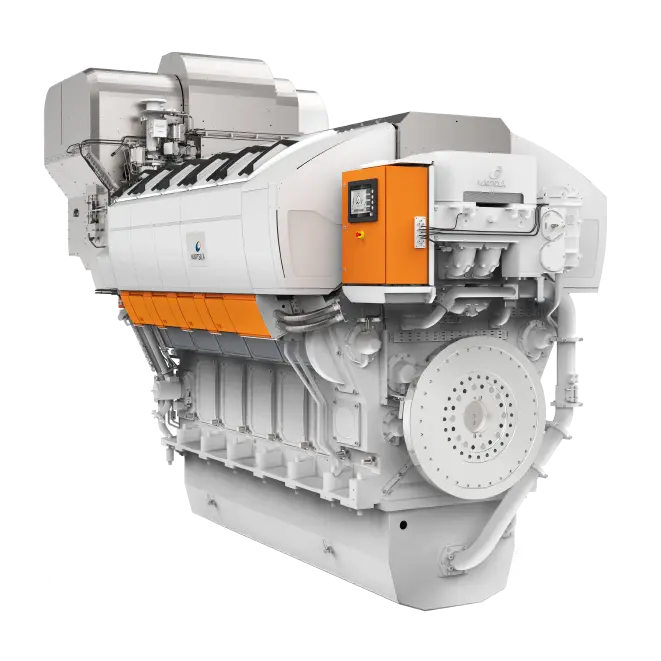
The main engine is a Wärtsilä 10V31 DF. “This is the most efficient 4-stroke engine in the world,” notes Lorensson, and it is recognised as such by the Guinness World Records. “It is dual-fuel, but we will run it on LNG and probably a little liquified biogas (LBG) also, if possible.”
The two auxiliary Wärtsilä 8L20 engines are connected to a GESAB SCR-Catamiser for NOx reduction and waste heat recovery. The combined dual-fuel thermal oil heater and inert gas production system, also from GESAB, is low on NOx and SOx emissions.
The 500kWh battery system supplied by Corvus Energy will continuously provide power to the system to boost propulsion, provide an alternative to running auxiliaries during narrow passages and harbour manoeuvring, and, most importantly from an energy saving perspective, allow for peak shaving. The energy storage system provides power for peak-shaving to balance variable loads on the main engine and auxiliary engines, saving an estimated 284 tons of CO2 each year on the open sea and 269 tons of CO2 in port during discharging if shore power is not available.
Lorenssen expects a battery life of eight to 10 years, and a financial payback, at worst, of six years. “But, we predict it will be better than that.”
The battery system alone could power the vessel for a short time in case of blackout, but combined with the 1.5kV shaft generator, the vessel could potentially sail at around eight knots if required during an emergency.
The WE Tech shaft generator features variable frequency drive technology, WE Drive™, variable speed generator technology, DC-link switchboards with dedicated inverter units and a power management system. With the DC-link distributing electrical power, energy efficiency can be increased by up to 35%, the main switchboard can have a smaller footprint with less copper used. Total harmonic distortion is low as is the reactive current flow in the electrical system. This enables the use of smaller inverters and less cabling.
Additionally, an Organic Rankine System waste heat conversion system, Orcan Energy’s Efficiency PACK, is connected to the cooling system. The solution uses waste heat from the thermal oil system and the jacket cooling water to produce electricity, thereby recovering waste heat from both the main engine and the auxiliary engines. At sea, this can provide 71kW net input to the switchboard, and during cargo discharging operations 83kW. This saves an estimated 205 tons of CO2 annually.
Like the two 15,000dwt chemical tankers being built for Tärntank Ship Management, and two 18,000dwt chemical tankers built for Furetank Rederi, companies that also originates from the island of Donsö, the vessels will have the ability to connect to shore power. Negotiations with the Port of Gothenburg have led the sets of newbuilds having the connection point in the manifold area located centrally in the EX cargo handling zone to minimise cabling needs and to enable the ships’ cargo cranes to do the cable lifting. At the Port of Gothenburg, a shore power station will be located centrally on the quay with approximately 50 meters of cable available. A similar arrangement is expected to be available in the Port of Rotterdam.
The 6.6kV power from shore will provide enough power for cargo discharge operations and for charging the battery system. As part of the shore power connection procedures, the plug room, too small for a person to enter, will be over-pressurised with nitrogen.
The use of oil onboard has been minimised: the actuators for the cargo and ballast valves are all electric. Supplied by Eltorque, they minimise energy consumption by having a low energy idle state and, they also avoid the need for having hydraulic pipes going down into the tanks. They are made from non-hazardous, fully recyclable materials.
Additionally, to reduce the need for oil, the THR Marine mooring and anchor winches are electric. This avoids the need for a lot of pipework and eliminates oil leakage risks. The Wärtsilä stern tube has a water lubricated seal, and the vessels have a frequency controlled, fixed pitch Wärtsilä bow thruster.
A Hydroniq rack cooler was chosen for its easy inspection and maintenance and for its compact design. The tubes are made from CuNi to prevent marine growth, and there is no galvanic corrosion, as it is fully insulated from the hull. The cooling system is a demand-adjusted system, so it’s not running at full speed all the time. “This makes it more efficient that a normal box cooler,” says Lorensson. “If you need to clean it, you can just close the tank and lift it up from the inside, and if you have dirt in the water from a river, for example, this doesn’t present a problem for the cooling system.”
The vessels are IMO type 2 oil products and chemical tankers with a cargo capacity of 28,000cbm and they feature 14 electric deepwell cargo pumps from Svanehøj . The cargo tanks are coated with Jotun Tankguard Special. Hot water coils are used for tank heating, and all cargo pipes and crossovers are self-drained down from the manifold to the cargo tanks.
Crew safety
The comfort and safety of the crew was paramount when designing the accommodation areas and the engineroom layout. “Everything was designed in 3D, and we spent a lot of time in the 3D model determining the safest outcome, so that the crew do not need to climb around pipes and equipment,” said Lorensson.
Mooring arrangements have been designed according to Mooring Equipment Guidelines Fourth Edition 2018 (MEG4). “Safe mooring is critical for the crew onboard,” says Lorensson. “We want to avoid incidents, so we also spent a lot of time here to design the best mooring system possible. The design calls for of eight ropes on drums fore and eight aft. The lines are straight, not going through any rollers.
The designers spent a lot of time reducing noise onboard the vessels. Engineroom fans are fitted with silencers, and the cargo pumps are electric to minimise noise. Outside noise level was determined to be at most 65db measured 25 metres from the side of the vessel when running two auxiliary engines and two engineroom fans. This compares very favourably with a similar vessel in the company’s fleet with a main engine of the same size.
Lorensson’s team is proud of what has been achieved and believe the design is the most efficient for the class of vessel to date. While the owners on Donsö are not direct competitors, they watch what each other are doing and learn from each other, always raising the stakes on environmental performance.
FKAB recently designed vessels for Donsö-based Furetank Rederi. These 16,300dwt chemical tankers are also equipped with batteries and dual fuel engines for LNG operation. Further afield, FKAB has also recently designed a series of dual-fuel, battery-ready 10,500dwt chemical tankers for Norwegian owners Utkilen and two 7,000dwt gas-ready stainless steel chemical tankers for German owner GEFO.
Tor Järnberg Business Developer at FKAB notes that FKAB’s environmental friendly designs have low EEDI values, with excellent hull forms and a careful selection of equipment to suit the shipowner’s requirements. This results in efficient energy consumption and low OPEX. “We work in close cooperation with owners to balance CAPEX and OPEX.”
Related Articles
 PROPULSION
 GENERAL NEWS
 HYDROGEN