



CHILEAN DEBUT FOR EFFICIENT NEW GEOMETRY ROPAX HULL DESIGN
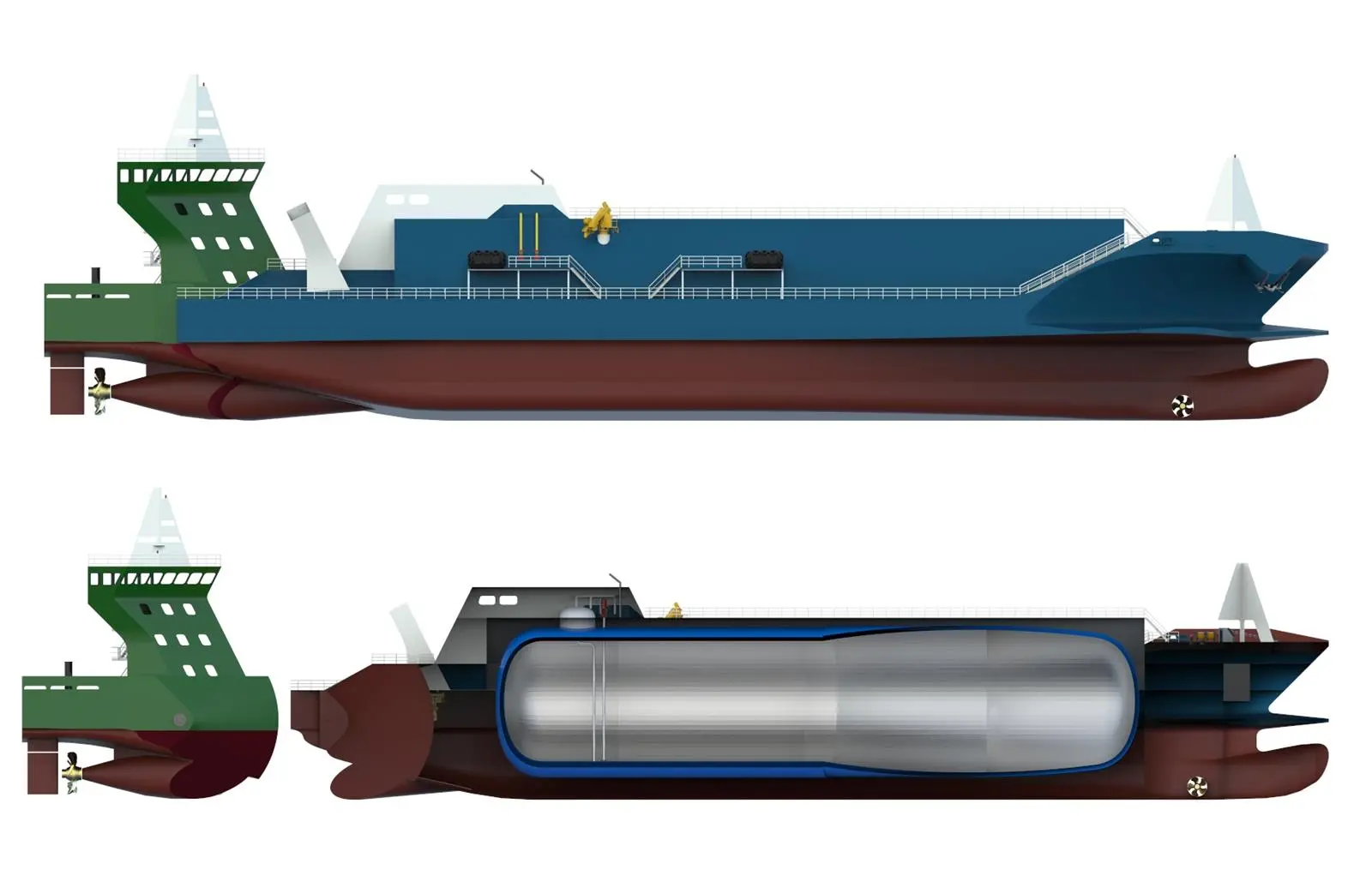
Vancouver-based NaviForm has designed a ROPAX that has the upper RORO deck extending all the way to the bow, a river container ship with external hull support that boosts container-carrying capacity and a Detachable Stern Vessel (DSV) that doesn’t suffer from the fuel penalties of a traditional Articulated Tug Barge (ATB). The concepts, with vessels built and in various stages of construction under ABS class, also feature a number of new design features to reduce fuel consumption.
The first of two ROPAX, MV Esperanza, entered ocean-going service in Chile for Navimag Ferries this year. She features a new winged bow that reduces hull resistance, resulting in either higher speed, or less power usage, fuel consumption and GHG emissions. It also reduces motion in waves, shown in testing and in operation to be 50% lower than conventional bows, and eliminates slamming, therefore making it possible to design a lighter hull structure.
The winged bow reduces power requirements, because it splits the hull into a slender form below the wings, and a very spacious form above it. The wings cut into waves and are shaped to produce inverted vertical force that prevents the bow from raising over the wave and then crashing into the next one. This has been proven in several separate model test programs spanning 20 years of research.
The design works best for the low weight / high volume payloads typically found it passenger, RORO or military vessels. At 10,500 ton, the 150-metre long Esperanza needs only 2,500kW to sail at 14 knots, while having 1,800 lane-metre capacity on only two decks, without any articulated internal ramps. It is the first time an upper RORO deck extends all the way to the bow at full width. “ABS had to verify that it is not prohibited by any regulations. It is not. Nobody simply thought of it before,” said a spokesman for NaviForm.
The vessel features another NaviForm innovation, new geometry stern bulbs that spin the flow of water into the propellers counter to their rotation. The design has been model tested at the National Research Council Canada towing tank in 2006 and shown to increase propeller efficiency by approximately 10%. NaviForm explains the results: “The higher the coefficient affecting propeller efficiency “w“, the higher the propeller efficiency. The typical value for this type of vessel is 0.15; it can go as high as 0.22. We discovered this new hydrodynamic phenomenon on our 15-metre model, for which the model basin measured w of 0.43. They kept re-checking it, as it was unheard of.”
The bulbs were actually designed for a different reason: to house the large engines and to keep the shafts short, a well known feature in many twin shaft ships. This new geometric feature led to extensive research of optimising stern bulb form to maximise propeller efficiency.
According to towing tank tests conducted at SVA Potsdam in Germany, the bow design results in a reduction in power needs of close to 20% compared to the next best hull of that size. However, she required a learning curve in operation, as the winged bow performs best in a narrow range of forward draught.
Esperanza is powered by two Wärtsilä 9L20DF engines each directly driving a Contracted and Loaded Tip (CLT) propeller via a Wärtsilä gearbox. The gearbox is connected to a 800 kW PTO/PTI motor which in good weather feeds excess power to support hotel load. In bad weather, the vessel’s service generators will take over that load, and in severe weather one of the gensets will supply an extra 800kW power into propellers.
Esperanza has an Energy Efficiency Design Index (EEDI) that meets present and future IMO targets without the need to reduce speed. Overall, fuel savings are claimed to be around 20%, with the bow and the stern bulbs contributing roughly half each. These numbers are being confirmed in operation. Esperanza sails on weekly schedule from Puerto Montt to Puerto Natales, in the port of Punta Arenas, Chile. Most of the route is in the Patagonia inside passage, narrow and twisting, followed by around 80-100 nautical miles in the open ocean where weather can be severe.
A sister ship of Esperanza is expected to be contracted shortly.
Exoskeleton boosts container carrying capacity
NaviForm has also designed a series of river-going container vessels with novel features. An external structure dubbed the Exoskeleton fits outside the hull to provide longitudinal strength rather than relying on the strength of the hull structure. This allows ocean-going and river hulls to be lighter and in the case of river hulls, also extremely shallow.
The vessels, currently being tendered to US shipyards by owner American Patriot Holdings, also feature a zero wave bow that eliminates the problem of shore erosion for river vessels and barges. Featuring two side skegs with a foil between them, it captures the flow and directs it under the hull, rather than to the side.
The vessels are designed for service on the Mississippi. Construction of the first hull is due to begin in Q1 2021, with three sister ships to follow at six monthly intervals. The 181 metre x 30 metre hulls have 2.7 metres draught. The hull depth is only 3.9 metres and steel weight only 2,300mt, around 40% less than vessels of a similar size. NaviForm says that for a river vessel of this size, the hull depth would typically be a minimum of eight metres, possibly more. This depth difference frees up space for 1.5 tiers of containers. The vessels will carry an unprecedented 1,700 TEU at speeds up to 16 knots, although the owner anticipates that when slowed by the traffic these LNG-fuelled vessels will only use half of their installed power.
ABS has issued an Approval in Principle certificate for the design, but there are very few existing rules that apply. “The concept is so new that rules simply don’t exist yet to address its components,” said Naviform’s spokesman. “For example, there are no rules addressing the Exoskeleton, so ABS had to review the design based on finite element analysis, as first of a kind.”
The vessels’ 11.5MB diesel-electric system will feature Voith Schneider propellers forward and aft. They will have two LNG Type C tanks with a total capacity of 1,000cbm located in the middle of the hull, between the generators, to minimise trim.
DSV expected to outperform ATBs and monohulls
NaviForm says its patented DSV offers the same benefits as an ATB but without the speed and power penalties. The ATB concept was developed in Europe in the early 1960s as a cost saving approach to short voyage trade: instead of three vessels with three engine rooms and three sets of crew, one tug would push a barge, leave it at a terminal where the second barge was unloaded and loaded, bring the second barge home, where the third barge was unloaded and loaded.
Today, this technology is best known in US where the tug and the barge are seldom separated. “While improvements have been made, it is still a barge, not as efficient as ocean going ships, and a tug that inserts its bow in a notch in the barge’s stern,” says the NaviForm spokesman. “The current performance penalty is estimated at around 12% more power and fuel consumption than a similar deadweight single hull ship.”
NaviForm reversed the approach. Instead of designing a barge and a tug and connecting them, NaviForm designed an efficient hull, then cut out the stern out of it. “When merged, it is hard to see where the one ends and the other begins. The stern (or the tug) bow does not resemble a conventional bow, but rather a double cone on a horizontal axis. This shape allows the stern to rotate inside the hull’s stern notch when it pitches in waves. The performance penalty is eliminated.”
While ATBs are known for their tugs pitching excessively in the notch, the DSV solves that problem by moving the connecting pin location close to the stern’s (tug’s) Longitudinal Center of Floatation.
When connected, the DSV is essentially a single hull, and when combined with the energy efficiency design features of the other vessel designs, it is expected to outperform conventional monohulls.
NaviForm’s designs are protected by patents in the US, EU and several other countries, four have already been granted, another three are pending. A trademark has been secured for the abbreviation DSV.
Related Articles
 PROPULSION
 GENERAL NEWS
 HYDROGEN