



China eyes Europe’s jewel in the crown
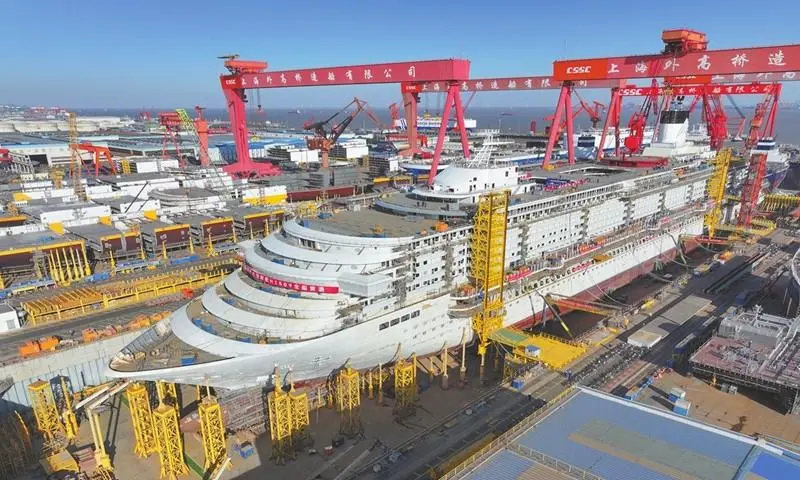
Notwithstanding structural changes in the Chinese economy, evidence of a slowing in the growth momentum, and recent talk of the incoming US political administration imposing tariffs on Chinese-built vessels, China’s increasingly adept shipbuilding sector looks set to consolidate its centre-stage global position, abetted by government industrial strategy. Ever-improving product quality and contractual performance achieved at the competitive prices obtainable can only continue to draw in fleet investors.
Having shown its mettle across all types of merchant vessel, including specialised and more complex tonnage, the industry is now set on generating higher added-value from its collective endeavour, and creating a stronger business platform for the future, by expanding the home-grown technological and design content.
At the same time, the delivery of a major cruise ship expresses a move to broaden the commercial reach still further. On a par in size, capacity and standard with the European-built product, the 324-metre Adora Magic City has signalled determination to break into what is generally regarded as the most prestigious field of civil vessel construction, a segment in which the European shipbuilding industry is supreme.
China’s entry to the international market for large, luxury cruise vessels, and the attendant plan to develop a fleet to meet vigorously expanding domestic demand, has been underpinned by foreign know-how input.
But growing self-reliance in all technical disciplines and craft trades associated with tonnage of the sophistication and outfitting intensity of passenger ships, can be expected to give added dimension to Chinese production in the coming years, and provide global players in the cruise business with an alternative and lower-cost option to having vessels built in Europe. Capabilities have already been graphically illustrated by China’s rise as the most prominent world supplier of large ro-pax ferries, with European operators as the main customers.
For the drive on the cruise ship front, China State Shipbuilding Corporation(CSSC) and Anglo-American company Carnival Corporation formally inaugurated a joint venture in November 2018 under the name CSSC Carnival Cruise Shipping, wherein CSSC ranked as the majority shareholder.
The creation of the undertaking was accompanied by the finalisation of an agreement for two vessels, initially specified as sisterships of 135,500gt, to be built by Shanghai Waigaoqiao Shipbuilding and crafted for the Chinese market. The two-ship deal was valued at about $1.5bn, and provided CSSC Carnival Cruise Shipping with the option to extend the build programme in China by up to four more vessels.
A separate joint venture was established by CSSC and Italian international shipbuilding group Fincantieri to provide the technical foundation for the cruiseship newbuilds in China, encompassing a technology licence for the ship model platform and support to Shanghai Waigaoqiao throughout the build process. The new, diesel-electric ships were accordingly laid down based on the proven Vista-class design, multiple examples of which have been produced in Italy for various brands of the Carnival Group.
ABB supplied an integrated package, the per-ship delivery having included two Azipod propulsors, five gensets, main switchboards, distribution transformers, and propulsion controls. The shipbuilding contractor has clearly gained appreciably from working with a European electrical engineering group so prominent in developing and providing complete, complex systems to cruise vessels.
CSSC Carnival Cruise Shipping subsequently became Hong Kong-domiciled Adora Cruises, which brought the first of the newbuilds, Adora Magic City, into service at the beginning of 2024. Fitted with 2,125 cabins for an adjustable passenger complement of between 4,250 and 5,246, the Adora Magic City made her commercial debut with a seven-day voyage out of the Wusongku International Cruise Liner Terminal, a contemporaneous development in Shanghai’s Baoshan district.
Making of a magic city
Construction of the Adora Magic City represented a pronounced learning curve for Shanghai Waigaoqiao, with Fincantieri acting as technical consultant, and was conducted at a deliberately methodical pace—over-and-above the time impediment occasioned by the effect of the Covid pandemic on yard personnel and material supplies—so as to ensure understanding and minimise re-working.
Illustrative of Chinese application to knowledge acquisition, the planned construction period for the second ship has been shortened by eight months relative to the first vessel, notwithstanding the post-contract decision to increase overall length by 17.4 metres. The enlarged volume(resulting in a gross measurement of 141,900t) has allowed for 19 more passenger cabins, raising the total to 2,144.
Float-out of the Adora Flora City is scheduled for June 2026, with a view to delivery towards the end of that year. The ship’s 2027 itinerary is expected to start with a voyage from Guangzhou Nansha International Cruise Port in Guangdong.
So as to exert closer control over build costs, as well as stimulate the national supply chain, Shanghai Waigaoqiao has sought to increase the localisation rate in the second ship by 10-30% relative to the Adora Magic City. The extended business co-operation with Chinese firms, substituting the need to rely on foreign suppliers, has embraced spheres such as electromechanical equipment, interior materials and décor, and entertainment facilities and systems.
China’s track record in luxury vessels goes back further with a smaller category of tonnage, the pioneering SunStone series of polar-class expedition-type cruise ships. China Merchants Heavy Industry(CMHI) delivered the first of the 80-passenger capacity, 104-metre Infinity class in 2019, and subsequent vessels followed at intervals through to 2023.
Through the nomination of an Ulstein design, the most distinctive feature of these ‘high-end’ cruise vessels is the Ulstein-developed X-Bow. To support the shipbuilder’s first foray into the cruise market, Bureau Veritas provided an extensive design review, including regulatory compliance, structural and stability analyses. During the build process, BV specialists assisted with project management and quality control issues.
The Infinity and Adora programmes, together with the growing export reference list for ro-pax ferries, denotes an increasing Chinese capacity to pair value-for-money with a high-grade product. This is drawing wider attention from overseas cruise ship operators. The fact that the premier European players in cruise vessel construction have orderbooks stretching into the 2030s, against the backcloth of buoyant market demand, could also play to the advantage of Chinese yards.
One dark cloud on the horizon, though, with possibly negative consequences for tonnage sourcing, stems from the report that the Trump administration is considering imposing levies on Chinese-built ships calling at US ports.
Among the factors contributing to the pre-eminence of the European shipbuilders in large, luxury cruise ships is the well-developed industrial eco-system, encompassing designers, outfitting subcontractors and trade skills, onboard systems, equipment and engineering, complemented by a policy of amply resourcing R&D and investing in innovation. Sustained European competitiveness is also a factor of project management capabilities and production control, vital not only in ensuring contractual performance, but in realising the requisite financial outcome for the yard.
While technological know-how is today comparatively easily transferable, it is not so easy to transfer project management skills, which are honed over many years and which are constantly tested by design variety, newbuild complexity and scale, and by the exacting expectations of shipowners. In addition, capabilities and flexibility within the shipyard domain may be severely tested during the course of newbuild production by contractual owners’ changes to the original specification.
The importance of the ecosystem cannot be overstated, since it has a fundamental bearing not simply on logistics but on viability(and/or industrial self-sufficiency), as some 70% or more of the total value of a cruise ship is typically represented by her equipment, machinery, operating systems and outfitting materials and elements.
While the few European yards that dominate the high-capacity cruise ship market have continued to augment orderbooks, the actual level of financial return can belie the input that is made in terms of grade, detail, technology, and innovation. Moreover, the typically ‘end-heavy’ payment terms and process, wherein the bulk of the contract price is paid on handover of the newbuild, can also challenge a shipyard’s finances.
In fact, the continuity of one of the industry’s most august players, the hitherto family-owned Meyer Werft, which has consistently ploughed earnings back into the business, has only been assured by public sector intervention. In September 2024, the German Federal Government and the state of Niedersachsen signed contracts giving them about 80% control of the cash-strapped shipbuilder.
Given the Italian and French state holdings in Fincantieri and Chantiers de l’Atlantique, respectively, national involvement in the organisations keeping Europe to the fore in luxury cruise ship construction has accordingly become even more substantive.
Market dynamics
China’s burgeoning middle class and increasing disposable income fuelled the growth of tourism until the Covid pandemic, when China ranked as the world’s second biggest source of cruise passengers. After a four-year hiatus, market recovery is now well in evidence, with passenger numbers reported to have increased by 15% in 2024. Domestic and international cruises constitute an ever-more popular choice of vacation, and the projections are for substantial year-on-year growth in demand.
In a newbuild context, it is inconceivable that China would seek to develop fleet capacity by ordering abroad. The nurturing of domestic capabilities in the design, production and outfitting of cruise vessels is thereby keyed not only to penetrating a high added-value sector of the global shipbuilding business, but also to meeting the home market’s evolution and realising economic benefit to the regions involved.
Chinese ambition as to the international market for luxury passenger ships is coloured by achievements to date in the large ro-pax ferry segment, which calls for particular capacities and strengths in the supplier network, the outfitting trades and project management, as well as the practical and design skills relating to complex shipboard systems.
Now the pre-eminent global force in ro-pax ferry, deep-sea and short-sea ro-ro vessel construction, collectively a field that had at one time been a major business area for European yards, China has come close to annihilating the European competition. As elsewhere, Chinese wage and material costs are certainly rising, but so is the quality and contract performance afforded at a still significant price differential with Europe. Moreover, ro-pax production has come to embrace vessels of high technological standard.
The two most recent examples of Stena Ro-Ro’s E-Flexer series are a case in point, as multi-fuel, hybrid ferries incorporating the highest battery capacities to date together with bespoke internal design and configuration tuned to the long-term charterer’s requirements.
Stena RoRo has commended builder China Merchants Jinling Weihai for quality and delivery performance, befitting the fact that the tally of E-Flexer contracts has reached 15, all underpinned by long-run charters to operators in North Europe, the Mediterranean and Atlantic Canada. Commonality of many elements coupled with serial production, of course, bears on price competitiveness, and potentially on yield per ship for the yard.
Related Articles
 PROPULSION
 GENERAL NEWS
 HYDROGEN