



China Lands European Heavy-Lift Series
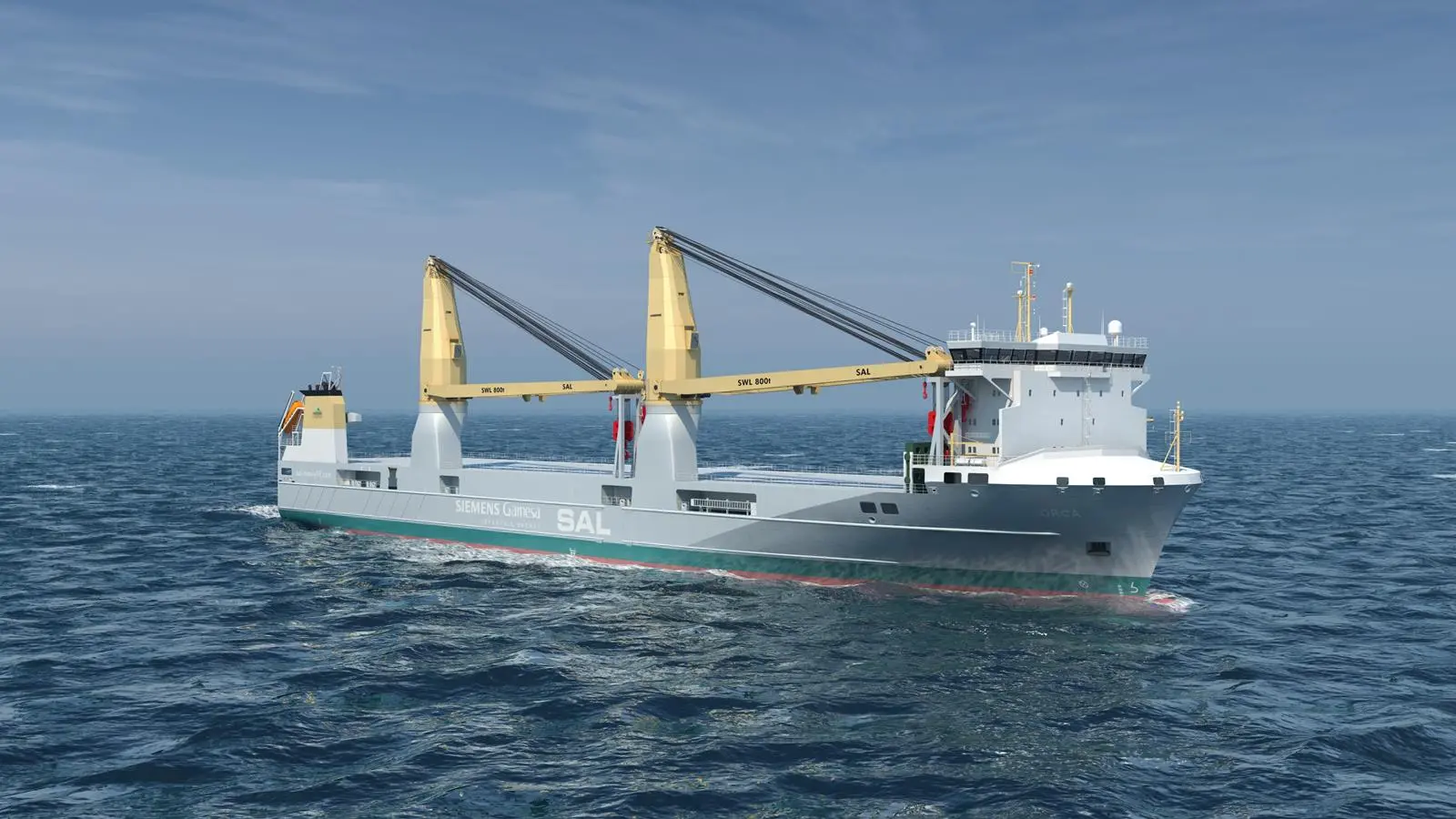
Two of four vessels ordered from Wuhu Shipyard by Hamburg-based SAL Heavy Lift will be operated under long-term charter to Siemens Gamesa Renewable Energy, while the second pair will be deployed in SAL’s partnership venture with Dutch specialist Jumbo Shipping.
Designated the Orca class, and developed by SAL in conjunction with Jumbo, the 150m vessels will each have two 800t Liebherr cranes for a tandem lift capacity of 1,600t. Deliveries of the first two newbuilds are scheduled during the second half of 2024, while the pair for the Jumbo-SAL-Alliance are expected within the opening half of 2025. SAL’s contract with Wuhu includes options on fifth and sixth vessels.
Each of the series has been specified with dual-fuel propulsion machinery capable of running on methanol, and complemented by a diesel-electric booster function.
At a service speed of 15 knots in diesel mode, consumption is anticipated to be significantly less than 20t of fuel oil per day, similar to smaller capacity, geared multipurpose tonnage. Alternatively, the vessels can be traded at an ultra-efficient speed of 10 knots, burning just 6t of fuel per day, while the installation as a whole provides for a maximum 18.5 knots, in the event of urgently needed shipments or schedule recovery. It is contended that, compared to other heavy-lift vessel designs, the hybrid setup of the Orca type features an especially wide range of economic speed settings and redundancy.
Funding from the German Federal Government under the NaMKu (“Sustainable Modernisation of Coastal Vessels”) programme allowed SAL to utilise what it describes as pioneering technology in the innovative power train of the Orca class, targeting high efficiency and substantial emissions reduction. The nominated arrangements promise a 10% lowering in NOx emissions below the IMO Tier III level, and a 21% undercutting of EEDI phase 3 limits for CO2.
Hull form and propulsion system were developed and optimised by SAL in cooperation with the Naval Architecture faculty at the Hamburg University of Technology (TUHH).
The bridge and accommodation structure is positioned forward, and the 149.9m x 27.2m hull envelope encapsulates a single, box-shaped hold with the largest dimensions in its class, plumbed by the two cranes mounted on high pedestals along the starboard side. The hatch covers can accept a loading of 10t/m2 and the ships will be certificated for sailing in open-top configuration so as to accommodate over-height cargo in the hold.
Notwithstanding the prominence of the deck gear, the Orca’s air draught will permit navigation of the Kiel Canal and access to strategically important ports worldwide.
The Liebherr cranes are of fully-electric type, suited to the intelligent energy management and recovery system to be incorporated in the vessels. This will be founded on a battery energy storage system that can be used together with conventional gensets in hybrid mode, or in combination with the onboard power connection to the shoreside grid, enabling fully-electric port operations.
The Jumbo-SAL-Alliance has 30 vessels under its wing, including the largest flotilla of ships in the 800t-plus segment, and with lifting capacities up to 3,000t.
Related Articles
 ALTERNATIVE FUELS & LUBRICANTS
 ALTERNATIVE FUELS & LUBRICANTS
 ALTERNATIVE FUELS & LUBRICANTS