



Choice of sulphur emissions abatement technology depends on payback time
MARPOL Annex VI stipulates the use of low sulphur fuel or an emission abatement technology on ships traveling in Emission Control Areas (ECAs). This is not news, as the regulation has been on the horizon with a 1 January 2015 enforcement date for several years. Despite the looming deadline, much of the shipping industry has been reluctant to come up with an ECA compliance strategy, preferring instead the ‘wait and see’ approach. Recently, however, it has become clear this approach is no longer valid – or wise.
Governments, supported by industry coalitions such as the Trident Alliance, are declaring their intentions for strict, timely enforcement and clearly understood consequences for non-compliance to guarantee a fair playing field for the entire industry. Shippers are now feeling the pressure, and in increasing numbers have begun to evaluate compliance options that make the most financial sense. The good news is there are compliance options that can also lead to a healthy bottom line given the right strategy and timing, especially for ships traveling more than 30% of the time in an ECA. With a payback period of one to three years, increasingly, for this kind of ship the preferred strategy is the adoption of emission abatement technology, i.e. scrubbers.
When the sulphur regulations were first announced, the most obvious option for compliance seemed to be a switch to low-sulphur fuels. For long-haul ships which spend less than 30% of their time in ECAs, dual-fuel switching capability is the popular option, since in general it is relatively low in both capital and operational expenditure. However, dual-fuel switching may require some engine modifications since low sulphur fuels such as marine gas oil (MGO), marine diesel oil (MDO), and low sulphur fuel oil (LSFO) lack the lubricity of heavy fuel oil.
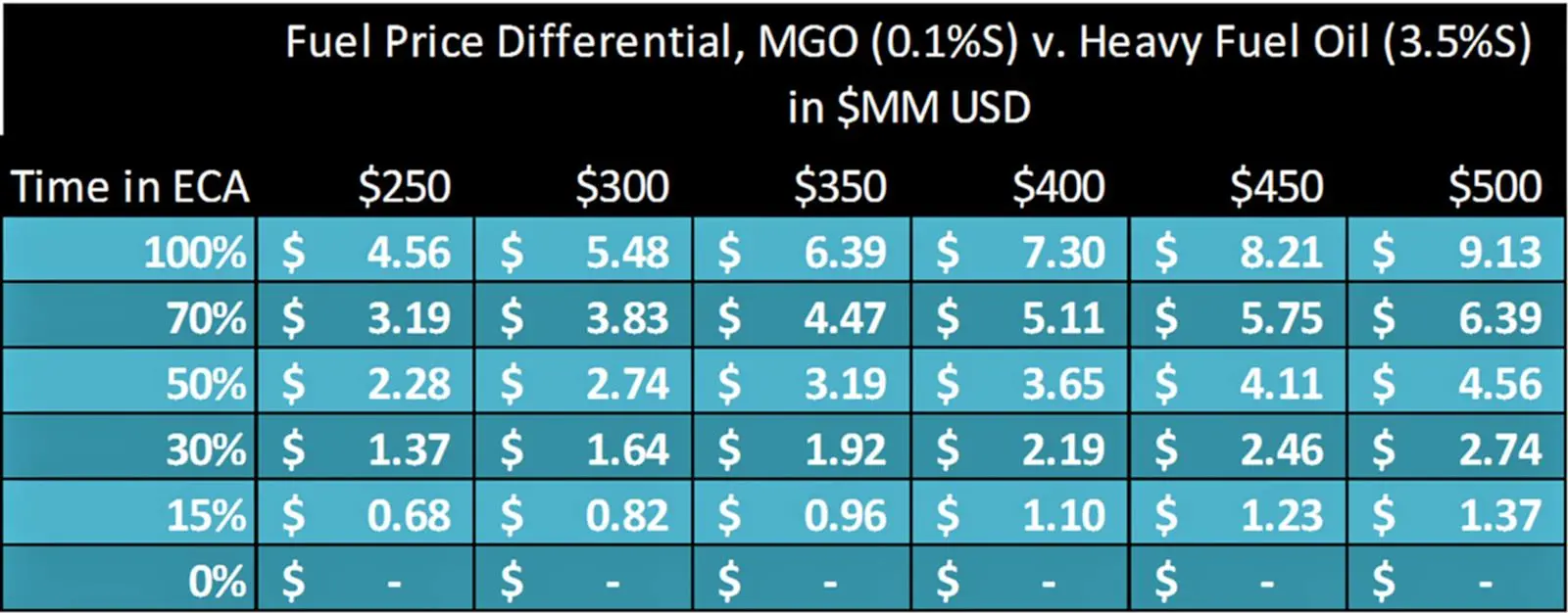
For ships spending more than 30% of the time in an ECA, a dual-fuel strategy or a strategy to burn low-sulphur fuel exclusively could be low capital, but the operating expenses are projected to be quite high. With the price differential already between US$250 and US$350/tonne depending on the bunkering location, a low-sulphur fuel strategy can get quite expensive. Additionally, refiners are not modifying their operations to meet the increased LSFO demand for the upcoming 2015 ECA deadline. Thus with static supply and drastically increased demand, prices are forecast to rise, with high estimates putting the differential to as much as US$500 in 2020. For a ship burning 50tonne/day of fuel in an ECA, even with a conservative US$300 price differential, that adds up to an additional operating expense of US$15,000/day or US$5.475 million/year.
As we look to the global ECA regulations, refiners are starting to take more notice and make plans to create 0.5% sulphur blends, but it won’t be quick, cheap or easy. The creation of new refinery blendstocks will require years of planning and billions of dollars of investment. Hence, this might explain why some in the industry expect the global sulphur limit to be postponed to 2025. However, the 0.5% sulphur limit in all European waters by 2020 will not change, regardless of the IMO decision, and at that point even more ships will be affected, including ships in the Mediterranean.
For ships traveling more than 30% of the time in an ECA, emission abatement technology adoption is increasing. As the January 1 deadline fast approaches, it seems every week announcements are coming out naming new contracts between scrubber companies and ferries, cruise ships and cargo vessels. It is hardly surprising to see the marine industry reverse its initially sceptical position on scrubber technology. This technology has been used for decades to successfully and reliably remove SOx and particulates on difficult land-based applications such as fluidised catalytic crackers in refineries, and to do so with few maintenance requirements and long periods (five years or more) without turn-arounds. Not only has wet scrubbing been successfully utilised on hundreds of refining applications, it has been effectively meeting IMO sulphur emission standards on a number of class-certified marine applications.
The market for emission abatement technology is ramping up, but it is racing against the 1 January 2015 deadline. Installation is easiest on newbuilds, but can be performed as a retrofit. Both job types will require custom engineering and design. For retrofits, most firms require installation to be performed while the ship is in drydock for many reasons, including safety. The installation can be timed to fit with the ship’s routine dry-dock schedule. Additionally, designs and testing need to be reviewed by classification societies. Lead times can take 6 months to one year before a system is fully installed, tested, and accredited. All the while, MDO costs will be on the rise. Thus, early technology adopters will be able to reap the benefits of scrubbers and realise their payback sooner.
Whichever strategy ship owners undertake, currently it seems that the highest cost option is now ‘wait and see’. Without a plan, ships will be at the mercy of the market. Higher fuel prices will be passed on to customers – whether for increased cargo or passenger fare. In Northern Europe concern about a shift away from ship transport is growing, as the cost advantage disappears with increased fuel prices, and trucking becomes more financially attractive. Additionally, charters are in a vulnerable position. As the fuel purchasers they want to be able to buy the lowest priced fuel, but they are not in the position to dictate which technologies the chartered ships install. For charters, a good strategy would be open dialogue with the ship owners, because in the future they will prefer to give their business to ships which can burn cheap heavy fuel oil (HFO) while maintaining compliance. Thus, charter companies should be working with shipowners now so as not to get stuck paying very high fuel charges.
We are unlikely to see significant investment in refining processes needed to meet the ultra-low sulphur marine fuel demands imposed by MARPOL Annex VI regulations for the 2015 deadline. For ships to take advantage of low-priced HFO and still meet the regulations, an exhaust gas cleaning system, or scrubber, is an increasingly popular option. Based on the amount of time a ship spends in an ECA, current fuel price differentials, amount of fuel consumed, scrubber costs, and other variables, a ship outfitted with a scrubber can have a payback period of one to three years. With fuel price differentials increasing, the payback period can even be shorter. Scrubbers offer a reliable, economical alternative that can help shield shippers from rising marine diesel oil fuel prices while keeping their vessels in compliance.
Related Articles
 ALTERNATIVE FUELS & LUBRICANTS
 FUELS & LUBRICANTS