



COMPETITION INTENSIFIES ON CHANNEL ROUTES
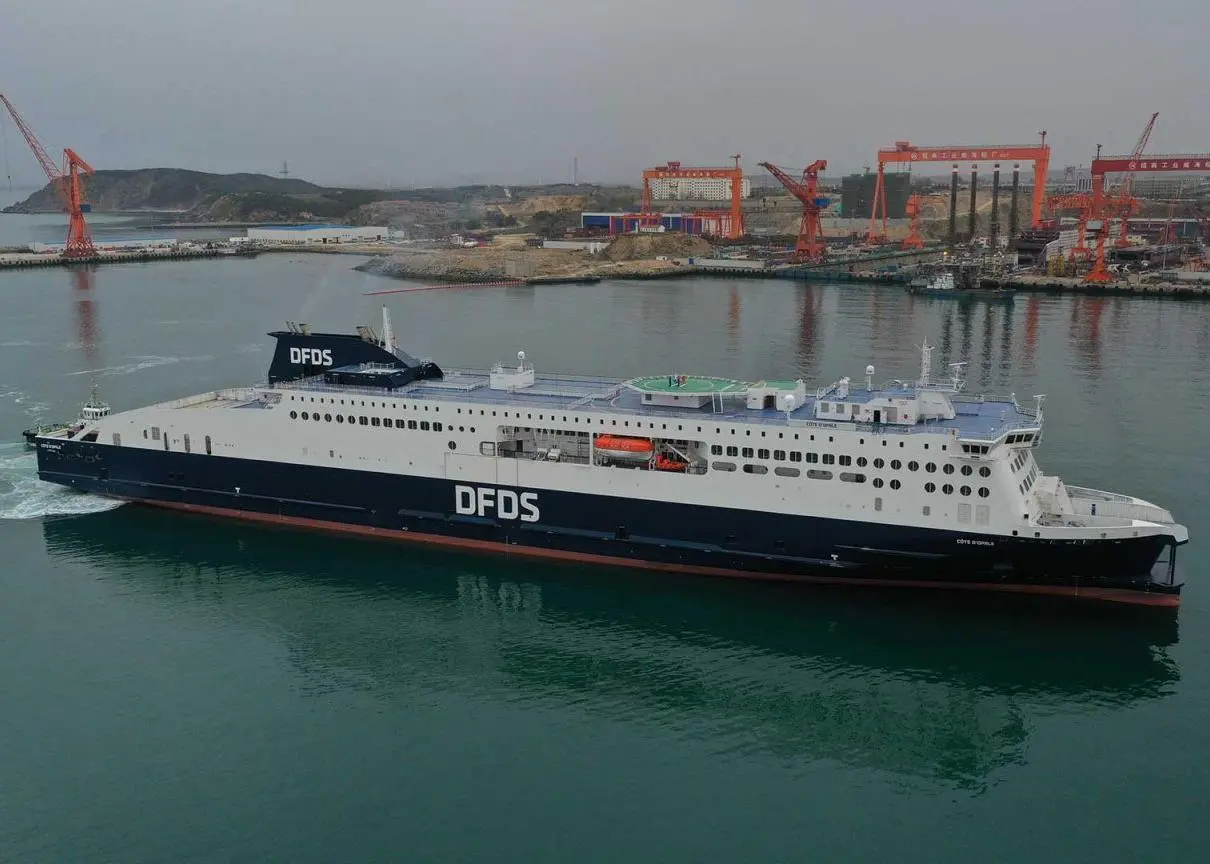
Secured on long-term charter from Stena RoRo, which has to date contracted nine E-Flexers in China, the 41,000gt Cote d’Opale has been specially adapted to suit the shortest Channel crossing and its intensive scheduling. Offering 3,100 lane-metres for freight, the design offers a major increase in ro-ro intake relative to the ferry that will be replaced, the 1,745 lane-metre capacity, 1991-built Calais Seaways, together with facilities for 1,000 passengers.
Cote d’Opale is the fifth delivery in the nine-ship E-Flexer programme assigned to CMI Jinling at Weihai (formerly AVIC Weihai). The Chinese yard has demonstrated increasing proficiency in the production of the high-grade ro-pax series, and the latest vessel was completed six weeks ahead of schedule on May 17. DFDS plans to phase the ship into regular operation at the height of the summer season.
The Danish group has made a 10-year commitment to the vessel, with an option to purchase at the end of the charter term. Registered under the French flag, as is the case with the 28,800gt Calais Seaways, the freight payload of the new ro-pax corresponds to 160 trailers. The drive-through configuration obviates the need to go about at each terminal, in keeping with the need for swift turnarounds to complement the fast transits.
Until the entry next year of the first of P&O’s innovative generation of 230m newbuilds, Cote d’Opale will be the longest ferry on the eastern Channel at some 216m.
The diesel-mechanical propulsion system is based on two medium-speed engines from Caterpillar’s MaK line-up, relative to the four-engine, Sulzer four-stroke installation in the Calais Seaways. The rationalised layout and technological progression represented in the machinery, coupled with the economies of scale rendered by an altogether more capacious ship, mean that energy consumption per commercial vehicle or trailer transported will be significantly decreased.
The power plant comprises two 12-cylinder, vee-type MaK M43C diesels, individually rated at 12,600kW driving twin controllable pitch propellers through reduction gears. Besides the gains in efficiency, Cote d’Opale offers a faster maximum speed, at 22 knots, than the 19-knot Calais Seaways.
A third bow thruster has been incorporated to facilitate the considerable amount of manoeuvring in harbour entailed with the Dover/Calais operating profile.
Notwithstanding the short-haul nature of the service, investment has been made in active stabilisation so as to better ensure passenger comfort and vehicle security in the sometimes adverse conditions that can be encountered on the Strait of Dover.
Onboard features include what DFDS claims as the “largest duty-free retail space on the Channel”, at 1,100m2, and increased facilities and complimentary dining for the important market segment constituted by commercial drivers.
The E-Flexer concept has been developed by Stena RoRo in conjunction with technical consultancy Deltamarin.
E-FLEXER ro-pax programme
|
Vessel |
Delivery |
Freight capacity (lane -m) |
Operator |
|
1. Stena Estrid |
2020 |
3,100 |
Stena Line |
|
2. Stena Edda |
2020 |
3,100 |
Stena Line |
|
3. Galicia |
2020 |
3,032 |
Brittany Ferries |
|
4. Stena Embla |
2021 |
3,100 |
Stena Line |
|
5. Cote d’Opale |
2021 |
3,100 |
DFDS |
|
6. Salamanca |
2022 (LNG dual-fuel) |
2,700 |
Brittany Ferries |
|
7. Stena TBN |
2022 (extended version) |
3,600 |
Stena Line |
|
8. Stena TBN |
2022 (extended version) |
3,600 |
Stena Line |
|
9. Santona |
2023 (LNG dual-fuel) |
2,700 |
Brittany Ferries |
|
10-12. |
options |
Related Articles
 PROPULSION
 GENERAL NEWS
 HYDROGEN