



Concerns about dual-fuel supply chain for engine makers overstated

The pace of LNG’s introduction into the deep-sea market since the first dual-fuel engined LNG carrier Gaz de France Energy was built in France in 2004 has been steady rather than spectacular, with pioneering owners finally beginning to place orders for such ships after another decade.
In 2015 there were 140 dual-fuel ships in service or on order all of them capable of running on oil fuel or LNG. Today the definition of a dual-fuel engine has expanded to one capable of running on any combination of oil and LNG, LPG, methanol, ethane, ammonia and perhaps soon hydrogen.
In response to the IMO’s GHG strategy – even before it was revised at MEPC 80 – owners were ordering ships that have inherent built-in flexibility across the whole range of ship types including tankers, bulkers and ore carriers as well as containerships, cruise ships, PCTCs, ferries gas and methanol carriers, offshore and tugs.
While regulatory approvals, technological constraints, as well as fuel availability and bunkering supply issues were initially identified as barriers to wider adoption, the progressive adoption of LNG as a fuel is now raising concerns about engine maker capacity.
It has been known for some time that to achieve the level of decarbonisation envisioned by the IMO, as well as an increased number of alternative-fuelled newbuildings, a significant number of existing vessels will need to be converted or modified. As dual-fuel engines take longer to construct, the implications of greater order volumes are beginning to be realised. Some studies have raised concerns that the capacity of yards and engine makers could be severely tested.
Dual-fuel beginning to dominate orderbook
Taking first the number of newbuildings, there has been a surge in recent years of interest in dual-fuel ships. According to Clarkson’s research, since the beginning of 2022 alternative fuel ships have accounted for around 60% of new orders in GT terms and at the end of the year accounted for 47% of the total new orderbook. Offsetting the dual-fuel spree, it was reported in September this year that of the 240 or so orders placed by Greek interests for tankers. Bulkers and other large ship types, only 10 were specified with dual-fuel engines.
It is difficult to gauge if the interest in dual-fuel ships is a trend or a spike caused by rush orders for new LNG carriers to counter the loss of pipeline gas from Russia to Europe compounded by multiple orders for containerships following two years of very strong freight rate growth.
Most analysts express opinions that for the foreseeable future, dual-fuel ships will account for around 50% of annual orders. For 2022 Clarkson’s Research said a record 61% by gross tonnage of all newbuild orders were alternative fuel (dropping to 46% if LNG carriers were excluded).
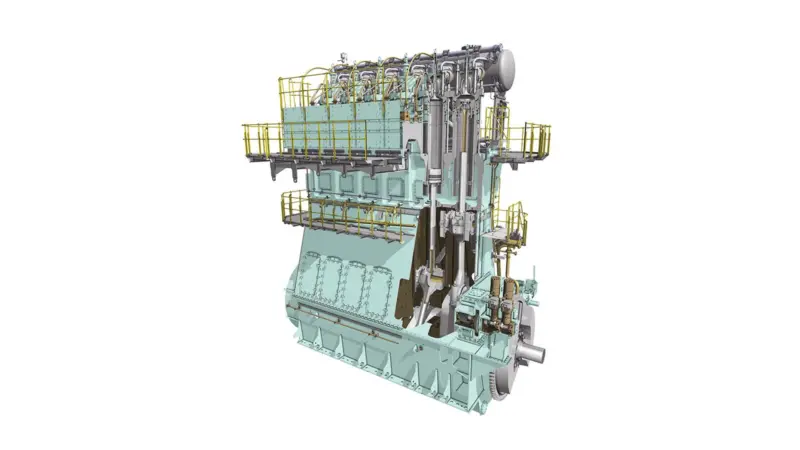
When it comes to engine builders’ capacity to supply dual products, tonnage is less important than vessel numbers or to be more precise engine numbers as some vessels will have multiple engines. Clarkson’s figures for the orderbook at the end of 2022 put dual-fuel ships numbers at around 993 vessels (LNG-825, Methanol-64, LPG-88 and ethane-16). With many of the dual-fuel orders being for larger ship types, the vast majority of new engines needed will be two-stroke, low-speed engines.
Figures provided by the two leading engine designers MAN ES and WinGD in October 2023 show that between them there were 1,728 oil fuelled engines and 928 dual fuel two-stroke engines contracted for. Neither believe that this figure should prove to be difficult for their licensees to produce over the three to four year timeline of the orderbook.
Engine firms see no newbuild obstacles
Some estimates for the time taken to produce a dual-fuel engine suggest can be as much as 30% longer than a conventional engine. Speaking for MAN ES, Thomas Storgaard Hansen said he considered this to be on the high side. A sentiment agreed with by Rudolf Holtbecker, Director Operations at WinGD who explained with the additional components to be produced and installed along with the testing in two different fuel modes – three if the changeover period is considered, extra time is needed but 30% would be a maximum.

Neither felt that there would be any delay to the current orderbook. Hansen made the point that the majority of dual-fuel ships past and present have been built in South Korean yards and the experience of the shipyards there alongside that of MAN’s local licensees would ensure no delivery delays. He added that Chinese yards and engine builders are rapidly gaining experience constructing dual-fuel vessels and that this capacity will be expanding with familiarity.
It is notable that globally the current orderbook is around 3,700 vessels of all types. That figure is well below the number of ships on order in say 2009 when close to 12,000 ships were planned for construction. That said, in 2009 the figures included many offshore vessels, ferries, small tankers and other small vessel types. Container ship size at that time was also well below what is becoming typical today. There were far fewer dual-fuel engines on order then and of those that were most were four-stroke types.
Conversions and retrofits are a different picture
Although both MAN and WinGD see little problem in coping with newbuilds, the potential conversion of existing vessels is a different picture. Lloyd’s Register published a 70-page report on the retrofit issue in late October. The report, similar to several other analyses of the retrofit market suggested that to meet IMO 2050 targets, a significant number of existing single fuel vessels will need to be converted to accept alternative fuels.
The LR report mentions, “A maximum addressable market of 9,000-12,900 large merchant vessels identified up to 2030, after which it is anticipated that all vessels will be built with net-zero or near-zero carbon fuels capability”. It goes on to say that “In all likelihood only a small number of these vessels will eventually be retrofitted as the business case for converting older vessels (beyond ten years) and smaller vessels will likely remain challenging. However, converting even a fraction of this potential market will require new capabilities and technologies from ship designers, shipyards and operators”. The figure is in line with or slightly lower than other forecasts which suggest 15,000-16,000 ships would need retrofitting by 2050.
In May 2023, a joint announcement by MAN and DNV also covered the subject of retrofits. It suggested key requirements for candidate engines would be: electronic control, a bore size of at least 500mm and a sea trial conducted after 1 January 2015. The announcement also said, “The cost of retrofitting, including the fuel storage and fuel supply system, ranges between US$5 million and US$15 million depending on the type of fuel and, as a rule of thumb, this should not exceed 25% of the newbuild cost of a ship to be economically viable. A ship should typically have a minimum newbuild cost of around US$50 million to be suitable for retrofitting”. Ships fitting these criteria include tankers above 50,000DWT, bulkers above 160,000DWT and containers above 7,000TEU, among others. However, in some cases, such as for ships retrofitting to methanol, this cost can be lower.
Yard capacity would also be a factor in determining the potential for retrofitting. Newbuilding yard numbers have virtually halved since the heady days of 2008 with around 200 having closed. Repair yards and drydocking facilities have not suffered this degree of closure but to remain competitive the sector need only cater for the normal scheduled repairs and the average annual amount of emergency work.
Newer engines designed for conversion
A typical conversion to dual fuel would involve a number of new engine components and the installation of a new fuel system for the chosen alternative fuel(s). Both Hansen of Man ES and WinGD’s Holtbecker stress the point that their engines have been developed for some years now with eventual conversion in mind.
Both organisations have their own service and engineering divisions that would likely be contracted to take on the work of conversions alongside repair yards and they would in most cases be drawing on the same bank of sub-contractors that licensees use for component supply. That would require a ramping up of production by contractors and also require recruitment and training of new staff. That would likely be a gradual process and in some respects is already getting underway as there have been a number of conversions already carried out.
An alternative to engine conversion might be to consider carbon capture. Several manufacturers of scrubbers are exploring the potential of upgrading a SOx scrubber to a system that can also capture CO2. For that to work, there does need to be a reception infrastructure to be developed, but if there is a financial value that can be extracted from captured CO2 as many believe this should not pose a big problem.
Assuming that shipping’s decarbonisation trajectory remains basically on track, none of the capacity problems would seem to be insurmountable even if the path is not as smooth as would be hoped.
Related Articles
 2-STROKE & 4-STROKE
 2-STROKE & 4-STROKE
 2-STROKE & 4-STROKE