



Connecting the disconnect
Despite the fact that LNG both arrives and departs by sea, many ports often have to rely on actually getting this particular fuel in by truck – even some of those very developed northerly Norwegian facilities. The problem with sorting out the obvious inefficiency is the supply chain; the liquefied gas can’t just be tagged onto other, more established cargo infrastructure.
For example, you can’t pipe LNG over long distances as today’s technology falls short of keeping LNG at the necessary -160°C temperature and import requires specialised facilities with a multibillion dollar price tag. Søren Christian Meyer, global sales director of OW Bunker says that the company “has no plans in the short term” for getting involved with bunkering LNG, although it “will continue to monitor the market”. He points out that apart from the considerable costs of establishing an LNG system and storage, it costs approximately twice as much to operate an LNG barge as a traditional one.
However, for smaller port operations that want to grow their offering for sectors such as offshore supply vessels and ferries bunkering barges may still provide a relatively ‘low threshold’ solution says Mr Koliopulos, especially if these are managed by a fuel distribution company.
The idea is that these barges will take on that important ‘step change’ from gas ship or export facility and vessels such as dual fuel platform supply vessels or ferries – two parts of the market already growing an LNG presence. With a broadening supply chain, these or even straight LNG vessels could widen their scope even further.
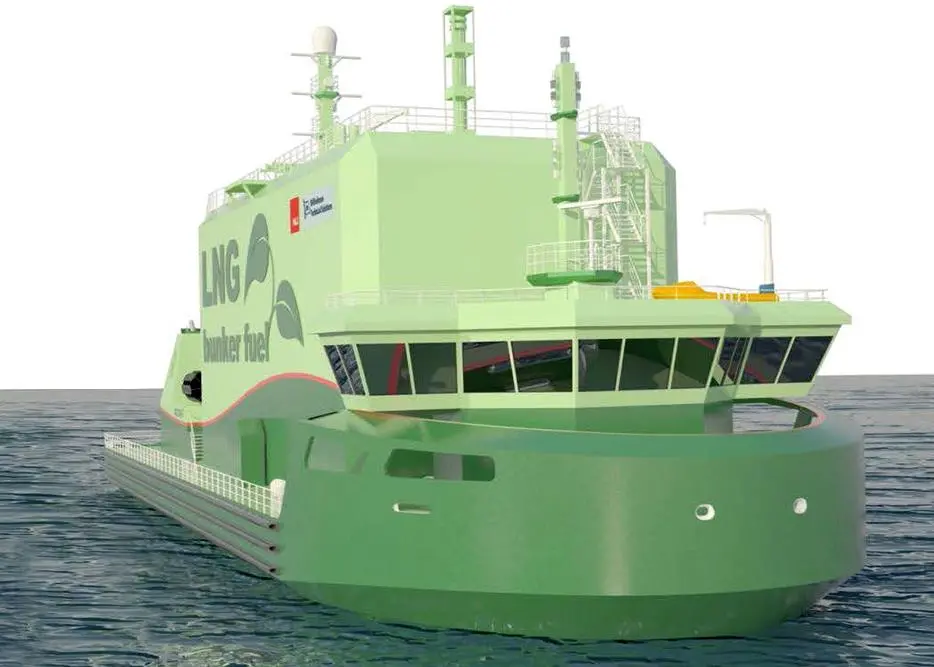
Because supply chain costs are central to the equation a new vessel from NLI Innovation has stepped into the market.
The HighTechBarge (HTB) promises to bridge some of these needs for a cost-effective, high-volume bunkering solution. MD Anders Tørud is clear about the remit of the HTB. “It’s not an ocean going vessel, this is where we have made the savings; many other barges are really more like shrunken carriers and so very expensive by comparison,” he says. This means the HTB is destined for port and sheltered waters only, probably either filling up from a big terminal nearby or taking on ship to ship replenishing from a tanker coming in on a rotation of port calls.
Since the costs get passed on down the chain, price-cutting factors like these are central to the argument about whether LNG bunkering will gain traction, so vessels such as the HTB could make a big difference: “The distribution cost is not a trivial element of the total fuel price” points out Mr Tørud.
The design itself started with the tank, he explains. It features an atmospheric, prismatic steel type ‘B’ tank with a capacity of 4,000 m3 and a new insulation system with very low levels of boil off gas. What excess there is will go to a large pressure tank on the aft deck, where it will feed the onboard power and propulsion or simply be delivered to a shoreside gas grid as there’s no economic argument for onboard recondensation equipment.
Since it also is very manoeuvrable – thanks to a podded propulsion system – it has quite a range in sheltered water, and could even take on the links through to some inland facilities. Further, the HTB gives vessels the advantage of fuelling from the sea-facing side. Mr Tørud points out that you gain a significant time and safety advantage if a PSV can do its unloading and loading in parallel with the bunkering, cutting down the time spent at the berth.
The HTB is particularly interesting because it is aiming to make itself comfortable in a particular niche despite the fact that the supply chain itself is still ‘under construction’. Mr Tørud admits the way forward is still a little woolly but he points out: “The most active players are the gas distributors like Shell, and the harbour authorities or operators, both want to make sure the services are in place. Shell itself is clear that it’s taking a major role all in getting the fuel all the way out to the end user.”
“It’s partly because LNG is a bit more complicated than oil based fuels to bunker, so distributors won’t be confident at passing all this over to the ports, at least initially,” adds Mr Tørud.
However, there’s probably more than one driver, says David Bull of OSC Ltd.
He points out that the very fact that Shell is working so hard at “getting ahead of the curve” to make bunkering a reality is extremely interesting, if only because it’s not the obvious choice. “I think it’s a given that the US will soon start exporting its gas as LNG. However, the huge price differences means a big player like Shell could potentially either double its US LNG returns by selling to Europe or quadrupling them on the Asian market,” says Mr Bull. “So, I’d say Shell’s looking past this and seeing how much it’d gain from creating the first, properly joined up bunkering fuel system.”
Shell has a pair of LNG bunkering projects, one on the St Lawrence Seaway and another at Port Fourchon in the Gulf of Mexico, both being ‘fed’ by nearby liquefaction plants. Mr Bull adds that Harvey Gulf is already investing in PSVs in the latter and others will probably follow. “After all, if it works well in Port Fourchon, then it can probably be rolled out to the rest of the world without too much difficulty.”
Deadline ahead
The big question remains: is the bunkering infrastructure is going to be developed enough to have an impact by the 2015 ECA regulation deadline?
Søren Meyer of OW Bunker says that while there is a lot of positive sentiment towards LNG “the reality is ‘no’,” and points out that LNG itself would have to be a lot cheaper than its energy rivals to push its take up.
However, he does think it will eventually come on stream and puts LNG’s establishment on the bunkering scene “sometime after 2025” but only in conjunction with items like scrubber technology and the “thorough development” of handling, delivery and HSE standards.
Despite this, a strategy for success is also needed. Lloyd’s Register’s Thanos Koliopulos explains that although a port might start off by making LNG available for a handful of regulars, this picture could change as more vessels with a deeper reach need larger quantities. Larger bunkering vessels will inevitably pile on the pressure and take more to manoeuvre, so early planning with an eye to the future is essential or facilities may find themselves trying to untangle an intractable knot of traffic, safety issues and space.
Further, he concludes that while the timing may be subject to debate, LNG “is the way the market is going”.
By Stevie Knight
Related Articles
 PROPULSION
 GENERAL NEWS
 HYDROGEN