



Corvus ESS trial with Seaspan ferries
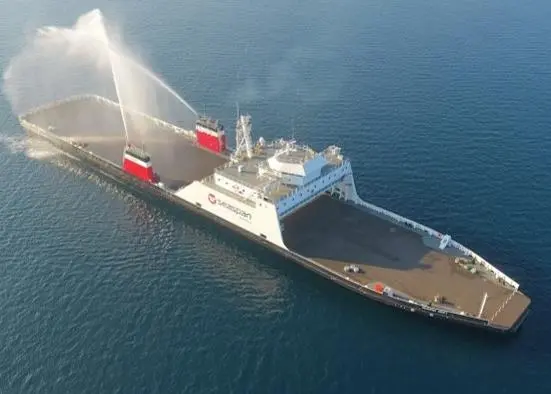
For the inaugural field trial, the rack-free, modular ESS will be installed on board Seaspan Reliant, a RoRo drop-trailer cargo ferry built in 2016 which services the route between British Columbia’s lower mainland and Vancouver Island.
“The field trial is an important pre-commercial activity that enables the development team to validate requirements for a high-volume robotic production line and a range of complex post-production processes,” said Richard Wing, chief research & development officer at Corvus Energy.
The Blue Whale ESS will replace an in-service first generation Corvus AT6500 ESS, increasing the vessel’s energy storage capacity from 545kWh to 1892kWh. Installation is scheduled for summer 2021 and trials will be carried out while the vessel is in full-service operation during the remainder of the year.
With three and a half times the previous energy capacity, Seaspan will be able to expand the use of battery power beyond spinning reserve to also provide fuel-efficient peak shaving, load balancing and possible zero-emission operation.
Once installed, performance data will be collected automatically, analysed and monitored remotely through Corvus’s cloud-based system, providing valuable feedback to the R&D team.
The trial has been made possible through contributions from Canada’s Ocean Supercluster, NRC-IRAP and Environment & Climate Change Canada through its Salish Sea Marine Emission funding.
Related Articles
 BATTERIES, SUPERCAPACITORS, FUEL CELLS AND OTHER ENERGY STORAGE TECHNOLOGY
 BATTERY HYBRIDS & FULL-ELECTRIC VESSELS
 BATTERY HYBRIDS & FULL-ELECTRIC VESSELS