



Cruise demand fuels German newbuilding
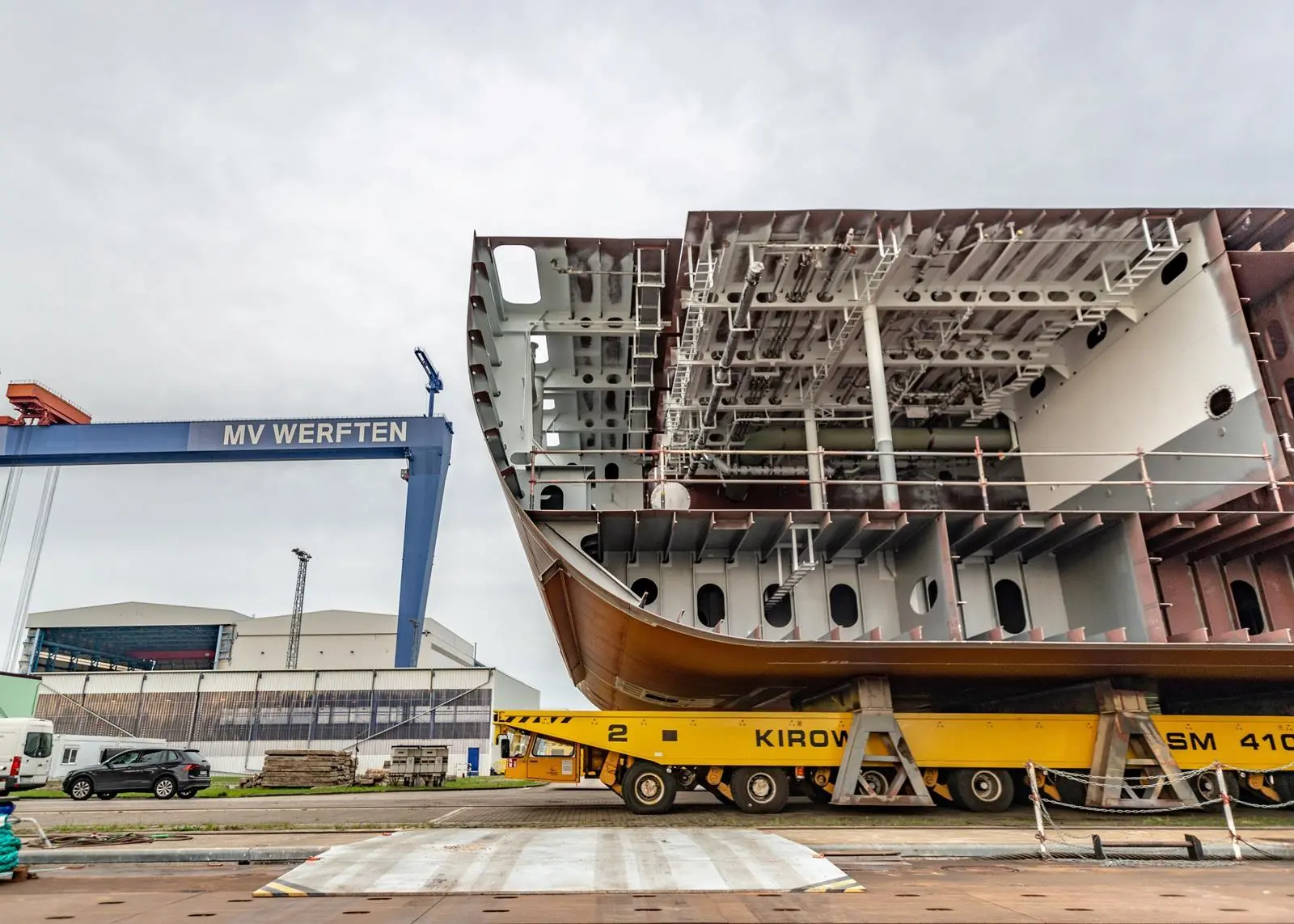
The keel-laying this autumn in Rostock of the biggest cruise ship ever built in Germany and that in Stralsund of the world’s largest Polar-class expedition cruise yacht will have dispelled any lingering doubts about the reality of MV Werften (MVW). If not, then news of yet another cruise ship class for MVW certainly will. It’s “a unique and remarkable newbuilding program” said just-appointed Chief Technology Officer, Raimon Strunck.
It’s still less than three years since the giant Malaysian group Genting, frustrated by long delivery times for its new cruise ships, bought the three former Nordic yards in Wismar, Stralsund and Rostock and created MVW.
The move has already proved a life-saver not only for Genting but for east German shipbuilding, facing a dismal future in 2016, and for the local economy. As of October, MVW employed nearly 2,400 people and still needed 200 more. “Owning the shipyard”, said Genting chief Tan Sri Lim Kok Thay, “means greater flexibility in incorporating the latest technical advancements”.
In September Genting’s Crystal Cruises said the first of yet another new class of cruise ships – the Diamond Class of about 67,000gt – was being ordered at MVW Stralsund for delivery 2022 – a delivery time probably impossible anywhere else at present.
At least two new Diamond Class ships are being ordered but no further details were initially revealed. MVW’s Susanne Meyer told the Motorship: “the technical details of the Diamond Class will not be available until next year. We are still in the very early design phase with this”.
GLOBAL CLASS
Already under construction meanwhile are MVW’s first two 204,000gt Global Class newbuilds for delivery to Genting’s Dream Cruises in 2021 and 2022. The first 342m long and 46m wide ship is being built in parallel in Wismar and Rostock. The 220m Rostock midship section will move to Wismar next year, where the bow, stern and superstructures will be added and where steel cutting for the second Global ship began last March.
They will each have ABB technology packages and six MAN 48/60CR engines with a combined output of 96,000 kW. “We are creating something truly great – MV’s first giant”, said MVW CEO Peter Fetten at the Rostock keel-laying in September.
Reports said some 95% of the first Global ship would be completed in Wismar. Susanne Meyer told The Motorship that after completion of its sea trials in late 2020 the ship would not return to Wismar but go to Bremerhaven. “That’s because the dredging of the port’s (Wismar’s) approach channel will not be completed by then and the channel will therefore not have the draught it needs”, she said.
Genting Group yard Lloyd Werft Bremerhaven (LWB) has said it will be involved in the final construction stages of the Global Class ships. Exactly what LWB will do was unclear but outfitting and operational completion seemed logical. LWB also spoke of more work for Genting and said it had a contract to use Bremerhaven’s West Kaje.
The 500m quay is being rebuilt up to 2019 at a cost of €30 million. It was earmarked for ship building in 2016 when Genting originally said its ships would be built at LWB. Genting later relocated construction to east Germany – a move which LWB MD Rüdiger Pallentin now believes was “strategically correct” given the now apparent scale of its owner’s newbuilding programme.
REGIONAL REVIVAL
German political leaders certainly still think so. Chancellor Angela Merkel commented at the keel-laying of MVW’s first expedition cruise yacht Crystal Endeavor in Stralsund in August that it symbolised regional revival. “Shipbuilding in MV has a future”, she declared. Even before the new Diamond ships were announced, it was reported that Genting had work for the town’s former Volkswerft yard to 2026.
The 164m Endeavor Class ships will be of just 20,000gt. For 800 passengers they will be in complete contrast to the 20-deck Global Class newbuilds which MVW said, will have room for 9,500 people at peak. Genting said the “globally unique” and spacious Crystal Endeavor will be the first of three for subsidiary Crystal Yacht Expedition Cruises. Billed as the most valuable ships ever built in Stralsund, they are for delivery late 2019/early 2020 and a year later. They will also boast ABB propulsion systems, electric power plants, automation and marine software as well as two Azipod D gearless thrusters each for Polar operations, and PC6 Polar Class ice rating.
Leading cruise ship builder Meyer Werft meanwhile has entered the LNG era. In November its 184,000gt AIDAnova, the world’s first cruise ship for complete LNG operation, was entering service. More LNG newbuildings will follow as Meyer tackles a full order load over the next few years at its main Papenburg yard in western Germany and at subsidiaries Neptun in Rostock and Turku in Finland.
Meyer’s Guenther Kolbe told The Motorship in September 28 cruise ships were for delivery up to 2024. Nineteen will be built in Germany – 13 at Papenburg and six (river cruise ships) at Rostock.
Some 6,000 people now work for the Meyer Group. All enjoy job security guarantees until 2030. Like MVW, however, Meyer said in autumn it still needs 250 more specialists in Papenburg and Rostock.
AIDAnova is the first of three HELIOS Class ships for AIDA Cruises. Two sisters will follow in 2021 and 2023 and all will operate in port and at sea on LNG. AIDAnova carries four dual-fuel, 16-cylinder, MaK M 46 DF hybrid engines from Caterpillar partner Zeppelin Power Systems and two CAT 3516 C-HD auxiliaries.
POLAR SHIPS
Next year and in 2020 Papenburg will deliver three rather than the usual two new cruise ships. This is being made possible by re-activating its 370 x 102m building dock 1 – normally used for block construction – to build two ten-deck, polar code ships for Saga Cruises. At 236m they are ‘compact’ enough to fit.
Spirit of Discovery and Spirit of Adventure are for completion next year and in 2020. Of 58,250gt they are Saga’s first newbuildings. Saga chief design engineer Simon Yeo reported the ships will be driven by Siemens SISHIP eSiPOD-M mono-propeller propulsion systems and powered by four MAN 9L32/44 common-rail diesels each of 5.4 MW. The duo will also have hybrid scrubbers from Yara.
Elsewhere Meyer’s twelfth ship for NCL – the Breakaway-Plus cruise ship Norwegian Encore of 167,800gt – is being delivered in the last quarter of 2019.
For completion next spring is the 168,800gt Spectrum of the Seas, the fourth newbuild for Royal Caribbean. A fifth follows in 2020.
Spectrum is designed for the booming Asia-Pacific cruise market. Group head Bernard Meyer has long seen that region as a threat to Europe’s passenger ship building. Günther Kolbe told this correspondent: “We are keeping a very wary eye on the competition from Asia and we regard it as a big danger for European shipbuilding”. Earlier this year Meyer also criticised some state subsidy practices in Europe as “uneven and unfair”
LNG ADDITIONS
AIDAnova will not remain Meyer’s only LNG ship for long. For delivery by Papenburg in 2020 is the180,000gt P&O Cruises’ newbuild Iona and, in 2022, another as yet unnamed sister for P&O.They will also be 100% LNG powered and P&O’s biggest ships ever. Three135,000gt newbuildings for delivery to regular customer Disney Cruise Line in 2021, 2022 and 2023 will also be LNG ships.
Part of Meyer’s strategy to combat Asian competition is to centralise shipbuilding functions. One step has been the concentration of group engine room production at subsidiary Neptun Werft, which now plays a pivotal role in that strategy.
The first four-deck, 140x42m floating engine room unit (FERU) built in the yard’s new €50 million,180x60x58m engine module construction hall was completed in August for transport to Papenburg and insertion in Norwegian Encore. Next was the engine block for P&O’s Iona.
Neptun MD Manfred Ossevorth said the hall had stood its first module building test well and was ideally suited to turn out a planned four complete modules a year – even six with time, as the yard improves productivity. Each unit comes complete with propulsion and supply systems for its designated newbuild – from engines, electrics, heating and air conditioning to LNG tanks for ships needing them.
Along with external partners Neptun now employs about 1000. It also works closely with Caterpillar in the LNG engine building sector and has been closely involved with Caterpillar/Zeppelin in the production of inland cruise ships. Late year it was busy with six more 135m newbuilds for Viking River Cruises all for delivery in 2019.
COMPLEX CRUISER
At Germany’s northernmost shipyard, Flensburger Schiffbau-gesellschaft (FSG) on the Danish border, the much-delayed cruise ferry newbuilding W.B.Yeats was putting to sea for tests in October.
The 194,60m, 54,975gt ship, which CEO Rüdiger Fuchs said was “the most complex ship ever built by FSG” had been due into service in July as the first of two for Irish Ferries. Fuchs cited delays in the delivery of interior components and hull and deckhouse electrical installations.
Boasting 2,800 lane metres, the €144 million W.B.Yeats is being billed as the “largest and most luxurious ferry” ever to sail the Irish Sea. A second ship is for delivery next year. Bigger than W.B.Yeats, and with 5,600 lane metres, it will be the biggest ship ever built by FSG and the largest cruise ferry in the world in terms of vehicle capacity. Cost is put at more than €160 million.
FSG has long been Germany’s top builder of ro-ro and ro-pax tonnage, and has often also led the world in the sector. Rüdiger Fuchs told The Motorship in September “nine ships are in the order book for delivery into 2021 – four ro-ro cargo ships and five ro-pax newbuildings. Our focus is clearly on these types of ship”.
For launch in December and delivery next May is the first LNG-powered ferry newbuilding to operate between France and the UK. The 42,200gt, 2,400 lane metre Honfleur is for Brittany Ferries.
GAS FERRIES
Two further LNG-powered DF passenger ferries for Australia’s TT-Line are also on order for delivery in 2021. They are together costing about €438 million, FSG said. A further 209m ro-ro ship from FSG, the 32,770gt Alf Pollak, was going into service late year as the first of two for SIEM charter to Italy’s ONORATO. FSG said it will be the biggest ro-ro ship in the Mediterranean
South of FSG in Leer, the inland Ferus Smit Shipyard was late year also handing over the first of four 149.5m cargo ships with nearly twice the capacity of previous ships in their class. The Arklow Wave is an enhanced 16,500dwt version of 8,500dwt class ships with a 3,840kW main engine,
Several other yard groups, like Lürssen and German Naval Yards, remain heavily involved in lucrative yacht newbuilding or government navy modernisation programmes. Others however are building some technologically impressive smaller commercial ships.
Hamburg’s Pella Sietas was due to deliver a 132m trailing suction hopper dredger to authorities in December. The yard said last year the €95 million job was “challenging” and the ship itself very complex. The newbuild will load 7,500m3 and have eco-friendly diesel-electric drive for Elbe operations.
Also due into service this year is Fassmer’s Branddirektor Westphal, the biggest fire-fighting vessel in the history of Hamburg.
The port told The Motorship the 43.5m, €16 million newbuild will be twice as big as Hamburgs’ current fire-fighting boats, state-of-the-art and powered by two eco-friendly 500kW Caterpillar engines. It will also have two rudder propellers and two bow thrusters from Schottel. Fassmer is also building the 75m, €113.8 million, LNG-powered government research ship Atair for delivery in 2020.
Related Articles
 PROPULSION
 GENERAL NEWS
 HYDROGEN