



Cummins powers the new offshore breed
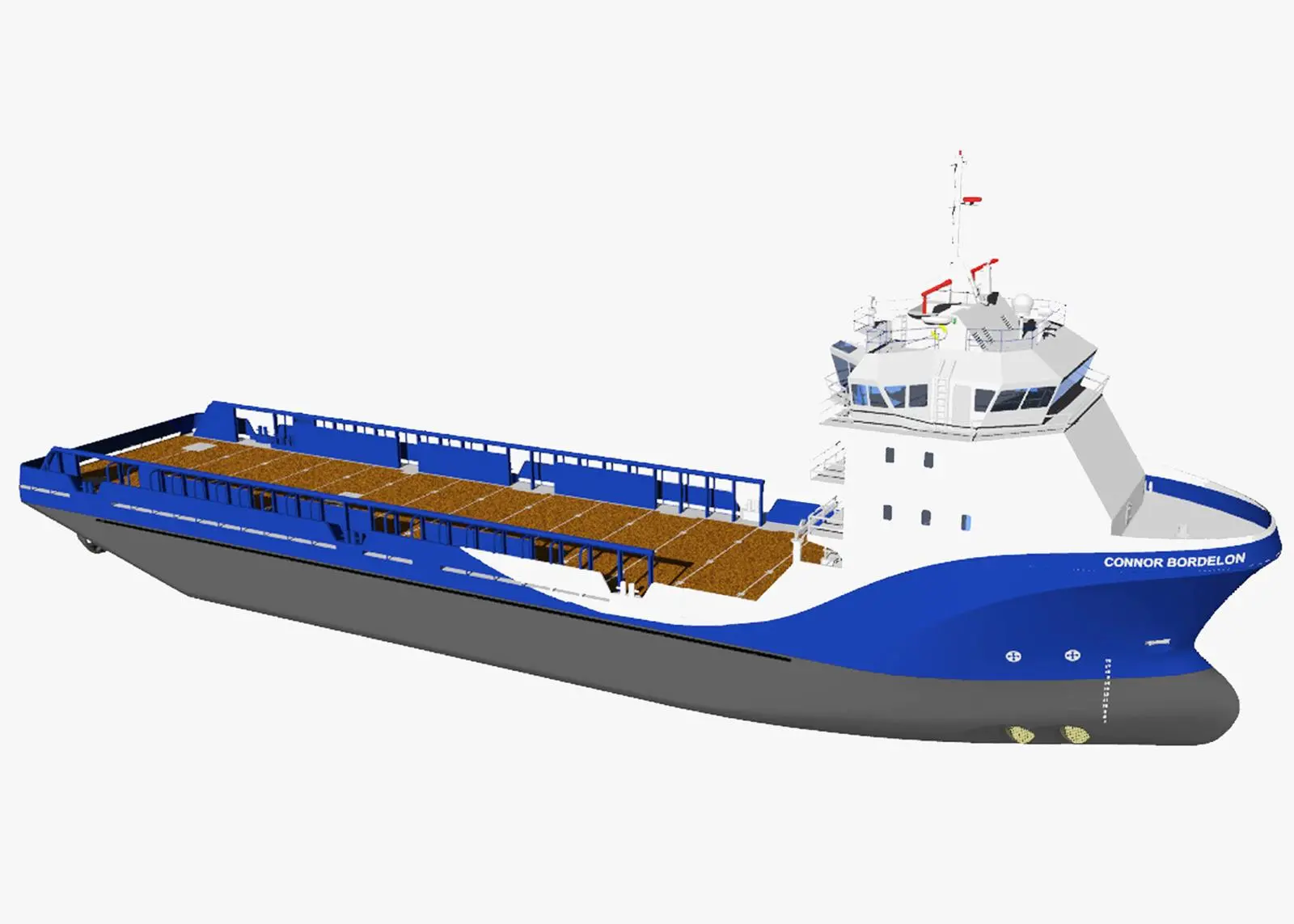
Cummins engines are proving popular in these applications. US company Bordelon was something of a pioneer in this sector, building a series of small Cummins-powered supply ships of about 45m and 50m length oa in 2001-2005. The company is now building a further series of three 77m vessels at its own yard in Louisiana. The new boats, known as the Stingray class, feature two Cummins QSK 60-M (Enviro friendly) Tier 3 main propulsion engines driving Schottel 1215, 2,200hp Z-drives, with Schottel STT2, 1,020hp bow thrusters giving a DP2 capability. Three Cummins gensets complete the machinery installation. With a maximum speed of 14 knots, economy and low emissions take precedence over speed in this case.
All systems are fully automated and controlled from the bridge. The vessels can accommodate up to 40 personnel and feature an internal ROV office and control room. The Stingray series is SOLAS classed, FIFI 1 ACCU, EEP 175, EPA Tier 3.
Seacor Marine is another go-ahead US concern that, according to Cummins, sets the future goals for the industry. Well-known for its aluminium-built monohull crew boats, the company has diversified with a group of catamarans in recent years. Now, while continuing that project, Seacor has announced the building of four monohull fast supply boats.
At 61.5m long and 10.4m beam, the new boats are about 4m longer than a previous series of eight boats, but with the same width. Five of the previous boats were each powered by five, Cummins 50-litre engines with a total power of 9,000bhp. These boats achieved maximum speeds, with propellers, of 26 knots and with jets of 29 knots.
The four longer boats will each have four Cummins QSK60 engines, each rated for 2,700bhp at 1,900rpm. Each engine will drive a Hamilton HT810 water jet through Twin Disc MGX61500 gears. This will give the vessels a design speed of 32 knots (light boat) or 20 knots loaded. Three 290kW generators, each powered by a Cummins QSM11 engine, will provide electrical power. The boats will be ABS Classed DP2 with the DP system provided by Kongsberg. Each vessel will be fitted with three Thrustmaster 200hp tunnel bow thrusters.
Up to 400t of cargo can be carried on the aft deck, and large capacity tankage is provided for fuel and water. Up to 64 passengers will be accommodated on the main deck level. Full accommodation with bunk cabins and galley will be built in the hull for up to 11 crewmembers.
According to Seacor boss Joe McCall, “The DP system, vessel monitoring system, and jet controls feature a dual, redundant CAN-bus network linking each component. This is a ‘fly by wire’ technology.”
Two of the new class are building at C&G Boat in Mobile, Alabama and two at Gulf Craft’s new yard in Franklin, Louisiana. The Robert C McCall is scheduled for delivery from C&G in July 2013, with the Clayton B. McCall to follow in October 2013. The two boats building at Gulf Craft are the Eric & Alex F. McCall and the Michael Crombie McCall to be delivered in November 2013 and April 2014, respectively.
Not only North American operators see the potential of fast supply vessels’ A series of 12 such craft has been ordered for work with Petrobras, Brazil’s semi-public multinational energy corporation. The vessels will be owned by Baru Offshore, a joint venture between Intertug and Senior Navegação. All 12 FSVs will be built at the Estaleiro ETP in Rio de Janeiro.
Designed by Incat Crowther of Australia, with the support of its Morgan City, Louisiana office, the 48m hulls have a 9.5m beam, affording a 225m2 cargo deck. Forward on the main deck a 30m2 covered cargo area is designed for transport of provisions and other rain sensitive cargos. This forward area also provides a passenger space that can also be used as a conference room. Below decks accommodation will be provided for 11 crew members in six cabins as well as a mess, galley and heads.
Propulsion will be four Cummins QSK50-M IMO Tier II compliant engines each delivering 1,800bhp at 1800rpm to FP propellers. The design service speed is 21 knots with maximum speed of 25 knots. The boats will be fitted with a pair of 150hp electric tunnel bow thrusters. Two Cummins QSM11-CP powered 300 kW AC440V, 60Hz generators, built by Cummins’ in Singapore, will provide auxiliary power.
Related Articles
 PROPULSION
 GENERAL NEWS
 HYDROGEN