



CUSTOM-MADE CABLESHIP FROM NORWAY
Cable-laying vessels are a distinct breed, requiring heavy investment to provide a robust, all-weather working platform and purpose-designed wherewithal for the task, plus a sophisticated power and propulsion system to efficiently and safely cover an operating profile characterised by large fluctuations in energy demand.
From a shipbuilding perspective, such tonnage poses particular challenges due to its technological and outfitting intensity, and because of the project management and system integration capabilities required to ensure that contractual delivery, quality and performance stipulations are met. Without the requisite planning, costing, production and organisational efficiency, yards will struggle to achieve a satisfactory net financial return on one-off projects of this kind.
A testament to the retained scope and competitiveness of the industry in Europe to undertake such construction is the 150-metre newbuild Nexans Aurora, now being outfitted in western Norway. The availability of a vibrant industrial cluster in the region is particularly apposite to the project.
Ordered from Ulstein Verft by the Paris-headquartered energy cable and telecom infrastructure group Nexans, the nascent vessel has been conceived primarily for the installation, recovery and repair of high-voltage DC and AC systems in both shallow and deepwater regions. Duties will include connecting offshore wind farms to the landside grid, placing offshore umbilicals, supporting the ‘electrification’ of offshore platforms, and creating undersea power interconnectors between countries
The ship embodies the experience and know-how not only of the owner and builder, but also that of the Norwegian consultancy Skipteknisk and the UK firm MAATS Tech, a specialist in the design and supply of cable and flex-lay equipment.
The 17,000dwt diesel-electric newbuild is scheduled for commissioning during the second quarter of 2021 and will be deployed by the contractual owning group’s Norwegian subsidiary Nexans Subsea Operations. She will become the largest and most versatile unit in the Nexans fleet, suited to the laying of all types of subsea power cables and umbilicals, including bundles, with the means also of undertaking cable jointing, cable system protection and trenching, and maintenance.
High manoeuvrability and station-keeping precision in all weathers was a fundamental requirement determining the design and engineering specification. The vessel’s capacity is such that she will be suited to long-range and long-duration operations without the need to pause for re-supply. Onboard facilities will ensure a high degree of independence and reduced reliance on outside support during deployments in areas of minimal infrastructure. Aalesund-domiciled Skipsteknisk developed the ST-297 CLV bespoke design for the DNV GL-classed newbuild.
The central feature of the Nexans Aurora is her high-capacity cable-handling spread, comprising a 10,000t split turntable with dual-product lay lines, for load-out, transportation and seabed installation in long lengths. The vessel will also incorporate a dedicated, enclosed cable splicing station offering a controlled environment for all product splicing and termination work to the same standard as that carried out in Nexans’ factories.
It is claimed that her 10,000t concentric carousel will be the largest in the market. In addition, the vessel will be fitted with a basket for up to 450t of fibre-optic cable.
The contract with MAATS embraced the huge carousel, load arms and roller pathways, cable capstan, five horizontal lay systems, bundling system, lay wheels and controls, plus a range of technical services that included the deck layout design and finite element analysis (FA) for key equipment.
Palfinger Marine of Salzburg, Austria, was chosen to provide a suite of deck gear comprising the 150t A-frame, two heave-compensated abandon and recovery (A&R) winches, two auxiliary A&R winches, two overhead travelling gantry cranes, a pair of offshore knuckle boom cranes and a single, offshore telescopic boom crane. The scope of supply was later augmented with two 64-person lifeboats and davits.
Cable-laying will be wholly accomplished across the stern. While the main bridge and superstructure are located forward, a second bridge is arranged aft, facing over the working deck at the stern and the remote-operated vehicle (ROV) hangar. A passive roll-damping system, in conjunction with the nature of the hull lines, will reduce motions both in a seaway and when in DP mode.
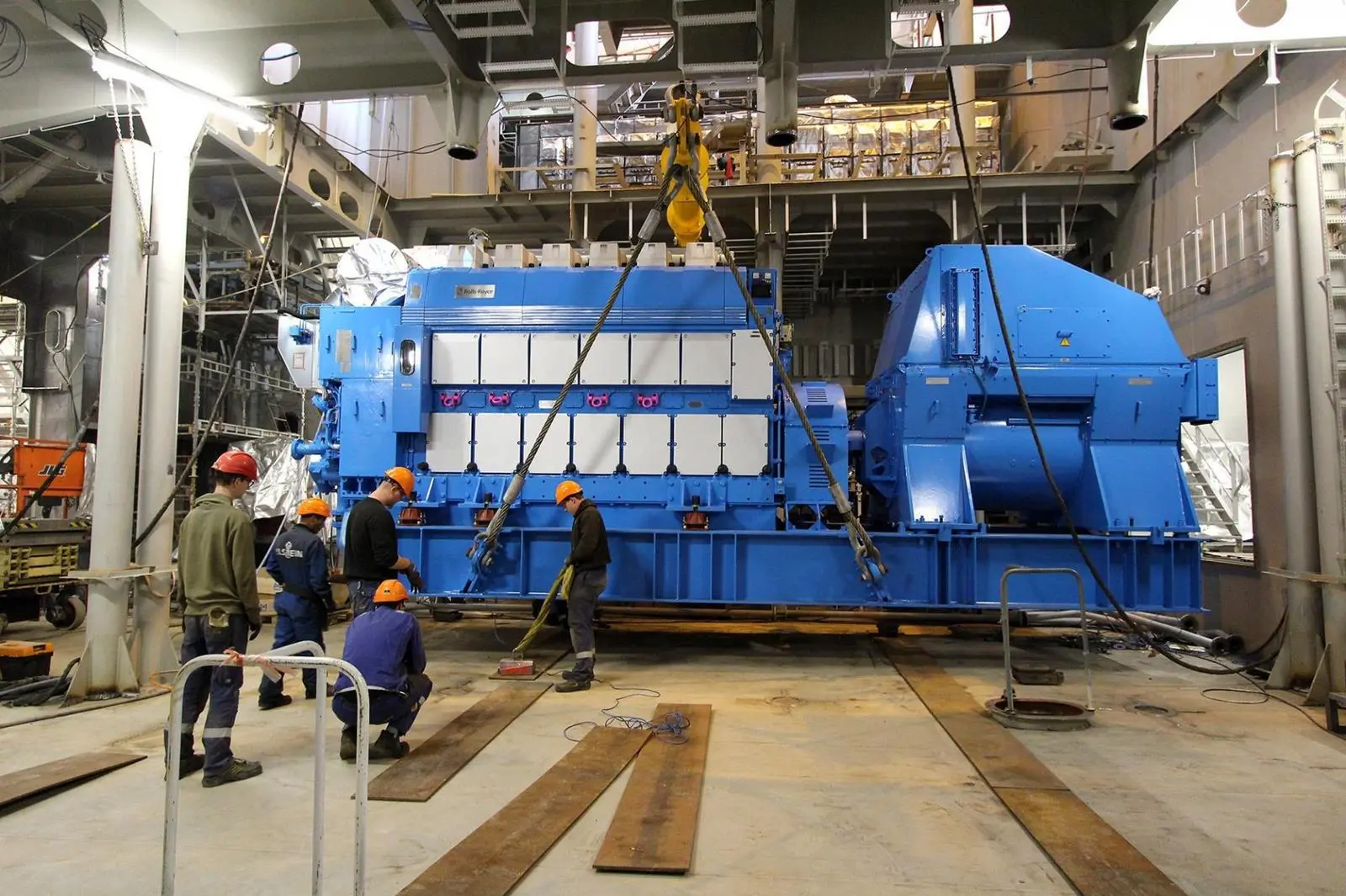
The diesel-electric powerhouse is based on six main gensets driven by Bergen engines individually rated at 3,450kW, rendering an overall power concentration of 21,000kW. Redundancy is of a high order, permeating the layout and control of machinery and related systems. Energy is converted into propulsive effect via three main azimuthing thrusters in nozzles at the stern, and two tunnel thrusters and a retractable, azimuthing unit at the bow.
The rating of each of the manoeuvring thrusters, at 3,000kW, is on a par with the 3,200kW of the main propulsors. The set-up engenders a DP3 standard of dynamic positioning and a relatively fast transit speed of up to 14 knots. The entire propulsor and thruster package is of local manufacture, having emanated from the Brunvoll factory at Molde.
Hydroniq Coolers of Aalesund was contracted by Ulstein to provide its proprietary Pleat seawater cooling system for the vessel’s main and auxiliary machinery. The patented Pleat solution is a module-based titanium cooler, devised for long service intervals and ease of maintenance of the elements compared to conventional heat exchangers.
The diesel generator plant will burn low-sulphur fuel. Among other measures that will lessen the ship’s environmental impact is the regeneration of cable-lay braking power, and the provision for making a connection to the shoreside grid when in port for cable loading, obviating the need for generator running.
Ulstein Verft subcontracted the hull and initial outfitting to Polish shipbuilder and steel fabricator Crist, and the partially-built vessel was towed from the latter’s Gdynia premises in June this year to the Ulsteinvik yard for equipment installation and completion. The main contractor’s work embraces the fitting of the main generators and power system, deck gear, winches and the topsides equipment.
Ulstein landed the deal for the Nexans cable layer in 2018 after the original order placed the previous year with Uljanik Shipyard of Croatia was cancelled.
Jobs to which the newbuild is already committed include the installation of three 65km offshore export cables and three 20km onshore export cables for the Seagreen 1 offshore wind farm in Scottish North Sea waters.
PRINCIPAL PARTICULARS – Nexans Aurora
|
Length overall |
149.9m |
|
Length, incl. sheaves |
155.2m |
|
Length bp |
142.8m |
|
Breadth |
31.0m |
|
Depth, to main deck |
12.8m |
|
Depth, to tween deck |
8.3m |
|
Capacity, cable turntable |
10,000t |
|
Capacity, optic tank |
450t |
|
Deadweight |
17,000t |
|
Main genset engines |
6 x 3,450kW |
|
Main azimuth thrusters |
3 x 3,200kW |
|
Bow tunnel thrusters |
2 x 3,000kW |
|
Bow azimuth retractable thruster |
1 x 3,000kW |
|
Class |
DNV GL |
|
Class notations |
+1A, Cable laying vessel, E0, SF, NAUT(AW), Clean(Design), SPS, DYNPOS(AUTRO), COMF(V-3, C-3), Ice(C), BIS, BWM(T), VIBR, Silent(E), Recyclable, Strengthened(DK) |
|
Accommodation, single cabins |
90 persons |
Related Articles
 PROPULSION
 GENERAL NEWS
 HYDROGEN