



Dancing with the FPSOs
“Everyone understands there’s an ongoing a need for maintenance personnel,” points out Rodrigo Araujo of Poseidon Offshore, adding that a floating accommodation block is a useful, cost effective way to provide it.
However, turret moored FPSOs present their own issues as the freely weathervaning vessel can rotate around the turret in any direction.
Traditionally Brazilian rig maintenance and technical support has been supplied by semi-submersible accommodation units but as Mr Araujo explains these have certain problems regarding their ability to follow these movements. “Semisubmersible support units usually connect at an angle to the stern so that, when alongside a turret moored FPSO – which will tend to align with the weather – they present an exposed side, increasing the impact of environmental forces and so having more difficulty staying linked when conditions worsen.”
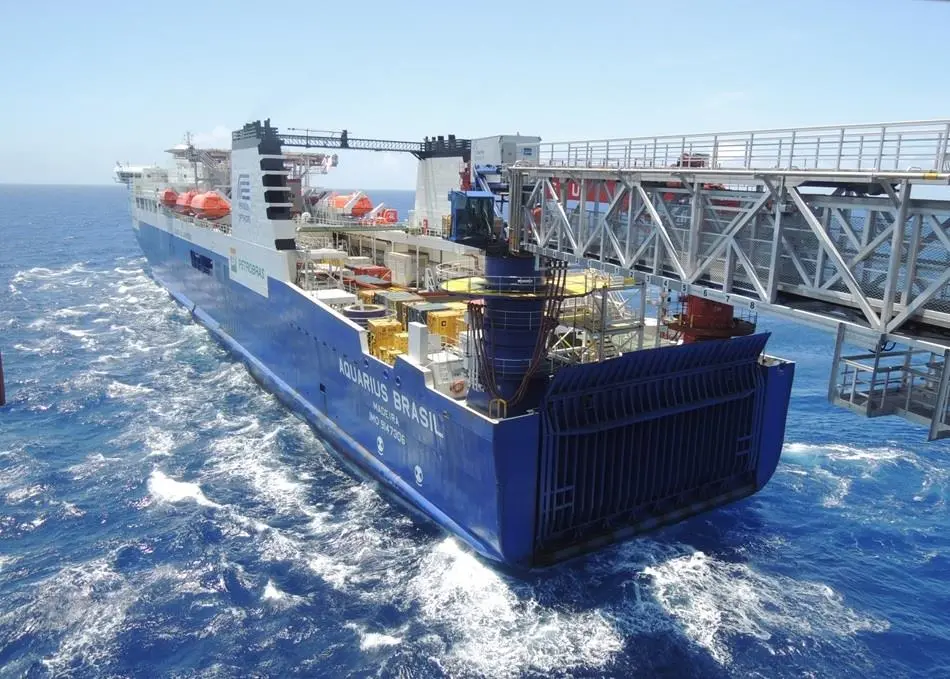
The answer might be using a new ship-shaped vessel. The idea sprang from the success of the safety and maintenance monohull, Aquarius Brasil, chartered by Petrobras on a five year contract starting back in 2013.
It seems this particular 180m long by 25m beam unit has been making a good job of servicing various installations in the Campos Basin. A conversion from a ro-pax vessel rather than newbuild (because of the short lead time) it’s big enough to provide accommodation for no less than 450 personnel in addition to the crew. Besides being home to maintenance technicians it also acts as a field workshop and store for between four and six months at a time, the length of an average campaign. Along with its offshore cranes and telescopic gangway it has a well-used helideck; though OSVs provide the supply function all personnel transfers take place by air: “Considering that the maximum stay on board for Brazilian personnel is about two weeks a reasonable number of helicopter flights are arriving and departing every day,” he says.
But most importantly, Mr Araujo explains where it wins over the other units: while the usual semi-submersible accommodation blocks have a roughly circular DP capability plot that’s more or less the same in all directions, a ship-shaped vessel has a preferential fore-aft DP and, if it can connect almost alongside the FPSO, even better as the unit will then only present the bow to the weather, avoiding the worst of its force while making the most of its DP capability.
After seeing how capably Aquarius Brasil supported semisubmersible and fixed structures in the field, Poseidon established a plan with Tecnitas, the consultancy arm of Bureau Veritas, to conduct a study on the feasibility of using a monohull accommodation unit with an eye to serving turreted FPSOs as well.
As it was a new concept, the study was intense. The first HAZID workshop allowed the central players – which included Petrobas and ship owner Pegasus Marine & Offshore – to investigate the main risks and mitigating measures; this was followed by the creation of a mathematical model to feed through to a simulation stage to look at the interactions of both FPSO and ship-shaped unit in different configurations. More, it was necessary to simulate the unit’s DP response to all of this, evaluated with reference to the conditions typically found in the Campos Basin, and then the whole thing had to be calibrated using tank tests. An extensive test campaign was carried out at Marintek’s offshore basin to evaluate all hydrodynamic parameters involved.
Hard work, “but it meant we could simulate any case or combination of environmental conditions and geometric position” says Mr Araujo. Based on this, Poseidon has started working together with Pegasus and Sembawang Shipyard on Aquarius II, and “although Aquarius II will be the same size as its “sister” at 180m long, the study gave us some indications on improvements”, he says, adding that the tailoring “means we can gain some efficiencies and keep the project costs down”.
To start with, there’s room for 500 client personnel – slightly more than Aquarius Brasil; “and as it only has to travel every four to six months we can drop things like the bulbous bow, one more element we don’t need in the water”, says Mr Araujo. There are bilge keels to decrease roll motion and the stern has also benefited from attention: rather than the being flat, as is usual on ro-ro ships, the sections have more of a curve in order to reduce the slamming effect.
“On the whole Aquarius II will look rather different to the first ship, probably resembling a huge supply vessel with a clean deck aft for cranes – we are keeping one side completely open so it’s easy to transfer larger components or other gear.” Further, that well-used helideck is no longer a separate element, but integrated into the superstructure.
The power is being more closely modelled to what is necessary, as Mr Araujo explains that Aquarius Brasil was slightly overpowered since it had the legacy of its original ro-pax engines: by contrast, this newbuild will have six 4.2MW gensets. It’s a clever configuration and despite this drop it is gaining hugely by installing elements like nozzled units: whereas the original vessel’s thrusters require around 18MW of power delivering (in total) just over 237 tonnes, the new vessel, for roughly the same power, yields a total of nearly 315 tonnes of thrust. More, it will also have DP3 capability, gaining again on its sister’s DP2 classification.
Taking advantage of the flexibility gained from newbuild, the interior (accommodation, work, storage, service and recreation areas) has been designed to make the most of the space available. Interestingly, it’s retaining something like Aquarius Brasil’s car deck as this gives a huge, very useful workshop and warehouse capability, with 5.5m free height to allow for the handling of large pieces. The whole cargo movement system has been designed for convenient operation including three offshore cranes to serve the open deck, a cargo lift system serving the warehouse from the exposed deck and overhead cranes for cargo management in the warehouse.
It should be an interesting build to follow.
By Stevie Knight
Related Articles
 PROPULSION
 GENERAL NEWS
 HYDROGEN