



DANES TO TEST FUEL CELLS AT SEA
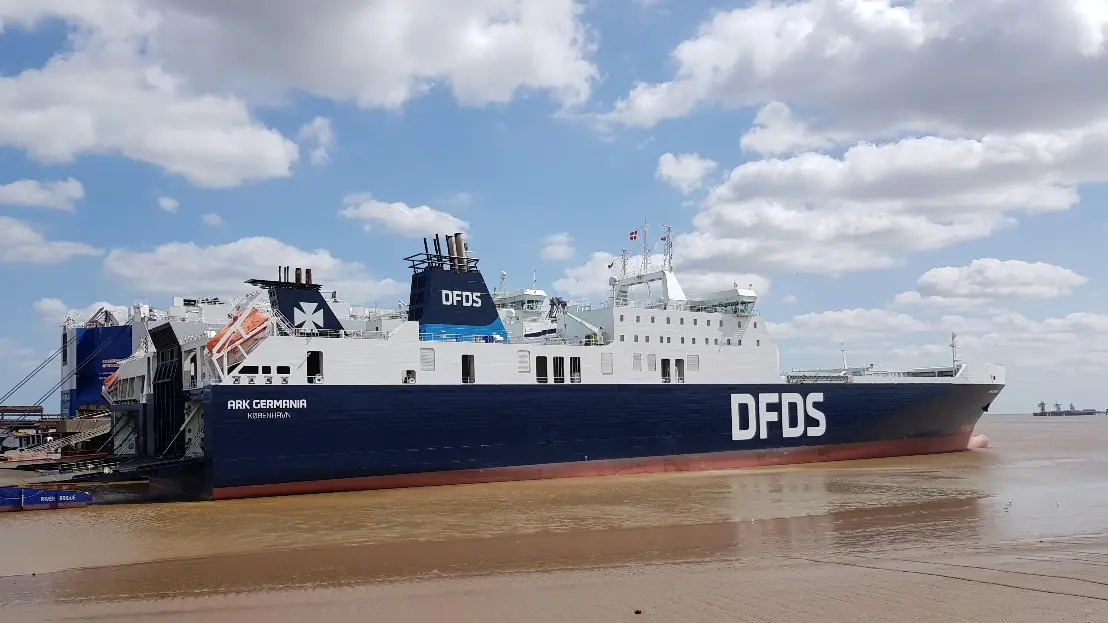
With financial support now authorised from Den Danske Maritime Fond (The Danish Maritime Fund), the DFDS-owned, 195-metre Ark Germania will be adapted to enable the installation and testing of fuel cell plant during the course of her regular operations.
The initiative is the latest in a series of measures implemented by European through-transport and ro-ro specialist DFDS in line with a strategy of cutting its greenhouse gas emissions by 45% from the 2008 baseline to 2030. The aim is complementary to the IMO target of a 40% reduction in shipping’s CO2 emissions by 2030.
The development of fuel cells that can run on hydrogen, methanol or ammonia, for example, necessitates significant investments and testing at scale, so as to reach the requisite reliability and cost effectiveness to make the technology a practical and viable, non-carbon energy source for merchant vessels. DFDS and other members of the Danish maritime industries consider that collaboration across the various disciplines, channelled into partnership projects, can provide a focus for fuel cell producers to stimulate work on marine applications.
The Danish Maritime Fund has just granted a total of DKK 18 million for 13 projects, and the DFDS scheme, entitled the Fuel Cell Test Ship, has received one of the single largest allocations.
The electrical infrastructure of the Ark Germania will be upgraded to allow for the testing of fuel cells of up to 1MW. Partners from the maritime cluster, collectively described as The Blue Denmark, will install containerised equipment placed on the weatherdeck, plugged into the ship’s net and connected to fuel sources.
The project will allow different types of fuel cell, and different suppliers, to be compared. The vessel will also allow tank containers to be installed next to the fuel cells, to supply the various fuels, such as hydrogen and ammonia, required for the different types of fuel cells being tested.
The project also opens the way to evaluations of new battery technology, supercapacitors, and detailed analysis of systems.
“The testing made possible will enable cost-effective live tests for the fuel cell manufacturers and should prove valuable for both DFDS and The Blue Denmark as a whole,” said Jakob Steffensen, DFDS head of innovation and partnerships. “Gaining familiarity with fuel cells will help speed up the development of maritime zero-emission fuel technologies, and we hope this inspires further innovation partnerships to give our industry hands-on experience with the new sustainable fuels.”
“With this setup, we make it more attractive for businesses to focus on maritime uses of green energy technology, so we can reach our ambitions of developing zero-emission ships,” he added.
Ark Germania was the second of two vessels ordered by DFDS from a German yard in 2010 on the strength of the shipowner’s co-operation agreements with the Danish and German defence ministries. These allow for the ships to be allocated to the ARK pool, whereby tonnage is deployed as required and on notice in support of military sealift requirements. The vessels are otherwise engaged on the carrier’s shortsea freight service network.
Completed in 2014, Ark Germania and second-of-class Ark Dania were designed to accommodate military transport needs as well as catering to DFDS’ varied ro-ro cargo manifests, with capacity for 3,000 lane-metres of wheeled freight, corresponding to some 185 heavy goods vehicles, plus 342TEU containers.
Each is powered by two low-speed MAN main engines of the 8S40ME-B9 type, giving a total output of 18,000kW, driving twin controllable pitch propellers. While contractual speed was stipulated at 20.5 knots, the service speed criterion for usual North Sea transits was 18.6-18.7 knots.
When deployed for military support duties and convoy sailing, speed can be reduced to about 12 knots using a single engine and screw, with the other engine stopped and its propeller pitch set in fully-feathering position.
Related Articles
 ALTERNATIVE FUELS & LUBRICANTS
 ALTERNATIVE FUELS & LUBRICANTS
 ALTERNATIVE FUELS & LUBRICANTS