



Dawning of the age of Aquarius
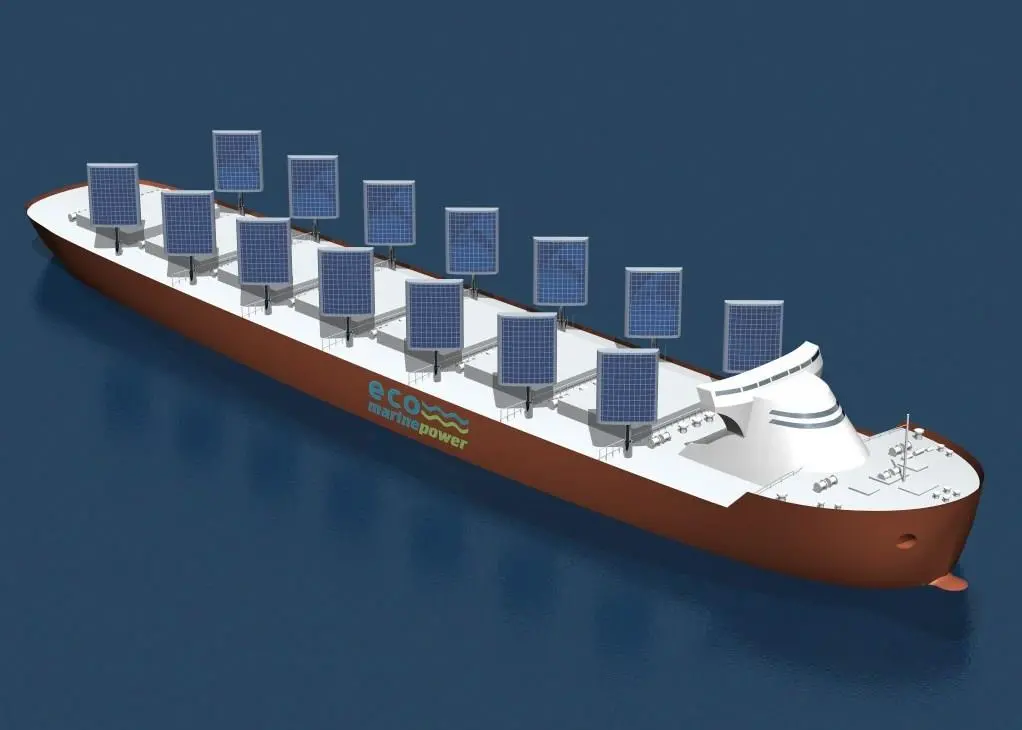
Known as the ‘Aquarius Eco Ship’, the concept is the result of a comprehensive study project which focused on optimising the design of a large ocean going ship, such as a bulk carrier or oil tanker, to harness the power of the wind and sun by using the Aquarius MRE system. This system uses an array of rigid sails and solar panels to form a ship-based renewable energy system. On large ships up to 20 rigid sails could be installed, whereas on smaller vessels just one or two sails would be needed.
The MRE system is not intended to act as the ship’s primary source of propulsion. Instead, it is being designed to work alongside other technologies in order to reduce fuel consumption and harmful gas emissions. Depending on the number, size, shape and configuration of the rigid sails, the company estimates that the system should reduce a vessel’s annual fuel consumption by up to 20%. This is a conservative estimate which takes into account days when weather conditions are not favourable for using the system.
Rigid sails are not a new concept and designs vary widely but, for a variety of reasons, rigid sails have, to date, not gained widespread acceptance. Solar panels, on the other hand, have over recent years undergone significant advances and become lightweight, more efficient and suitable for the harsh marine environment. Already a number of commercial ocean-going ships have been fitted with solar panels such as NYK’s Auriga Leader and Nissan’s Nichioh Maru.
By offering an advanced integrated system that includes energy storage modules and a computer control system based on the KEI 3240 computer system developed by KEI System of Osaka, the array of rigid sails and solar panels on the Aquarius Eco Ship will be automatically positioned to best suit the prevailing weather conditions. They can be lowered and stored when not in use or in bad weather, and could even be used when a ship is at anchor or in harbour. The company says the MRE system will require little attention from the ship’s crew, will be relatively easy to install, will require little ongoing maintenance and offer an attractive return on investment for shipping companies and ship owners.
Wherever possible the materials used to build the rigid sails (known as EnergySails) and other system components will be recyclable. A rigid sail, for example, could be made out of marine grade aluminium or a carbon fibre composite material. The EnergySails will help move a ship by using the available wind, plus they may collect solar energy during the day if solar panels are mounted on the sails or elsewhere on the ship.
EMP claims that the system will significantly reduce a ship’s fuel consumption and noxious gas emissions. In addition, ship owners and operators will be able to reduce the CO2 footprint of their fleet and employ the solution on a variety of ship types. Although the system is being initially designed for large ships, much of the technology being developed will be suitable for smaller vessels such as coastal freighters and passenger ferries. A study is being conducted to determine if it would be feasible to use the system on naval and government vessel such as patrol ships.
The company adds that future Aquarius Eco Ships could incorporate other fuel saving measures such as an advanced electrical propulsion system, optimised hull design and waste heat recovery technologies. This combination of technologies could lead to fuel savings of 40% or more and reduce SOx and NOx emissions, while the use of renewable energy would reduce the vessel’s carbon footprint.
On a large bulk ore carrier the total installed solar power could be 500kW or more. However, as the cost of solar panels decreases and their efficiency increases, it may become feasible to expand the capacity of the installed solar power towards 1MW. An Aquarius Eco Ship could additionally be fitted with sufficient advanced energy storage modules, based on lithium-ion technology from Corvus Energy of Vancouver, so that it would not need to use auxiliary diesel generators in port. These energy storage modules could be charged via the solar panels or by the ship’s main generators.
EMP says it is seeking to work with a shipyard or shipping company and investment partners in order to further develop the Aquarius Eco Ship concept. It is anticipated that this work will lead to the development of further design concepts and patent applications, and building a commercial version of the system. The company says that a prototype version of the system is planned to be ready for testing sometime during 2012.
Related Articles
 PROPULSION
 GENERAL NEWS
 HYDROGEN