



De Hoop’s Esnaad evolution
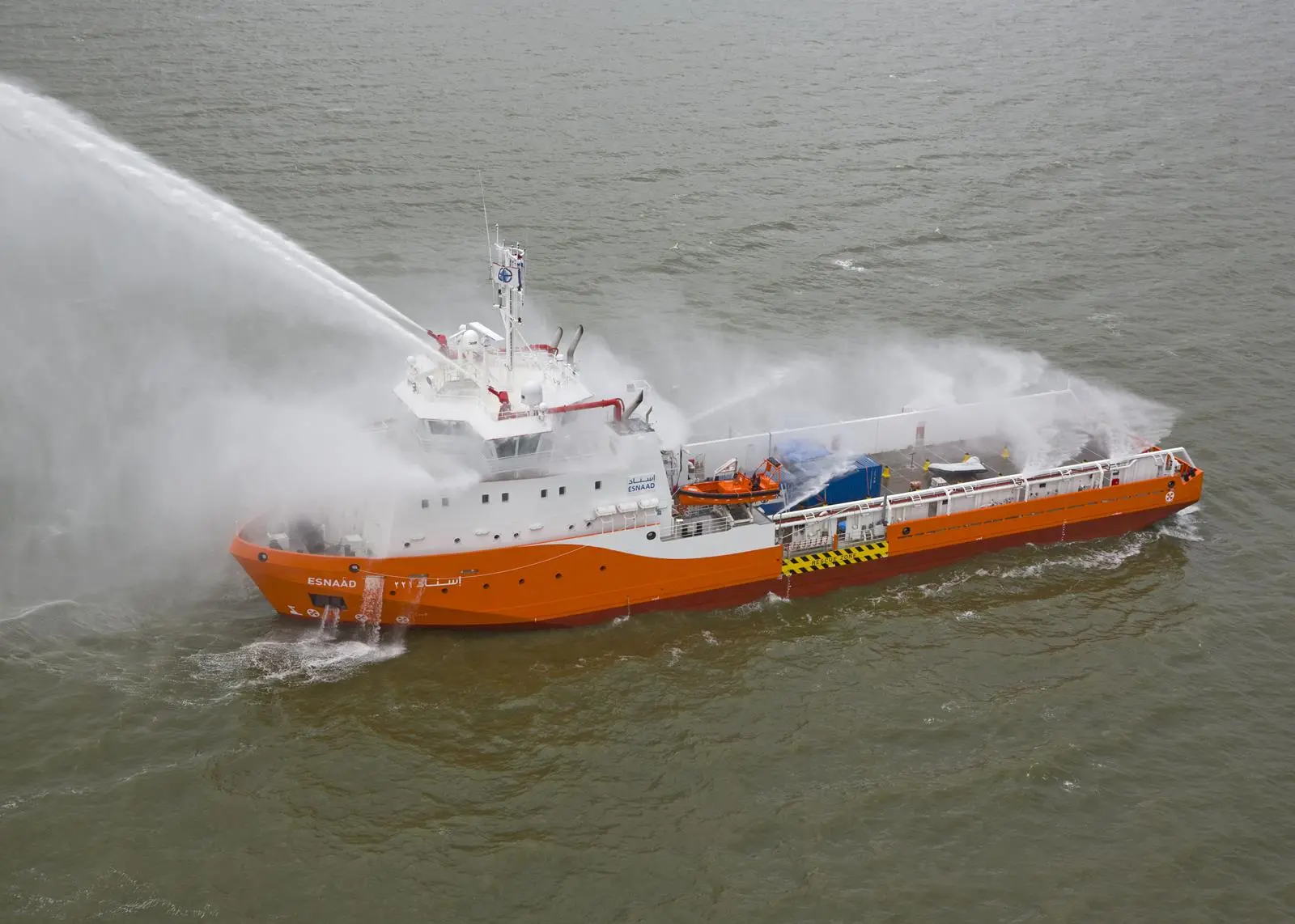
In 2013, Abu Dhabi National Oil Company (ADNOC) tendered for the design, build and delivery of ten platform supply vessels (PSVs). The contract was won by Dutch company Shipyard De Hoop, which delivered the first vessel in June. The remaining vessels – produced at De Hoop’s locations in Lobith and Foxhol – will be delivered in sequence until the last is handed over in 2017.
De Hoop says the new vessels – the Esnaad series – herald an evolution of its proven PSV designs. All ten vessels will be active in the United Arab Emirates, supporting ADNOC’s activities in national offshore oil and gas fields. As such they are designed to operate at maximum efficiency and optimised cost with minimum impact on the environment – in line with the UAE’s strict regulations -whilst at the same time avoiding harmful implications to people.
The Esnaad vessels are primarily designed for offshore supply purposes, but can also serve an array of other offshore support functions including stand-by and firefighting. Propulsion is provided by three tunnel bow and two azimuthing stern thrusters, allowing for high-accuracy station-keeping – and a transit speed of 13.5 knots – at the lowest possible power requirements. To further improve efficiency the hull is fitted with a unique bulbous bow, which sufficient width to hold the forward bow thruster.
ADNOC has chosen a diesel-electric propulsion configuration for the vessels. But in contrast to recent De Hoop PSVs, the generators are located below the main deck, underneath the front of the ship’s superstructure. This has allowed them to accommodate larger, medium-speed generators.
The three main generator sets – freshwater-cooled Wärtsilä diesels of 1,480kW each – offer a high level of redundancy. The power management system arranges equal load sharing and includes an optimal generators configuration for several usage scenarios – resulting in minimised NOx emissions whether at DP or in transit. A harbour generator set – a water-cooled MAN of 238kW is also included, as is an auxiliary generator (an air-cooled MAN of 250kW) in compliance with SOLAS and class requirements.
The propulsion system consists of two azimuthing Schottel thrusters in the stern, wth fixed-pitch propellers, and three Schottel bow thrusters. Stern thrusters are driven by freshwater cooled electro-motors of 1,250kW, while the transverse tunnel thrusters in the bow (used primarily during DP) are driven by electrical motors of 600kW. Speed control is by means of a variable frequency converter.
Electrical power distribution is split into three circuits to obtain the redundancy required for DP2 certification. The main distribution power is three phase 480VAC/60Hz, whilst all lighting and small consumers are on a 220VAC/60Hz circuit. For shore power use, cable connection facilities are provided.
Cargo volume has not suffered because of a sleek hull shape: the deadweight of 2,050 tonnes at a restricted draught of 4.85m is testament to the optimisation, thanks to high-capacity liquid cargo tanks positioned in the hull. Between the thrusters and the engine room are tanks for dry bulk, brine, fuel oil, drilling water and liquid mud (with agitators preventing separation). Tanks for fuel oil, fresh water, sewage, sludge and bilge water tanks are found in the fore ship, along with the foam and dispersant tanks needed for firefighting and oil spill recovery.
Deck cargo will be accommodated on a large 515m2 main deck, designed to withstand loads of up to five tonnes per square metre. The design permits the carrying of large quantities of various offshore requisites, and is also equipped with fittings and lashing points to accommodate containers. The main cargo deck also features integrated recesses in which struts can be affixed when transporting drill pipe casings as deck cargo. The casings will be stacked to starboard and portside in between the struts and the bulwark.
A tugger winch behind the superstructure at the starboard side assists crew to operate heavy towing gear and handle deck cargo or hoses. A quick release towing hook on centreline, for emergency towing purposes, is remotely controlled and can be released from the bridge with a push button. The towing hook has a safe working load of 50 tonnes. ESNAAD 221 is equipped with a Sormec offshore crane, braced into the bulkhead of the workshop. The TL-series crane features a fully hydraulic telescopic boom with a lift capacity of 15 tonnes at 2.5m, or 0.5 tonnes at 25m.
Two remotely controlled monitors on top deck aid external firefighting, with a self-protection deluge system fed with water from the dedicated Fi-Fi pumps as well as foam from integrated storage tanks. The PSV is also fitted with two six-metre spray booms for applying dispersant to the water surface in case of an oil spill.
The vessel also meets the low noise and vibration levels required by Lloyd’s Rules for Crew Accommodation Comfort (CAC), for which the PSV will be assigned CAC3 class notation. The superstructure offers accommodation for 28 people in six single-berth cabins on the C-deck and eleven two-berth cabins on the B-deck. A changing room, laundry/linen storage, hospital, fitness room, galley, freeze/cold provision stores, various offices and an Islamic prayer room are also housed in the superstructure. The combined mess and dayrooms are split into an officers area on portside and a crew area to starboard side.
The full width navigation bridge on the E-deck, with a 360-degree enhanced visibility, comprises an extensive package of nautical, navigation and communication equipment. The wheelhouse is separated into two effective bridges: the forward facing part for transit sailing, and the aft facing area from where DP operations can be controlled.
In between the accommodation ‘layers’ and the wheelhouse is the reduced-height D-deck, comprising a technical space, the air-treatment room and a sanitary space.
PRINCIPAL PARTICULARS – ESNAAD
Length oa: 70.40m
Beam 15.77m
Depth: 6.00m
Draught: 4.85m
Max speed: 13.5kn
Accommodation 28 persons
Deadweight: 2,050 tonnes
Deck area: 515m2
Related Articles
 PROPULSION
 GENERAL NEWS
 HYDROGEN