



Design modification offers increased Flettner fuel efficiencies
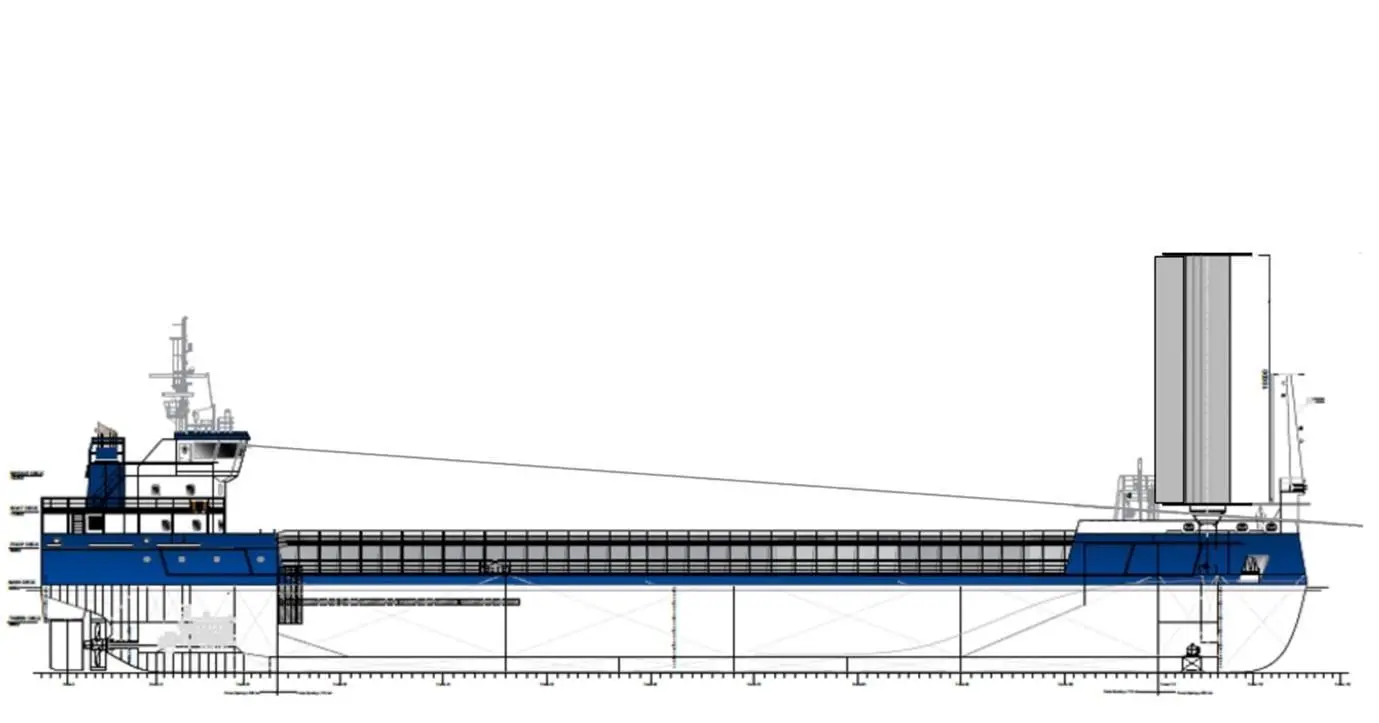
On behalf of the Technical University Delft (TU Delft) and the Sea Axe Fund, Blue Wasp Marine studied the effects of adding a flap to a Flettner rotor to a vessel’s performance and fuel consumption.
The modelling was intended to demonstrate the effectiveness of incorporating a flap to the rotor to fix the flow separation point, thereby altering the lift and drag forces created.
The modelling suggested that the modification of the rotor would result in improved performance, and would lower the fuel consumption and environmental emissions of the vessel significantly, compared with an unmodified Flettner Rotor.
“The fuel savings are increased from 6.8% to 9.2% when using 1 rotor (which is an increase of about 35%), or from 10% to 13.3% when using 2 rotors (which is an increase of about 33%),” a Blue Wasp Marine representative confirmed to The Motorship.
Controlling for reliability
To collect the required data on Flettner rotor aerodynamics, Blue Wasp conducted tests at the wind tunnel at the Politecnico de Milano in Italy. This information was then combined with the in-built force models of Blue Wasp’s proprietary Pelican software.
Next, Blue Wasp established a series of controls to ensure the accuracy of the experiment. Blue Wasp Marine used the Pelican software to model the impact of the design modification on a vessel fitted with a Flettner rotor sailing at the same speed, in the same conditions, on the same route.
The company selected to perform the study with a Damen Combi Freighter 5000. This 86 x 15.3 metre vessel serves as a good representative of its type and indicates the effects of the Flettner rotor and flap on a nearshore cargo vessel operating on a representative North Sea route, between Rotterdam, the Netherlands and Trondheim, Norway.
Factors included in the tests were the thrust of the Flettner rotor, wind, resistance in both waves and calm water and resistance resulting from leeway, heeling and rudder operation.
Improved upwind performance
The tests demonstrated that the addition of the flap delivered a significant increase in aerodynamic thrust, increasing the vessel’s operating profile. The vessel equipped with the Flettner rotor and flap has a tacking angle in the region of 15 degrees smaller than the one with only the rotor. This allows the vessel to sail significantly closer to the wind, vastly improving efficiency of performance upwind.
Though not a part of the study, the results also established that, in most positions, the flap’s decreases of lift and drag resulted in reduced downwash and less accelerated flow in the rotor wake. This results in a relatively smaller aerodynamic sideforce, requiring smaller heeling, leeway, and rudder angles to reach sailing equilibrium. This means that the vessel with the rotor and flap can operate at higher wind speeds.
Giovanni Bordogna, founding partner and aerodynamics specialist at Blue Wasp Marine, said, “These tests demonstrate the significant potential of wind-assisted propulsion to support the maritime industry meet the challenges it is currently facing. Our results demonstrate how a small adjustment to a Flettner rotor can have a big impact, making shipping operations considerably cleaner and more cost-effective.”
Related Articles
 ENERGY SAVING DEVICES
 ENERGY SAVING DEVICES
 AMMONIA