



Digital Twin Designed to Evaluate Multiple Energy Saving Technologies
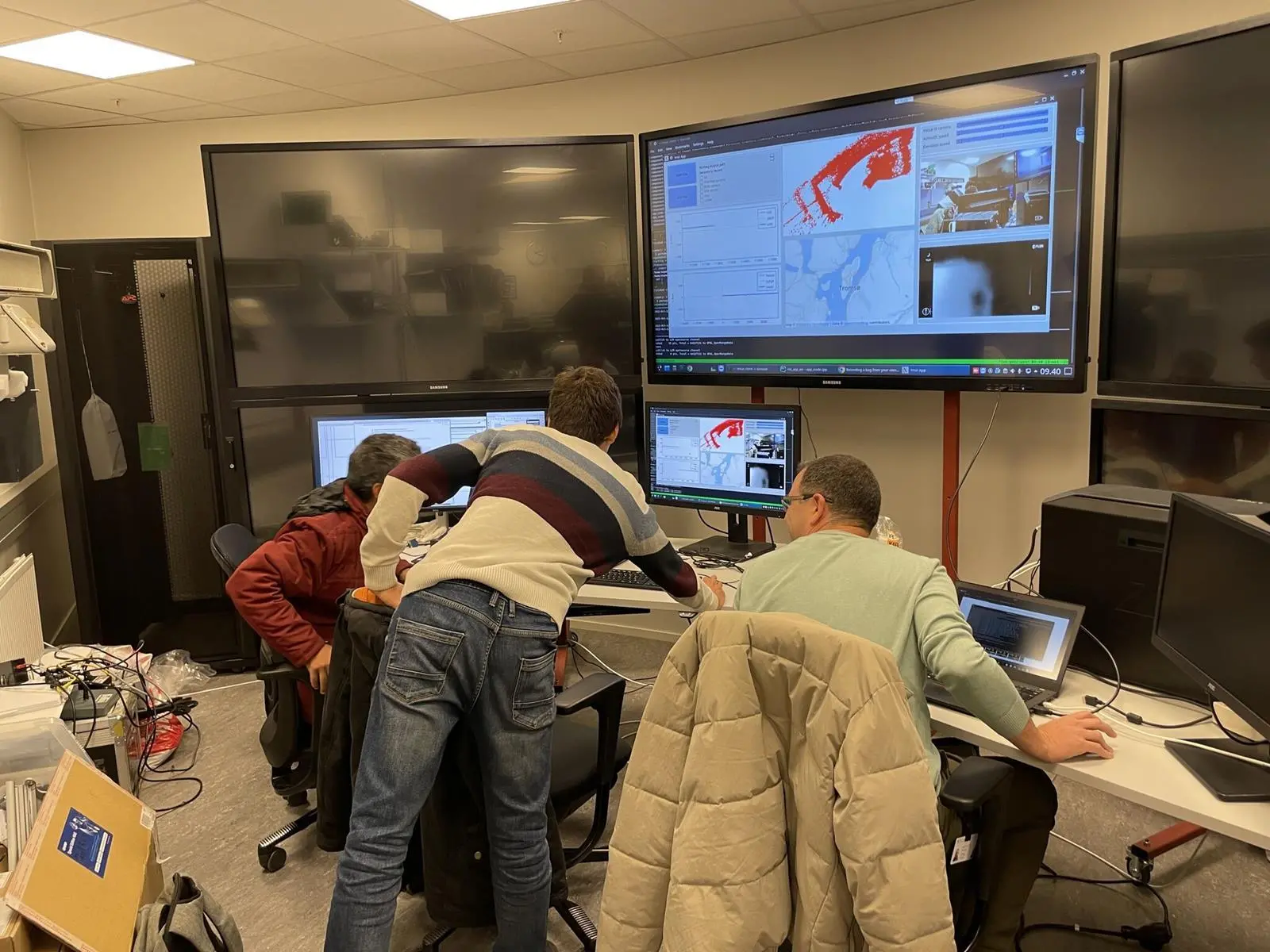
The EU-funded SeaTech project began in 2019 with the aim of combining bow-mounted foils with new, sophisticated control systems for a Wärtsilä dual-fuel 31 engine to allow the engine to work in tandem optimally with the foils.
The SeaTech engine is an ultra-high energy conversion, dual-fuel engine supported by a precisely controlled combustion process to reduce emissions. The propulsion innovation consists of a bow-mounted bio-mimetic dynamic wing capturing wave energy to create extra propulsion thrust. This reduces required engine power whilst also dampening undesirable ship motions such as rolling and pitching in high or moderate wave conditions.
The project is on-going and expected to lead to emissions reductions of 30% or more when using both the engine technology, running on LNG, and the dynamic wing. Part of the development work, along with engine and large-scale model testing, has involved the development of a digital twin and comprehensive data science environment that is being used to predict the performance of the systems and their lifecycle costs.
Key to that development was the desire to create something with the flexibility to evaluate other technologies in the future. The shipping industry needs energy efficiency and emission reduction technologies to achieve the ambitious emission reduction targets being set, and this means technologies that have been developed under experimental or laboratory conditions just like the SeaTech project, says Professor Lokukaluge Prasad Perera from the Arctic University of Norway.
“The digital twin framework that we are working on is open for integrating additional energy efficiency and emission reduction technologies into ocean-going vessels. It allows for the energy efficiency and emission reduction technologies that are under laboratory or model scale conditions to be integrated into a data science environment to quantify their performances. Therefore, shipowners can use it to decide which technologies can achieve the respective emission reduction targets. That way these technologies can come to the market sooner rather than later.”
Engine modelling
In the SeaTech project, the baseline for comparison is a diesel engine that is similar to the SeaTech engine. Both fuel consumption and emissions for a selected vessel with a diesel engine and a SeaTech engine with a dynamic wing are also considered for a life cycle cost analysis (LCCA) based on the data science established. The LCCA for the engine includes construction costs, operational and maintenance costs, and disposal costs. The respective fuel costs and possible costs due to emissions are also included in the LCCA.
“We have estimated that a 39% GHG emission reduction and up to a 22% fuel efficiency can be achieved under more optimal operational conditions by replacing LNG with diesel – this without considering the efficiency of the SeaTech engine, but just a dual-fuel engine,” says Perera. “Therefore, at the end of the project, I would assume we would achieve beyond 30% fuel reduction. This is not an unrealistic number since we are integrating two innovations, the SeaTech engine and the dynamic wing.”
The SeaTech project has developed several models for the project. “The models bring confidence to predict full-scale efficiencies, but that can be slightly higher in some situations. Therefore, we always conduct full-scale or large model-scale experiments to verify the model predictions. When it comes to LCCA, we are often deal with full-scale data, but when such data are not available, we are forced to use model-scale data. That is an acceptable approach in LCCA.”
Wave modelling
As the SeaTech project involves a wave harvesting device (the dynamic wing), it brings value when a vessel is navigating in wave fields to harvest energy. That means vessels with a dynamic wing should optimally navigate in relatively high sea states.
Part of the SeaTech research has included the development of suitable wave models, as ship length significantly influences the effectiveness of the wing in different operating conditions. The percentage foil retraction is also a significant factor in operating bow foils with a large variation depending on ship heading and encountered sea state. The researchers have therefore developed a holistic approach to evaluating route and ship specific energy savings.
Accurate assessment of wind, wave and current effects are critical to the process. Perera says that existing ship performance and navigation data sets have been collected by ocean going vessels but not necessarily utilised properly. Existing mathematical models are inadequate and cannot accommodate such data sets. Hence the need to develop a data science environment that can utilise all the required data sets and apply advanced data analytics such as digital twin concepts. This has enabled the researchers to begin quantifying technology performance in a way that can also be fed into the LCCA modelling.
Interaction modelling

The engine and foil interaction has also been a key part of model development. Because they interact, they should be studied in the same data science environment to achieve the desired accuracy for shipowners to base their decisions. The researchers have therefore combined analysis of realistic head wave conditions on both innovations within the one model framework.
The same thrust and ocean wave conditions have been applied to the engine and the wing and the data sets collected from the engine testing platform have been integrated with propellor characteristics and analysed using machine learning and artificial intelligence algorithms to develop the digital twin.
The digital twin has developed a hybrid engine-propeller combinator model using both theoretical calculations from hull design as well as data driven calculations from ship performance and navigation data sets to compare their performance in a single model framework. This has been used to establish the basis for identifying optimal vessel navigation and ship system operational conditions, in particular the various wave and thrust conditions that are optimal for a given test vessel.
Optimal wave conditions will vary depending on vessel size and length. Since ocean waves can consist of a mixture of different wave heights, lengths, and directions, the situation can be complicated, says Perera. “We have considered a mixture of such head waves, as a wave profile, for a selected ship by assuming it would encounter them throughout the engine’s lifetime (around 20 years). So based on such a wave profile, the engine operating conditions can be calculated and then emissions can be calculated.”
LCCA analysis
The LCCA analysis of the engine indicates that operation hours, engine loads and fuel costs are major contributing factors in determining operating costs and therefore influence the total life-cycle cost of the engine.
“Advanced data analytics and LCCA calculations complement to each other and include dynamic interactions involving uncertainty analysis of utilising new technologies,” says Perera. “This approach opens a path for integrating and evaluating energy efficient and emission reduction technologies in a data science environment. Appropriate technologies can be compared against their energy efficiency gains with respect to existing vessel technologies, especially in engine and propulsion systems.”
It is important to compare the total cost performance of the SeaTech engine with that of a diesel engine in a similar context (e.g., power output, engine speed and operational profile), says Perera, and that is a data-intensive process that is still on-going with more wave models being developed and assessed.
Market potential
“For the Seatech project, the underlying vision is that within five to eight years, it will be possible to bring to the market two symbiotic solutions that can make shipping radically greener in light of tightening regulations and initiatives,” says Perera. “The envisaged primary target market is short-sea shipping, followed by deep-sea vessels. Short-sea shipping plays a significant role for Europe, representing one third of intra-EU exchanges in terms of ton-kilometres. It is also a segment in which early innovation adopters are easier found than in the more conservative deep-sea market, which is at the same time subject to less strict emission regulations.
“Assuming only 10% of EU short-sea vessels would be retrofitted with SeaTech, this would result in CO2 savings of 32.5 million tons annually, which equals the emissions of 200,000 passenger cars per year,” says Perera. “It is expected that the SeaTech product will generate a cumulative net profit of EUR 820 million within five years after entering the market in 2025.”
Related Articles
 2-STROKE & 4-STROKE
 2-STROKE & 4-STROKE
 2-STROKE & 4-STROKE