



DIRECT DRIVE SYSTEM BRINGS NEW OPPORTUNITY FOR ELECTRIFICATION
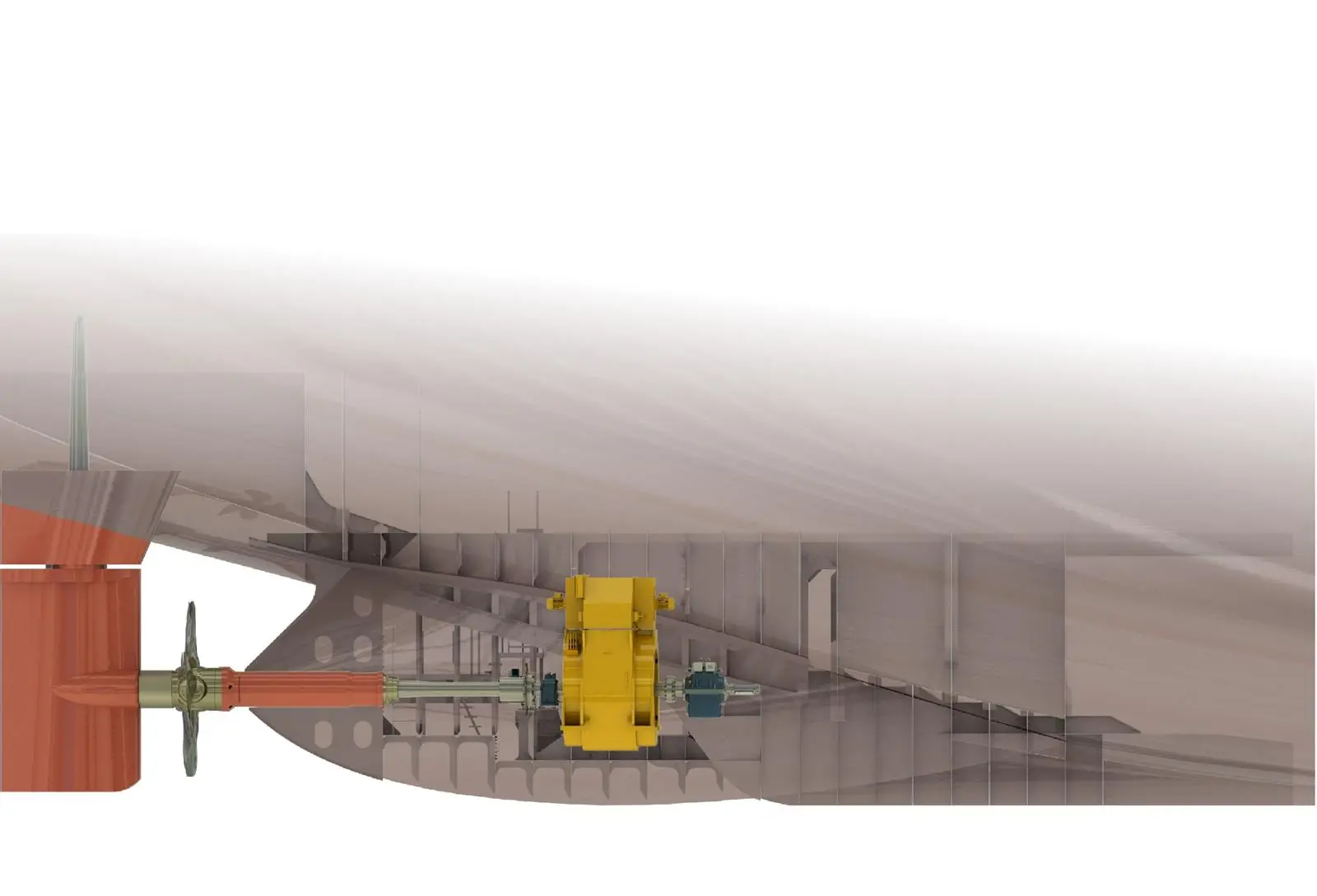
Shipping’s transition to electrification is well underway, but the new system brings an opportunity that many shipowners might not yet realise is possible, because the technology is an advance in efficiency and robustness beyond current expectations, says Jonas Nyberg, Managing Director West at Berg Propulsion. “This is something very new in the industry.”
A traditional approach to electric propulsion is to use an electric motor driving a gear box that in turn drives the propeller shaft. “In our solution, there is no gearbox. The electric motor is actually a part of the propeller shaft and drives the propeller directly, and this means we are eliminating a major component that impacts efficiency, reducing ancillary components and reducing maintenance requirements. It’s simpler, and at the same time you are getting a more robust arrangement.”
The direct drive system was developed by Berg Propulsion and The Switch jointly and uses already-proven permanent magnet motor technology which results in high efficiency, low electrical losses and allows full capability to vary rpm, torque and pitch. The unique feature of the patent-pending design is how the electric motor is integrated with the shaft. The typical arrangement has an electric motor driving a shaft with its own bearings. In this system the motor has no bearings of its own but rather relies on the ones in the shaft line eliminating the need for bearings in the motor together with inherent alignment and integration issues.
“There is no physical contact between the electric motor stator and the propeller shaft,” explains Nyberg. “Instead, the stator of the electric motor sits straight on the ship’s hull foundation with the rotor of the electric motor bolted onto the propeller shaft. There is only an air gap connecting the motor and the propeller shaft, so there’s no moving parts in this concept except the propeller shaft.”
Design advantages of direct drive system
Without a gear box, the shaft line can be shorter, fewer bearings are needed and engine room footprint is reduced. The system reduces energy loss with an extremely high torque capability allowing the use of much larger propeller diameters than is usually seen on this kind of installation, further increasing efficiency.
Removing the need for a gearbox reduces energy losses by around 1-2%, and the improved efficiency of the motor brings around 2-3% better fuel efficiency, says Nyberg. Add to that the benefits of being able to put a very large propeller onto the vessel and you will see aggregate gains of 10-30% over conventional or podded propulsion systems. “This is what is so brilliant about the concept,” he says. “You are eliminating complex components, making it simpler, and at the same time getting a more robust arrangement. There is no downside.”
With the industry-wide shift towards the electrification of ship power already underway, Nyberg says the system is ideal for integration into the new systems being formulated – incorporation of gas or dual fuel engines, use of new fuels, fuel cells and batteries. The concept works very well in the medium to high power range, he says, and Berg has already undertaken conceptual studies for icebreakers, offshore vessels, ferries, naval vessels and cargo ships.
“We believe that offshore vessel owners will find this solution very appealing, because it’s so robust, and this segment is already going electric to a very large extent,” says Nyberg. Ferries are also likely to be early adopters with many battery-electric newbuildings slated. Single screw cargo ships and bunker vessel are also likely candidates as environmental regulations drive the need to incorporate new low-carbon fuels. Additionally, other ships where high manoeuvrability or high redundancy is required will also benefit from electric propulsion.
Twin Fin concept
The direct drive system is used in Berg’s patented Twin Fin system. In this configuration, the propulsion train is housed in fins attached to the hull. Twin Fin was originally developed in partnership with Odense Maritime Technology and Scandinavian Marine Group as a solution to make vessels operating in polar regions less vulnerable to ice damage to the propulsion system.
The drive system is arranged so that it is fully protected within the compact, hydrodynamically-shaped fins which are custom-designed to optimise flow through the propellers to minimise fuel consumption and noise. Major transmission parts in the system are accessible from inside the vessel, enhancing ease of maintenance and averting unnecessary drydocking.
The fins offer additional protection from mechanical damage, and they can also be equipped with ice knives that prevent ice from hindering the propellers and affecting performance. With the fins positioned externally, they create buoyancy, and in some cases, this can add value to the vessel by increasing available cargo carrying capacity. Flap rudders are used to provide excellent manoeuvrability.
The system is tailor-made for each specific project, says Mattias Hansson, Global Account Manager at Berg Propulsion, and can also include tunnel thrusters, attached to the fins or to a central skeg running between the fins to support dynamic positioning. The system suits a wide range of operational profiles including offshore supply, ice-class operation, seismic survey and cruising. Advanced modelling and simulation techniques ensure the tailor-made solution is optimised for the vessel’s requirements and operational profile.
Twin Fin references
The Twin Fin direct electric drive propulsion system has been chosen by Canadian shipowner CSL for a large bulk carrier under construction in China. The newbuild 26,000dwt SUL (Self Un Loader) bulker, expected to be commissioned at the end of this year, will have a service speed of 12-14 knots and will operate with a high degree of flexibility, making electric propulsion ideal. The vessel’s four variable diesel-electric MaK gensets, having a combined total power of 9.5MW, will have two fully-feathering controllable-pitch propellers. Each shaft will be powered by Berg’s direct drive system, in this case a 3MW permanent magnet electric motor without a gearbox.
The project comes after over 60,000 hours of trouble-free operation of a Twin Fin system for shipowner Polarcus. The 2014 retrofit of a similar Twin Fin system on the seismic research vessel Polarcus Nadia has proven to be an excellent reference for Berg Propulsion, with the vessel achieving fuel efficiency gains of 27% compared to the previously installed thruster-based system. With operating costs of US$200,000 per day, downtime was a problem for the vessels that normally spend 85% of their lifetime at sea, often in remote locations.
In this case, it was possible to retrofit the Twin Fin installation and the vessel’s existing gensets could continue to be used, and the new system provided additional reliability, improved fuel efficiency and increased bollard pull thrust. The retrofit had a payback period of less than three years, says Hansson. The vessels’ performance has increased significantly, and no wear has been recorded so far.
Berg Propulsion’s design work is all undertaken in Sweden, and last year the company moved all its manufacturing capability there as well, including construction of controllable pitch propellers, azimuthing and transverse thrusters and associated power management and control systems. The company offers a range of components and services, and its designers work with sub-contractors and integrators to meet any requirements that shipowners have for specific products, ship designers or shipyards. The company takes a whole-of-ship view, where every interconnecting factor that can impact on vessel dynamics including hydrodynamics, marine rotordynamics (axial, lateral and torsional vibrations) and structural vibrations are subject to rigorous analysis.
Hansson says Berg Propulsion will lead the way in ensuring that vessels are prepared for shipping’s electric future. He notes that the Twin Fin solution can be combined with batteries, hydrogen fuel cells, gas-electric or diesel-electric gensets. “We evaluate different concepts and present all the pros and cons openly to our clients. We make recommendations and then the iterative optimisation process starts, using advanced calculations and simulations, until we reach peak efficiency.”
Nyberg adds: “We believe it’s very important to be involved early in the vessel design process as the biggest advances when it comes to efficiency can be made in the conceptual phase.” This follows some of the latest trends in the industry and the shift towards looking more and more towards a wholistic design of vessels rather than a collection of subsystems. “We have the experience to achieve the best efficiency gains from these solutions, as we understand the propulsion technology as well as the electrical systems. This is critical, and as a result we have delivered remarkable solutions in terms of efficiency and cost of ownership.”
Related Articles
 INTERVIEWS
 CONVENTIONAL FUELS & OILS
 GENERAL NEWS