



DSICs first dual-fuel VLCC on track for delivery by year-end
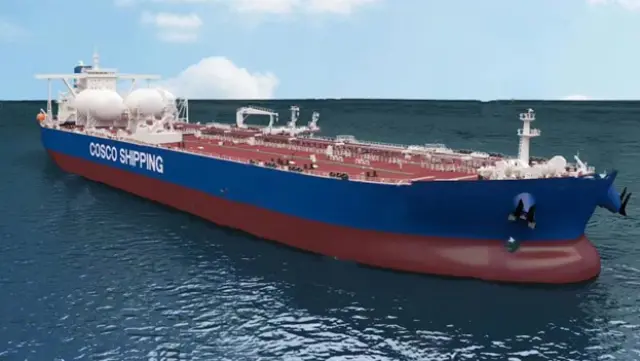
Scheduled for delivery this year by Dalian Shipbuilding Industry Co (DSIC), a 319,000dwt crude carrier incorporating dual-fuel main and auxiliary machinery is a milestone for China’s maritime interests as a whole, embracing not only ship production and shipping, but also design and engineering.
Ordered by COSCO Energy Transportation (CSET) as part of a four-ship programme at DSIC employing diesel propulsion, the tanker’s specification was subsequently upgraded to an LNG-fuelled capability at an additional cost of US$6 million.
The project involves a Chinese-developed fuel gas supply system and low-pressure, dual-fuel two-stroke propulsion engine technology from Chinese-owned Winterthur Gas & Diesel (WinGD) of Switzerland. The re-specification also introduced three dual-fuel generator sets and two low-pressure dual-fuel boilers.
The new ship provides the first VLCC reference for the X82DF-1.0 engine, which was conceived by WinGD primarily as a main mover for the largest tankers, ore carriers and Panamax container vessels. The seven-cylinder model chosen for CSET’s prospective fleet addition has a top rating point of 30,240kW at 84rpm, although the design offers a power diagram that affords a high degree of flexibility as to contracted MCR, down to the R4 rating of 17,430kW at 65rpm. The Motorship reported on the engine’s successful type approval test in May.
The dual-fuel engine follows the Otto cycle combustion principle. In gas mode, the X82DF-1.0 is IMO Tier III compliant without the need for exhaust gas aftertreatment. Due to the comparatively small amount of pilot oil fuel required, stated as less than 0.5% at 75% load, the engine achieves minimal SOx and particulate matter emissions. It is claimed that the vessel will be the first VLCC to fully meet EEDI Phase III requirements, such is the calculated reduction in CO2.
LNG will be the ship’s primary fuel and the 7,000m3 storage volume will ensure that the vessel can make a complete round-trip between China and the Middle East steaming wholly on LNG.
The two 3,500m3 Type C LNG fuel tanks are located on the weather deck, just forward of the aft superstructure, minimising the impact on the ship’s layout and cargo capacity within the given hull envelope. The storage tanks have been fabricated from 9% nickel steel. LGM Engineering manufactured the fuel gas supply system, the largest such system commissioned to date from the Chinese company.
Constructed to criteria laid down by China Classification Society (CCS), the new tanker builds on the LNG-fuelled VLCC design for which DSIC obtained approval in principle (AiP) from DNV back in 2015. The AiP recognised that the design allied with DNV’s gas-fuelled notation and with the then recently adopted IGF Code.
Related Articles
 PROPULSION
 GENERAL NEWS
 HYDROGEN