



Efficient Seahorse design enters UK bulker fleet
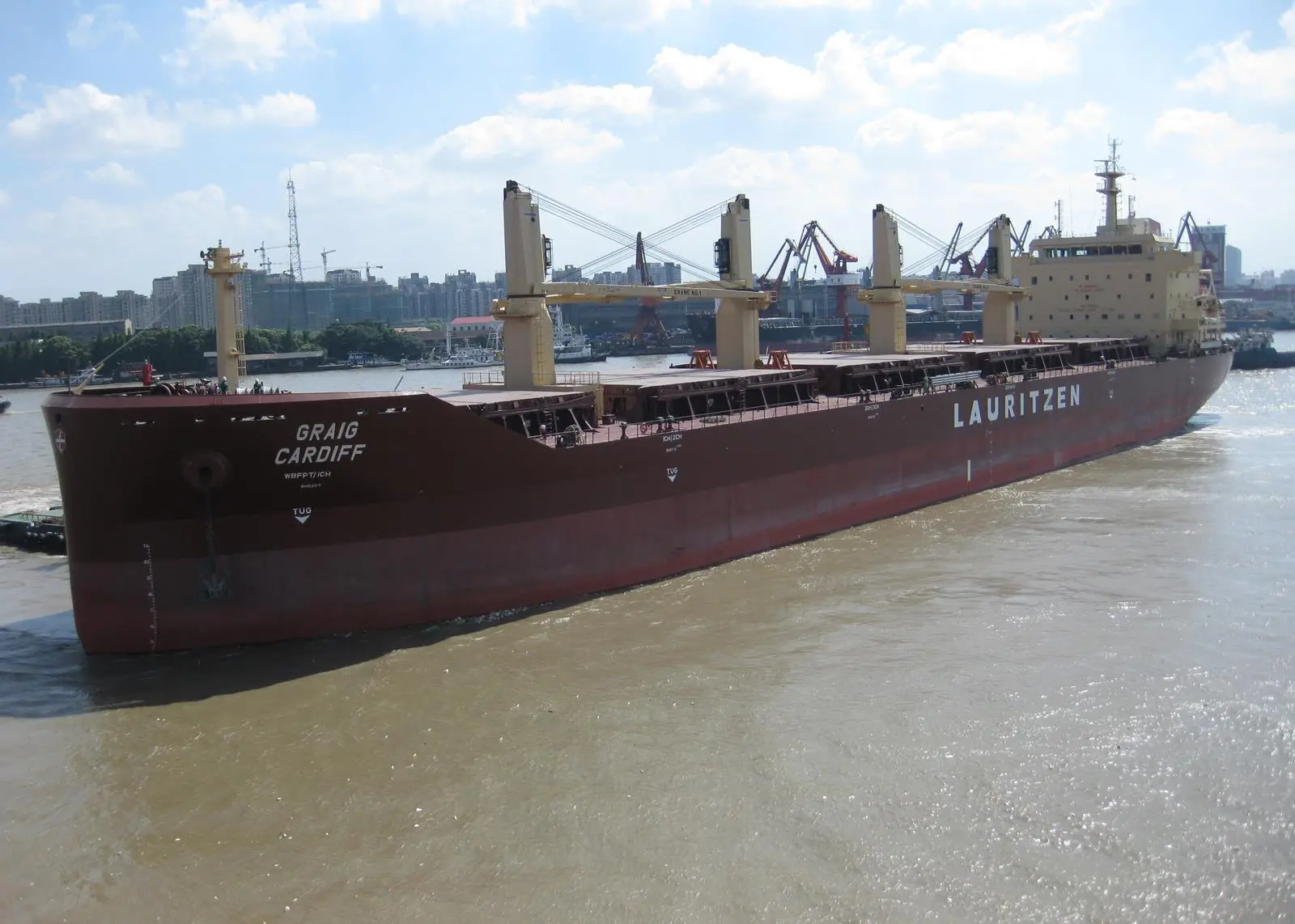
The Cardiff-based Graig Group has realised the first phase in a strategy of phased reinvestment in shipowning through the commissioning of an energy-efficient ‘maid-of-all-work’ for the bulk commodity trades. The 35,000dwt geared handysize carrier Graig Cardiff encapsulates the successful, Danish-conceived Seahorse 35 design, distinguished by a vertical stem with no bulbous bow.
Early vindication of the latest ship’s marriage of attractive properties relating to payload intake, fuel consumption, and cargo flexibility is implicit in the UK flag vessel’s entry into the Lauritzen Bulkers pool. Sister newbuild Graig Rotterdam, due for handover later this year, is destined for the same pool, which has particular strengths in geared, grab-fitted handysize and handymax tonnage. Following delivery from Jiangdong Shipyard at Wuhu, on the Yangtze, Graig Cardiff sailed north from Shanghai to Jinzhou to take on a cargo of bulk granular urea for discharge in Argentina.
The entire focus in the project, employing the design developed by Grontmij(formerly Grontmij Carl Bro) and specific elements and arrangements selected by Graig, has been to provide tonnage that will deliver value for money in the charter market. Grontmij is a participant in the Green Ship of the Future programme, a Danish pan-maritime industry initiative aimed at formulating strategies and systems to reduce vessel exhaust emissions and improve energy efficiency, and the Seahorse 35 design has served as a developmental platform in various concept studies.
Graig has considerable experience and current commitments in supervising construction of vessels in China, mainly for other owners, and this resource has been applied in the case of the Graig Cardiff and Graig Rotterdam through the Shanghai office of Graig China. Technical management for Graig Cardiff and her future consort will be provided from the UK group’s Cardiff base. Full Chinese crew have been assigned to both ships, drawing on the manning and management framework already used to effect for the various Chinese-owned vessels husbanded by Graig.
The group’s investment in bulkship technology in recent years has been expressed in the development of successful Diamond-class handymax and handysize designs, while operational and technical skills in the sector have been increasingly applied and honed through management and superintendency contracts. The company took delivery of a Diamond 53-class bulker, Graiglas, from the Nam Trieu yard in Vietnam during 2007, but the vessel was subsequently sold to Norwegian interests, such that Graig Cardiff signals a return to bulker ownership.
The Seahorse 35 type has been very well received by owners and yards, and is the subject of ongoing design optimisation. The first representative was contracted in China by Danish interests in 2008, and the tally of ships in service and on order reached 41 by August 2012, including three awarded within the previous month, and involving nine different Chinese yards.
Graig Cardiff has five double-skinned holds, without exposed framing on the sides and without conventional hopper tank tops. The spaces are accessed through wide hatchways and plumbed by centreline deck cranes. The cargo list is extensive and includes coal, grain, iron ore, cement, alumina, bauxite, mineral sand, salt, steel coils, packaged timber, fertiliser, scrap, direct reduced iron, seed cake, ammonium nitrate, sulphur and saltpetre. Lashing points in the holds are located on the longitudinal bulkheads, and maximum tank top loading is 22t/m². Payload possibilities are enhanced by the provisions for securing cargo on the hatch covers.
Self-sufficiency in cargo handling is considered essential by most operators in the handysize field, such that the Seahorse 35 type has four 30t wire-luffing MacGregor cranes with a maximum outreach of 25m. The ship carries her own set of 12m³ Peiner remote-controlled grabs, stowed on cross decks between the hatches. The MacGregor hatchcovers are of end-folding, hydraulically-actuated type, incorporating grain/cement feeder openings.
While the sides of the holds are flush, in the interests of cargo handling and cleaning, the transverse bulkheads are corrugated in conventional manner, resulting in a somewhat higher cubic measurement than would have been obtained with smooth-faced transverse subdivisions. Overall capacity is 46,762m³ grain-equivalent and 46,683m³ bale, wherein the highest individual intakes are provided in the identical No2, 3 and 4 holds.
Effective and expeditious hold cleaning and preparation is an essential requirement for such vessels that have to frequently switch between disparate and often dirty types of bulk cargo. Graig Cardiff uses two portable washing machines, and fixed outlets for water and air are arranged in each hold at tanktop level. By using the return line serving each hold, a portable pneumatic pump can transfer wash water to a pair of dedicated holding tanks in the upper wing spaces for temporary storage and later discharge ashore. This facility allows cargo hold cleaning to proceed in environmentally sensitive and restricted areas.
The fire main line, hydraulic and freshwater piping, and electric cabling are accommodated in a pipe duct in the upper wing tanks, affording protection from ‘green water’ and cargo handling damage, reducing maintenance, and providing a passageway fore-and-aft.
The Seahorse 35-type has a comparatively shallow laden draught so as to maximise cargo intake at restricted ports and terminals. The barge like-bow with its straight stem is a designer’s measure to improve overall fuel efficiency in the bulker trades against the backcloth of the generally lower service speeds that have come to be adopted by the industry. From a fuel consumption perspective, it is claimed to be especially effective in adverse weather conditions. By bulker standards, the after body is slender, contributing to optimal hydrodynamic performance in conjunction with a high efficiency propeller.
Graig Cardiff is installed with an STX Dalian-produced, MAN five-cylinder S50MC-C engine in its C8 version, substantially derated to a specified maximum continuous rating (SMCR) of 6,900kW at approximately 110rpm. With a normal continuous rating (NCR) of 6,000kW, some 87% of the SMCR, the ship offers a service speed of 14 knots when ‘full and down‘, and 15 knots in ballast.
Main engine fuel consumption is anticipated by Graig at 25.5t/day, an experience-based assessment of the likely performance in consideration of the power/consumption graphs. The overall fuel burn by the auxiliaries across the operating profile is estimated at about 2t/day.
The three gensets are based on Anqing-produced Daihatsu 5DK-20e diesels of 660kW in an installation featuring the use of waste heat recovery (WHR) technology. Two of the auxiliaries are served by a combined WHR unit of 2 x 150kg/h capacity. The system obviates the need to flash-up the boiler when steaming at slower speeds, when insufficient heat is available from the main engine exhaust stream.
With the combined WHR design, the exhaust gas boiler remains warm at all times, ensuring fast availability of steam and the avoidance of corrosion from the water side due to cold water with a high oxygen content. It also offers advantages in terms of reduced space requirement, cost and maintenance. Both the WHR unit and the boiler, which has a capacity of 800kg/hr at 87% main engine MCR and employs a rotary cup burner, were supplied by the German company Saacke.
Optimisation of auxiliary systems is indeed a worthwhile goal in the bid for enhanced ship energy efficiency given the several, continuously running electrical consumers on board a bulk carrier, including the seawater cooling system. An important measure taken with Graig’s new vessels has been the adoption of frequency-controlled seawater cooling pumps, reckoned to reduce motor power requirement by as much as 70-80%. In the Desmi equipment used, a frequency converter adjusts the flow of the pump to the actual needs of the system.
Naval architect Michael Schmidt, who headed the Grontmij Carl Bro design team that prepared the Seahorse 35 type in 2007-2008, founded his own company, Schmidt Maritime, in 2009. Schmidt Maritime and Grontmij have a cooperation agreement on bulker design development, and are working together on the further development of the Seahorse 35 concept so as to meet evolving market demands. Key targets are substantial reductions in fuel oil consumption and Energy Efficiency Design Index (EEDI).
PRINCIPAL PARTICULARS—Graig Cardiff
Length oa 180.0m
Breadth 30.0m
Depth 14.7m
Draught, scantling 10.1m
Corresponding deadweight 34,827dwt
Gross tonnage 24,386gt
Net tonnage 11,521t
Holds 5
Hold capacity (grain) 46,762m³
Hold capacity (bale) 45,683m³
Stowage factor 50ft3/t
Cranes 4 x 30t
Main engine MAN 5S50MC-C
Main engine – specified MCR 6,900kW @ 110rpm
Main engine – NCR 6,000kW
Service speed, laden, at NCR, 15% sea margin 14.0 knots
Main engine fuel consumption at 14 knots 25.5t/day
Auxiliary engine consumption 2t/day
Classification society DNV
Flag UK
DNV Class Notations – Graig Cardiff
1A1 Main class rules for hull, machinery, installations and equipment
BC ESP Bulk carrier—enhanced survey programme
ES (D) Enhanced strength, double side skin bulk carrier
CSR Common structural rules
BC-A Bulk carrier with cargo density >1.0t/m³ and alternate hold loading
DG-B Suitable for carrying dangerous goods in solid bulk cargoes
E0 Ship operation with periodically unattended machinery space
Fuel (380cSt, 991kg/m³, -15°C)
BWM-E(s,f) Ballast water management based on ballast water exchange system
HA(+) Hatches strengthened for heavy cargo
Grab(20) Holds designed for loading/unloading using grabs with a maximum weight of 20t
Coat-PSPC(B) Corrosion protection of tanks/spaces
BIS In-water survey of ship’s bottom and related items
Holds(2,4) may be empty
TMON Tailshaft monitoring
Related Articles
 PROPULSION
 GENERAL NEWS
 HYDROGEN