



Emissions limits drive search for cleaner fuels
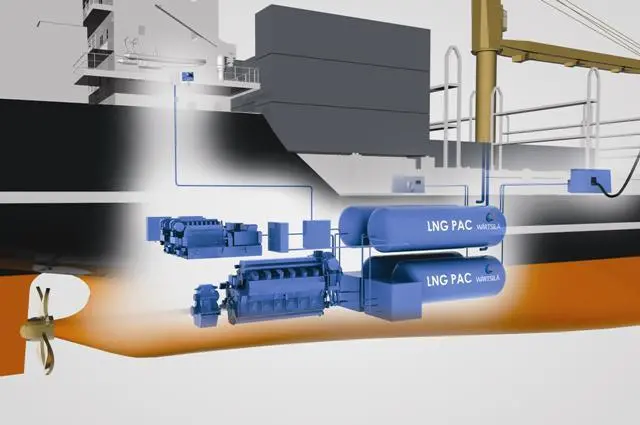
The need to transport natural gas many miles, from the gas fields to where it is needed across the globe, means that modern, large, LNG ships are probably one of the industry’s strongest sectors. Traditionally powered by steam turbines fuelled by boil-off gas from the cargo, the later generations of vessels have been turning to dual fuel gas-diesel engines. Based mainly on medium speed diesels, these engines have proved successful, to the extent that smaller versions have been introduced to the market for other types of vessel able to operate where the refuelling infrastructure exists, such as tugs, coastal ferries, and offshore support ships.
Wärtsilä’s dual-fuel version of its smallest medium speed unit, the 20, is typical of this approach. The company says that it offers ship owners and operators a compact unit that brings fuel flexibility to auxiliary applications, such as generating sets, or as the prime mover in smaller vessels. Like the 32DF and 50DF, the 20DF can run on natural gas, marine diesel oil (MDO), HFO and bio fuels, thereby providing maximum flexibility in fuel choice.
The company claims that when a DF engine is running in gas mode, CO2 emissions are about 20% lower since natural gas has a lower carbon content than liquid fuels. The lean-burn combustion process employed means that NOx emissions are reduced by some 80%, while SOx emissions are completely eliminated as natural gas does not contain any sulphur. Particulate matter is negligible as natural gas has virtually no residuals.
Wartsila says that its lean-burn combustion technology results in low emission values and high engine efficiency. Combustion of a lean air-gas mixture is initiated by injecting a very small amount of MDO as pilot fuel. A dedicated electronic control system ensures operation at the correct air-fuel ratio, and the correct amount and timing of pilot fuel in each cylinder.
Fuel cells
2009 will go down as the year in which fuel cells onboard ships became a reality. With the first installation, the Eidesvig offshore ship Viking Lady, due to be publicly unveiled at COP15, more details will have to wait until a later issue.
Renewables
Various alternatives to conventional fuels came into the news in 2009; biofuels were once considered outside the scope of ship fuel, but are currently being looked at rather more seriously. Wartsila has considerable experience with biofuels in power generation, and has been undertaking a wide-ranging programme of research into oils made from the jatropha plant – a high-energy non-edible fruit which can be grown in near-desert conditions as well as by-products of fish and chicken processing; all of these oils have shown themselves suitable for engine use.
Although not a fuel as such, the wind can provide propulsion energy to supplement conventional fuel. German company SkySails is probably the most advanced of several looking into once again harnessing the wind for ship power. Its kite-based wind assistance system has been tested in several installations, mostly with encouraging results, with most of the recent developments concentrating on the computerised control and launching system, integrating the deck components into a single unit.
Skysails freely admits that the system is not suitable for all ship types or all routes, but for vessels regularly travelling routes with a favourable profile of prevailing winds, potential fuel savings have been proved to be significant.
Lubes
The switch to low-sulphur fuels is putting higher pressure on lubricant suppliers. Castrol has recognised that there is a widening skills gap onboard current vessels which could lead to problems in selecting the correct lubricants, and launched a training aid programme, Castrol Academy, designed to be used onboard or by companies’ own training establishments. The system comprises a number of modules covering basic marine engineering as well as specific lubrication courses.
ExxonMobil, meanwhile, has launched a programme of seminars designed to help ship operators reduce overall lubricant costs and meet environmental challenges. The company also launched its DAC (detecting asphaltene contamination) oil analysis programme, which it says can prolong cylinder life and significantly save lubricant costs in four-stroke engines, in which residual fuel contamination is a problem that is growing with lower fuel quality and lower sulphur content.
Related Articles
 ALTERNATIVE FUELS & LUBRICANTS
 FUELS & LUBRICANTS