



Engine makers ready engines for the 4-stroke methanol market
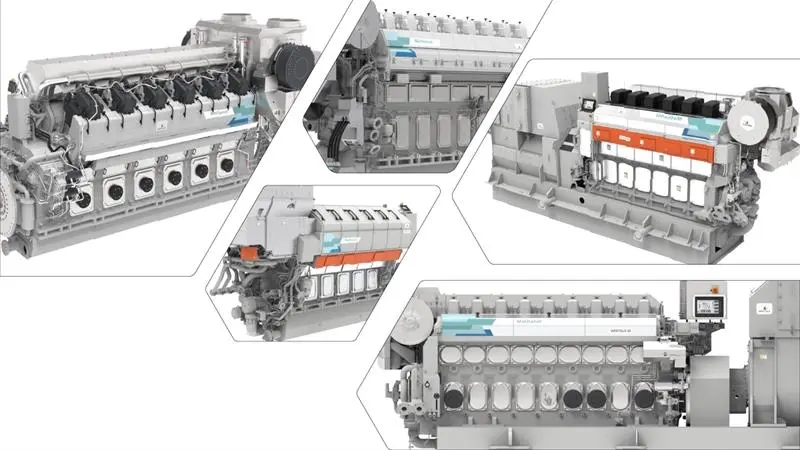
April will see MAN Energy Solutions fire up its 4-stroke seven-cylinder 51/60 test engine in Augsburg configured for methanol combustion. Type approval is expected in Q3 2025, followed shortly after by a first pilot installation, the details of which are being finalised.
As a retrofit, the MAN 51/60R-DF-M engine will have low-pressure, pre-mixed (Otto) combustion via the installation of a port fuel injection (PFI) system. This injection system is simpler and more robust than the high-pressure diesel direct injection based on diffusive (Diesel) combustion that will be used for new-built engines like the MAN L/V 32/44CR MeOH ready or the MAN 49/60. It will have an operating pressure of a maximum of 50 bar compared to 800-1,000 bar for the high-pressure injection.
The high-pressure technology, which will enable engine operating with highest methanol shares in all load ranges, will be introduced later to retrofits. For now, the methanol retrofit kit for the 48/60 engine will involve conversion to a well-proven 51/60 engine type including an optimized combustion chamber (cylinder head, liner and piston) and a methanol map ranging from 25% to 85% with less than 3% diesel, making it comparable in performance to other MAN dual-fuel engines. Beyond 85% engine load, the percentage of diesel will be higher, possibly up to 50%.
Bernd Siebert, Head of Retrofit & Upgrades at MAN PrimeServ in Germany, says the retrofit requirements will involve new components throughout the engine, with mainly just the engine block and crankshaft remaining as original. This is partly due to the bore change but also because of changes required to the injection system, turbocharger, air cooler and automation system to ensure a safe and optimized methanol operation. “It is a big investment, and the overall investment for the vessel is even higher with tanks, fuel supply system and piping. But finally our customers will get back an like-new engine after the methanol conversion contributing to decarbonize the maritime industry.”
Siebert highlights that MAN is working with industry partners, including shipyards and class, to streamline retrofits as much as possible while still meeting the high safety requirements required to protect people and assets. “The target for retrofits is to spend as little time as possible in drydocking. The vessel modifications can be undertaken even if methanol is not yet available, and we have packages with all the technical specifications needed ready to hand over to customers today.” He urges shipowners not to wait too long as resources for engine builders and shipyards are limited given the high demand from shipowners taking action on CII requirements.
For engines more than 15 years old, it may not end up being an economical retrofit, and Siebert suggests that MAN’s diesel efficiency kits like the latest Lifecycle Upgrade retrofit product are another option for meeting CII requirements as they reduce fuel consumption and emissions by around 10-12%.
For newbuilds, MAN is currently concentrating on 4-stroke methanol-ready engines, including for the 175D and 49/60DF, with the newbuild engines expected to be available by 2027.
Expanded portfolio
Wärtsilä will introduce another four methanol engines to its portfolio this year: Wärtsilä 20, Wärtsilä 31, Wärtsilä 46F and Wärtsilä 46TS. This is in addition to the Wärtsilä 32 methanol engine already launched. The company is also developing the corresponding methanol retrofit capabilities, including for the Wärtsilä 31, Wärtsilä 32, Wärtsilä 46F, Wärtsilä 46TS and Wärtsilä ZA40S engines.
The Wärtsilä 20 engine range will cover a power range of approximately 1-2MW and is expected to be available for genset applications late 2024. It will feature low-pressure (30-40 bar) PFI for the methanol fuel. While low pressure means the methanol/diesel share is lower than the higher pressure injection used in larger engines, maintenance time is expected to be the same as if the engine was running on gas or distillate fuels. Product manager Johan Kålax says the choice of PFI was a trade-off between lower installation and operating costs and performance. Regarding engine price, he says: “You don’t see a big difference between, for instance, a dual-fuel gas engine and this methanol engine, but the big difference is outside the engine where we are talking about maybe up to 40% lower initial cost for building the whole installation setup.”
The Wärtsilä 31 Methanol engine range builds on the highly efficient 31 technology introduced in 2015. The power range will be 5-10MW per engine. It will be available for delivery as a genset or main engine in Q1 2027, but the methanol-ready solution is already available, and due to the modular design, upgrade to methanol operation will be streamlined. Although it is a second engine in the same medium bore engine space as the Wärtsilä 32, it will be offered with more and different cylinder variants and in a higher power range.
The Wärtsilä 46TS is the company’s newest engine range, providing power in the large bore 7-22MW range and suitable for a wide range of propulsion and vessel types. It will be the first platform to have the new high-pressure, multi-fuel injection system that is expected to bring power density equivalent to a diesel engine and able to handle a methanol share of above 95%. Due to its modular design, the 46TS will be suitable for conversion from diesel or gas to methanol, says Federico Bottos, Wärtsilä 46F product manager. “The 46TS was built with modularity in its roots.” A pure diesel version of the engine will also be launched this year.
The Wärtsilä 46F Methanol engine range will also have a high-pressure injection system and efficiency equivalent to that of a diesel engine. This engine is adding the ability to run on HFO as well as methanol to the large bore portfolio and will be available for delivery from 2026.
Fuel storage
SRC introduced its Methanol Superstorage to market at the end of 2023. The storage increases fuel tank volume by over 85% while having little impact on general arrangement. The motivation comes as it takes around 2.5 times the methanol to achieve energy efficiency equivalent to HFO. A 16,500 TEU container ship – typically 366m long and 51m wide – would lose 300 TEU to provide the extra fuel storage needed to sustain conventional bunkering patterns, according to Alphaliner.
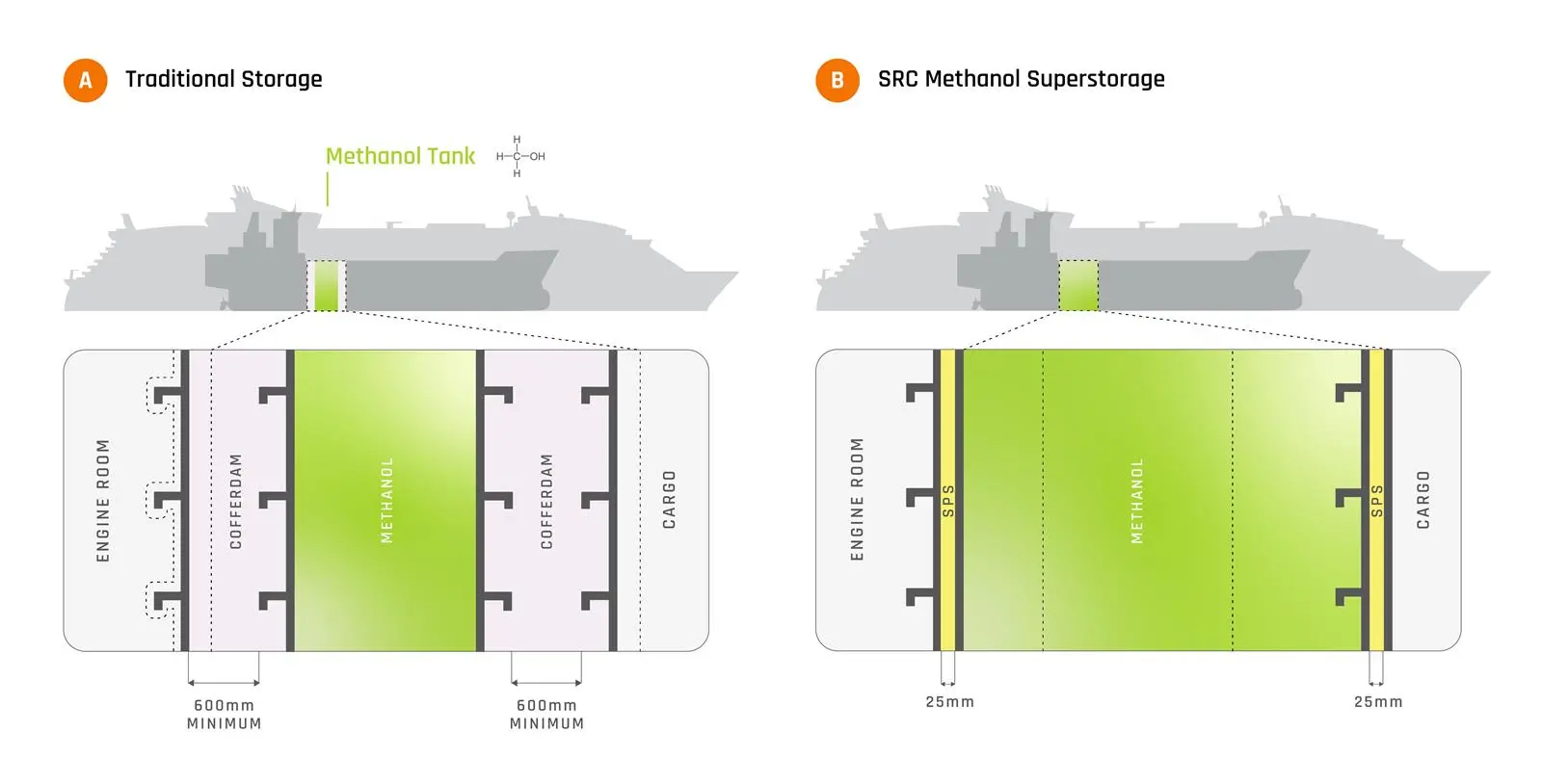
Tanks storing low flashpoint fuels on board ship conventionally requiring cofferdams of at least 600mm across to separate internal and external walls as a safety precaution. Instead, Methanol Superstorage features 25mm thick tank walls formed by sandwich panel system technology that consists of a continuous polymer core injected between two steel surfaces. The patent protected steel-polymer-steel barrier has been approved for permanent repairs by IACS class societies for over two decades, including for corrosion in ship structures. Class laboratory tests of the polymer core have verified chemical resistance – including for methanol.
Financial viability
The question of the financial viability of choosing methanol as a fuel has been evaluated in a new report from Lloyd’s Register (LR) which has found that the total cost of ownership (TCO) for passenger ships retrofitted with methanol dual-fuel engines to be more than double the cost of blended fuel (Blend B30), heavy fuel oil and HFO with onboard carbon capture and storage technologies (CCS).
Fuel for thought: Methanol for Passenger Ships examined the TCO for operators over a 15-year period and based results on a calculation that 65% of voyage time would be spent in EU waters.
For retrofits, the report states that “Costs include engine rebuild, piping, fuel system, tank coating, as well as design, planning and drydock costs. Indications suggest that engine and fuel system costs, which will be most of the overheads, could be in the range of 10% to 25% of a vessel’s value.” Also, the costs of rebuilding an engine need to be carefully evaluated given not all engines will have a test engine equivalent to ensure it meets emissions testing requirements under IMO regulations.
Overall findings identified in the report, based on analysis by the LR Business Advisory team, show the bunkering price of methanol to be the main commercial barrier for its adoption, with the use of less environmentally friendly fossil based (grey) methanol a more commercially attractive proposition for passenger shipowners than a blend of 50% grey, 25% bio- and 25% e-methanol, even when EU emissions taxes are taken into account.
However, the study highlights that methanol is a technically viable fuel for ship operators looking to reduce the carbon emissions of passenger ship newbuilds, owing to the similar characteristics of methanol to existing fuels. Viable retrofit paths have also been taken to the sector, such as the pioneer LR project for the Stena Germanica back in 2015. This technical viability is reflected in the global orderbook with passenger ships ranging from small inland vessels to the largest cruise ships awaiting delivery.
Related Articles
 2-STROKE & 4-STROKE
 2-STROKE & 4-STROKE
 2-STROKE & 4-STROKE