



Excursion vessel concept claims zero carbon emissions
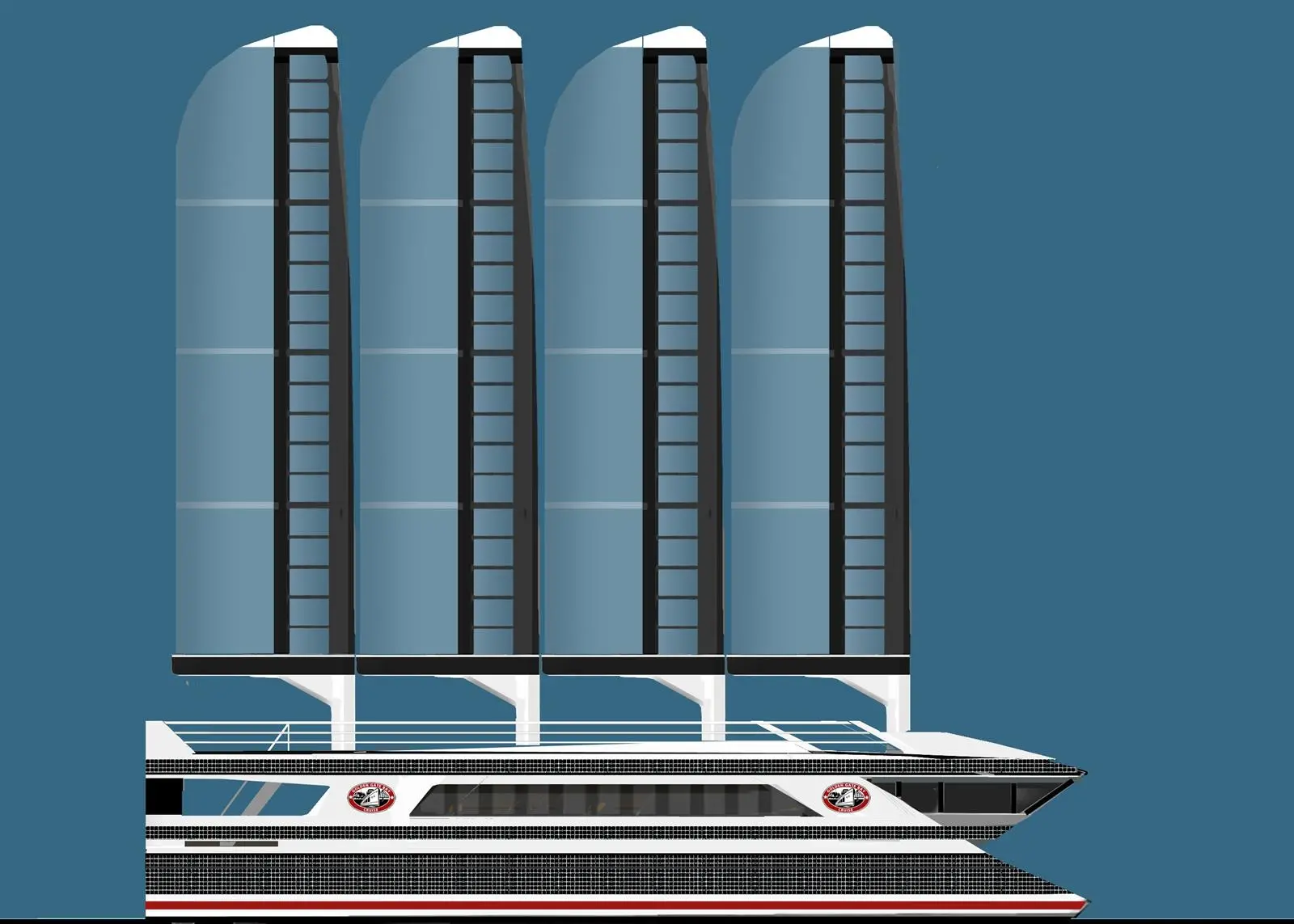
Company head Richard Sauter believes the 25m ship would provide “the ideal zero carbon viewing platform for the upcoming America’s Cup in the San Francisco Bay.” He commented: “Considering that the America’s Cup is founded on a carbon free maritime legacy, It’s only fitting that spectators viewing from day trip ferries should have the opportunity to revel in nature’s bounty as well”.
The vessel carries 149 passengers and operates with a crew of six. It harnesses energy from its 100kW exo-skeleton of photovoltaic cells and 30kW turbine propellers. This energy can be used immediately, returned to the grid, or stored in batteries. The ferry is powered by two hybrid 500hp Duramax V8 Eco Marine Propulsion motors, built to comply with EPA ‘on-highway’ regulations, which Sauter says qualifies them as the cleanest marine engines available. The motors are supplemented by automatic Dynawing sails, of 320m² area, which, in conjunction with the 5MW UPS, maintain a minimum cruising speed of 12 knots.
Sauter says that despite the advanced concept, the ship employs readily available technology that exists now in the maritime industry. Shipyards such as Bollinger, Kvichak and Austal posses the experience of building wavepiercing catamaran hulls in lightweight marine grade aluminium alloys, while high-efficiency counter-rotating propeller pods are supplied by ZF, CMD and Volvo Penta. Eco Marine Propulsion provides the hybrid power system, and the Dynawing mainsails that reduce energy consumption by some 20% are supplied by Carbon Works, Scaled Composites and Core Builders Composites.
The Solbian marine solar panels are rated up to 30% efficiency due to better cooling and the abundance of reflective magnified light at sea. They are strong, lightweight and flexible, and come with a 25 year SunPower warranty. Corvus, Rolls, Lifeline and others can supply the plug-in 500kW battery system.
Sauter believes that the design successfully assembles available technology that can deliver a 50% to 100% reduction in fuel consumption, which should more than cover the construction costs of the Greenline Ferry over its service life. At the maximum 14 knot speed, the ferry offers a 50% to 75% reduction in CO2 and fuel consumption, while cruising at 12 knots fuel and CO2 are lowered by 75% to 100%, with unlimited zero carbon cruising range at an average of 10 knots. Zero carbon operation on battery power provides a range of around 30 naut mile. The Greenline Ferry is a certified carbon offset project, with potential to achieve a 5,000 tonne reduction in GHG emissions over 10 years.
Related Articles
 PROPULSION
 GENERAL NEWS
 HYDROGEN