



Experience Builds Wind-Assist Technology Confidence

Global provider of mechanical sails Norsepower has continued to call for the publication of third party verified performance information to build confidence in the market for wind-assist technology. “Everyone knows wind is variable; you can never trust the wind to be consistent,” says Chief Sales Officer, Jukka Kuuskoski. But by publishing actual operational data demonstrating the fuel-saving value of the equipment, OEMs can help build industry confidence that takes this uncertainty into account, at least for specific vessels and operational profiles.
However, as the ABS and MARIN-led WiSP project ascertained, the savings are usually predicted based on calculations whose assumptions and conditions vary wildly amongst publications.
Qing Yu, ABS Director, Technology – Structures & Hydrodynamics, notes that the energy saving performance assessment of a wind assisted propulsion system can follow IMO MEPC.1/Circ.896 2021 Guidance on Treatment of Innovative Energy Efficiency Technologies for Calculation and Verification of the Attained EEDI and EEXI. A few key assumptions are applied in this guidance, including:
• Apply the global wind probability chart derived from the average of all wind conditions along the main global shipping routes
• Allow up to 50% of availability (i.e., the up time) of the wind assisted propulsion system
• Ignore the secondary effects, such as added drag due to leeway, rudder angle and heel and reduced propeller efficiency in light running condition
• Ignore added resistance in wave
• Allow wind tunnel model test, CFD/numerical calculations or full-scale test to determine aerodynamic forces.
As Yu observes, while the IMO guidance provides a performance assessment approach for wind assisted propulsion systems in calculating and verifying the attained EEDI and EEXI, the actual energy saving performance could be significantly affected by a vessel’s real operational profile that may lead to conditions different than the assumptions in IMO MEPC.1/Circ.896.
ABS, jointly with MARIN and a group of other partners including Norsepower, is working together within the joint industry project Wind-Assisted Ship Propulsion (WiSP JIP) and its second phase (WiSP2 JIP) to develop and evaluate the assessment methods and tools for energy saving performance of wind-assist propulsion systems as well as regulatory and classification requirements for vessels equipped with wind assisted propulsion systems.


The aim of WiSP2, finishing up this year, is to identify the amount of fuel savings shipowners can achieve, enabling them to make informed investment decisions, while keeping in mind CII requirements. It aims to do this by improving methods for transparent and verifiable performance prediction, developing efficient approaches for energy saving prediction, proposing a speed trial procedure for vessels equipped with wind assisted propulsion systems, reviewing regulatory requirements, and assessing the influence of vessel manoeuvring compliance and seakeeping operability on the performance of wind assisted propulsion systems.
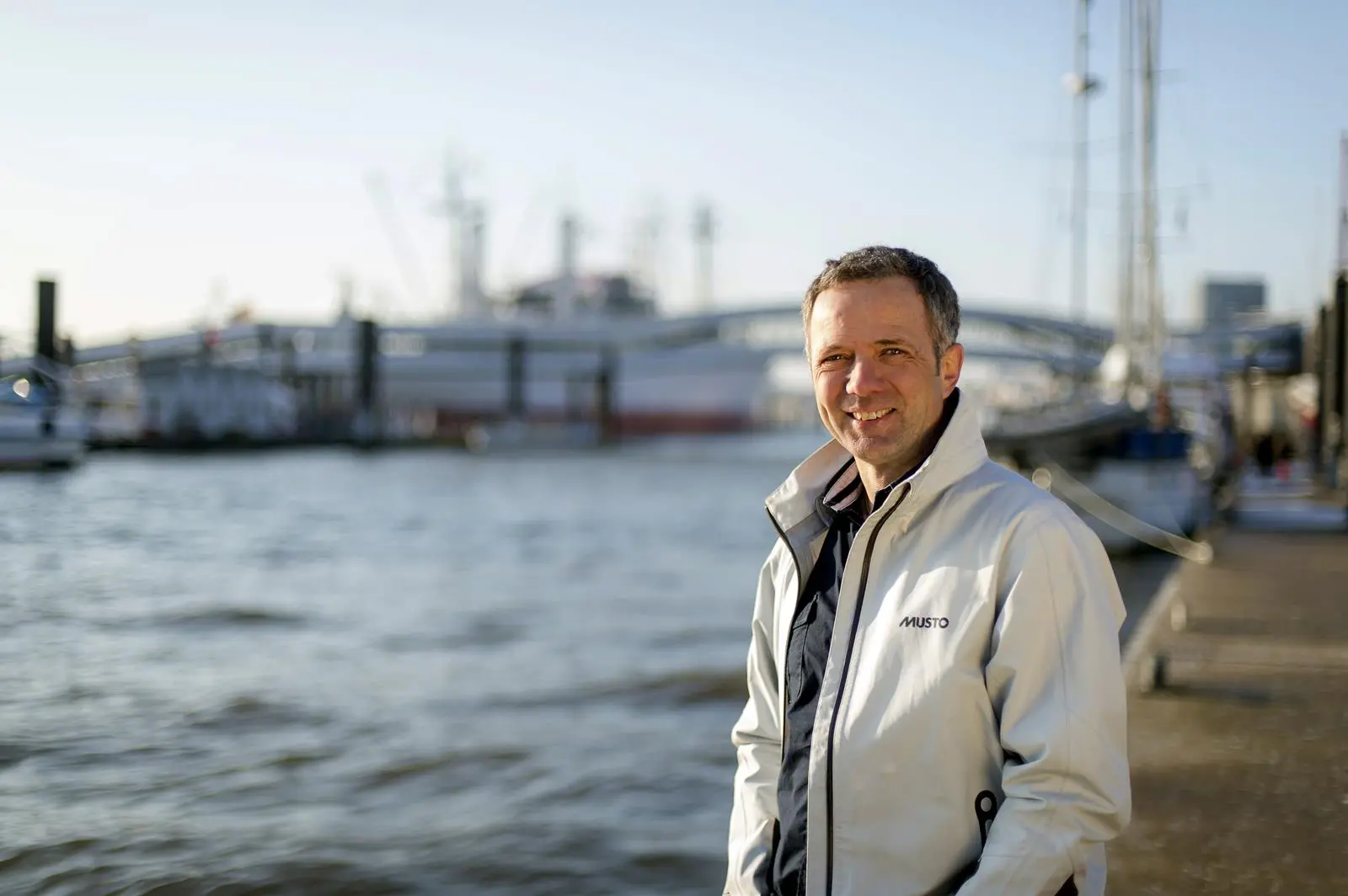
Bureau Veritas (BV) is also a WISP participant, and Aude Leblanc, Technology leader – sustainable shipping, Bureau Veritas (BV) Marine & Offshore, says: “In this era of fast-paced technology development, our role as a classification society is to independently assess and validate new systems, ensuring safety above all. This is where BV is a key ally for the industry, and where our role goes far beyond just assessing compliance. By developing common sets of standards that are recognised across the sector, we provide guidance that supports the developers of wind propulsion technologies, while giving shipowners confidence in these innovative solutions.”
BV contributes to a number of industry workshops to share knowledge and best practice related to wind-assist technology. For example, the NORVENT project aims to carry out an inventory of the needs and approaches used to evaluate the performance of wind propulsion systems for ships. It constitutes the first step in harmonising evaluations in order to give strong credibility to the results produced among users, an issue regularly raised by other shipowners.
RINA is now offering wind-assist performance evaluation as part of its digital ship performance monitoring system, SERTICA. Through a Data Collector installed on board, it continuously collects data from ship navigation and automation systems, as well as directly from sensors if required (i.e. high precision inclinometers, torque meters, flow meters, etc.). Exploiting machine learning to create hydrodynamic models of the ship, it can, for example, analyse dry-dock payback period to evaluate the real impact of refitting new technology on the ships’ performance.
Patrizio Di Francesco, Principal Engineer at RINA, notes that the limited weather conditions experienced during sea trials do not enable accurate assessment of fuel savings, so SERTICA gives shipowners the on-going ability to monitor performance.
Sea trials focus on safety
Granting type approval means that class can essentially consider wind-assist technologies as a black box when it comes to installation, so during sea trials their vigilance is directed at key safety elements for ships and crew.
Dr Zhang Rongxin, China Classification Society (CCS) Expert of Hull Structure & FEM analysis notes the importance of sea trials: “Sea trials are necessary in order to test the wind-assist system robustness, stabilities, effects etc. and CCS always insists that the Safety of Life is the most important. Secondly is the environmental safety, and the third is the property security.” This means hull and sail structures meet the safety requirements set by CCS and concerns such as navigation bridge visibility and manoeuvrability should meet SOLAS, International Code of Signals, collision regulations and other relevant standards.
Retrofit projects are currently taking six to 12 months, he says, but he expects that to reduce to less than three months as stakeholders gain confidence and experience. “We always believe wind-assisted technology will be one of the most important methods to reduce carbon emissions.”
Norsepower’s Kuuskoski, is already seeing the benefits of that increasing confidence. “The actual rotor sail installation is very quick if the ship is already prepared. With the foundation and cables already installed, the actual rotor sail installation has been done in a matter of six hours. When we have the rotor sail ready, tested, and assembled alongside the pier, it’s a matter of using a crane to lift the unit onto the foundation, which is ready on the ship, connecting the flange connection bolts, connecting cables, making the first test runs and then the ship is ready to sail.
“We can complete the commissioning during the sailing, so it’s a really minimal time out of service at that stage. Of course, the pre preparation time for making the ship retrofit project ready without takes a few weeks, and that’s why it’s typically done in a maintenance docking.”
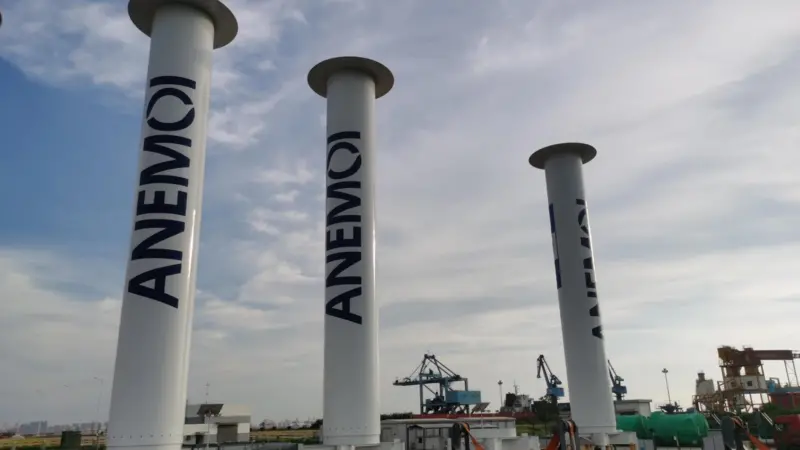
A key metric for rotor sails OEM Anemoi is minimising time off hire for the vessel by careful planning of the work that needs to be undertaken in dry dock and alongside. “Experience is key to success in these projects and guides the months of integration design work, plan approval and project management that lead up to the actual retrofitting,” says Luke McEwen, Anemoi’s Technical Director.
Main activities in dry dock include fitting of the structural steelwork for the rails, foundations and electrical conduits and modifications to the switchboard, which can be done in parallel with the normal dry dock work provided that parts have been pre-fabricated in the yard prior to the vessel arrival and the dry dock work is well planned with the yard and owner.
More minor tasks such as preparing cabling and connections for the control system can be done at sea in advance. Installation of the rotor sails themselves can be conducted alongside in a few days – for example all three rotor sails were craned on board and secured to their foundations on the Kamsarmax TR Lady in just two days. Once the rotor sails and deployment system have completed final commissioning on board and passed their harbour acceptance tests, sea trials can be conducted as part of the vessel’s normal operation.
Hasso Hoffmeister – Senior Principal Engineer at DNV, warns project time depends a lot on whether the required certification of the sail system is already available or still must be obtained. It also depends on the complexity of the system and the installation situation on board. He says sea trial and quayside trial program are put in place to assure these systems are working and are working together properly in practice. Some systems are highly automated in order to avoid having additional crew on board, and the main functions of these systems will have to be proven, including emergency stop functions. “If the manoeuvrability is potentially influenced a lot by the effect of sail systems, the flag authority might ask for some specific manoeuvres, but we have seen this requirement satisfactorily covered by simulations,” says Hoffmeister.
“I have been asked: After about 100 years of the absence of sailing, are we seeing a renaissance in shipping? And I answer: Yes, of cause, because it is still the same physical principles how wind converts to propulsive power, but I also complement this with a clear: ‘No! today it is very different! We are using new materials, much better efficiencies, digital solutions paired with lots of automation.’ This distinguishes modern wind propulsion from ancient sailing!”
Related Articles
 ENERGY SAVING DEVICES
 ENERGY SAVING DEVICES
 AMMONIA