



Extending Year-Round Polar Odysseys
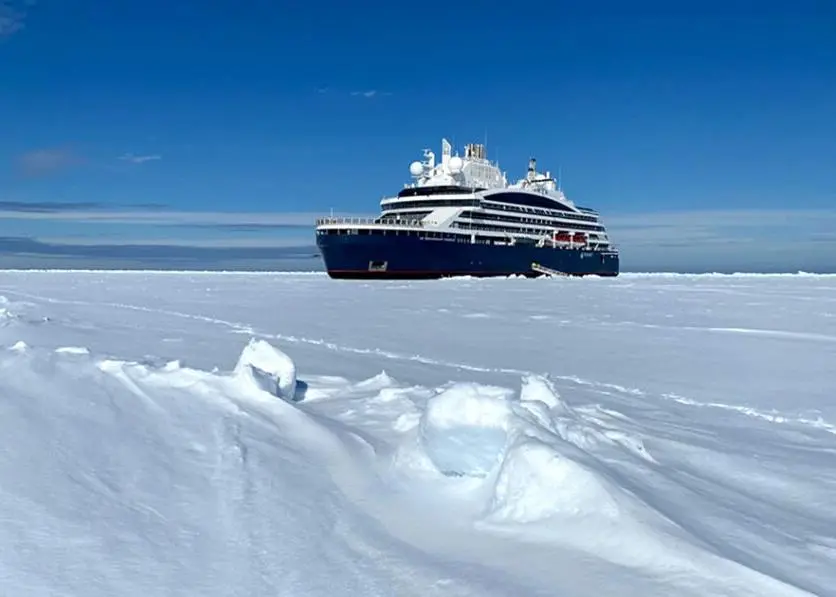
Technically distinguished by a hybrid electric power and propulsion system, using LNG fuel and employing podded, azimuthing thrusters, the 150m vessel incorporates the largest energy storage system on a cruise ship to date. Constituting an investment in excess of US$300 million, Le Commandant Charcot enhances and extends the Arctic and Antarctic programmes that can be offered by expeditionary vessel operator Ponant Cruises.
Voyages to areas previously confined to the open-water season will now be possible on a year-round basis, as the ship features a Polar Class 2 icebreaking hull and the ‘double-acting’, ahead/astern ice-going principle.
The luxury vessel is a product of Fincantieri subsidiary VARD’s European shipbuilding network, using a design and engineering concept developed by Aker Arctic Technology in cooperation with the shipowner and Nantes-based Stirling Design International. Hull construction was undertaken at the VARD Tulcea yard in Romania, with fitting out accomplished at the builder’s Soviknes premises in western Norway.
Since delivery towards the end of July, the ship has been the subject of an intense sea and ice-going trials campaign out of the VARD Langsten yard, first sailing to the Svalbard archipelago, then to the Belgica Bank, off north east Greenland, and subsequently to north west Greenland and the high Arctic.
ABB’s Azipod technology is an enabler of the double-acting concept, whereby a vessel is formed and equipped to navigate ice-covered waters either stern-first or ahead. Hitherto mainly applied to dedicated icebreakers, service vessels, tankers and other merchant ships trading in heavy ice-prone regions, the double-acting mode now has its first reference in the cruise sector by way of Le Commandant Charcot. The installation comprises two 360-degree steerable propulsors with integral 17MW electric motors.
In a passenger-carrying context, the arrangements improve the safety factor in a climatically-hostile environment, and help ensure cruise schedule-keeping. In addition, the Azipod system allows the vessel to be brought to a complete stop in 50% less time than would be the case with a traditional shaftline set-up.
The Polar 2-certified vessel can move through multi-year ice up to 2.5m-thick, and has the capability, in double-acting mode, to run astern in severe ice conditions, potentially negotiating towering ice ridges. The cruiseship’s performance is comparable to existing polar icebreakers, but with lower ice resistance ensuring better fuel economy. Atmospheric impact is also substantially lessened through the provision to operate wholly on LNG fuel, while having the facility to switch to diesel at any time if need be. The Corvus Orca 4,520kWh battery installation allows for periodical, zero-emission sailing, and confers load-levelling and spinning reserve benefits.
The icebreaking cruise ship is a showcase for Wartsila’s versatile 31-series medium-speed engine platform, employing six examples of the type in its dual-fuel version as the main generator drives. Two of the aggregates are based on 10-cylinder models (10V31DF) producing 5,500kW apiece, and four are driven by 14-cylinder engines (14V31DF), each rated at 7,700kW. The total installed mechanical power is thereby 41,800kW.
The plant confers a cruising speed of 15 knots in open water, as well as the requisite ice-forcing potency plus hotel load. An ABB power and energy management system (PEMS) oversees the hybrid power supply to ensure the optimal engine load.
Noise abatement solutions, plus the nature of the propulsors and the facility to switch to silent, battery energy cruising imbues a high degree of onboard comfort for the 245 passengers and complement of 235. The vessel has also been fitted with research facilities available to the scientific community to study and analyse water, air, ice and biological diversity at the extreme poles.
Revenue-generating polar odysseys begin with a series of cruises out of Punta Arenas, in southern Chile, followed over the New Year period by a 16-day cruise from Ushuaia, at Argentina’s southern tip, to the Antarctic Peninsula and Weddell Sea ice pack. The ship sails under the registry of the French Polynesia territory of Wallis and Futuna.
TECHNICAL PARTICULARS
Le Commandant Charcot
| Length overall | 149.9m |
|---|---|
|
Length bp |
142.4m |
|
Breadth |
28.3m |
|
Depth |
15.3m |
|
Draught |
10.2m |
|
Gross tonnage |
31,283gt |
|
Passenger capacity |
245 |
|
Passenger cabins |
123 |
|
Crew |
235 |
|
Propulsion system |
Hybrid dual-fuel/battery -electric |
|
Main generator engines |
4 x 7,700kW + 2 x 5,500kW |
|
Electric propulsion motors |
2 x 17,000kW |
|
Cruising speed |
15kts |
|
Battery capacity |
4,520kWh |
|
Class |
Bureau Veritas |
|
Ice class |
Icebreaker 3 (bow); Icebreaker 4 (stern); Polar 2 |
|
Flag/registry |
France/Mata Utu |
Related Articles
 BATTERIES, SUPERCAPACITORS, FUEL CELLS AND OTHER ENERGY STORAGE TECHNOLOGY
 BATTERY HYBRIDS & FULL-ELECTRIC VESSELS
 BATTERY HYBRIDS & FULL-ELECTRIC VESSELS