



FAST CAT SETS PHILIPPINES BUILD RECORD
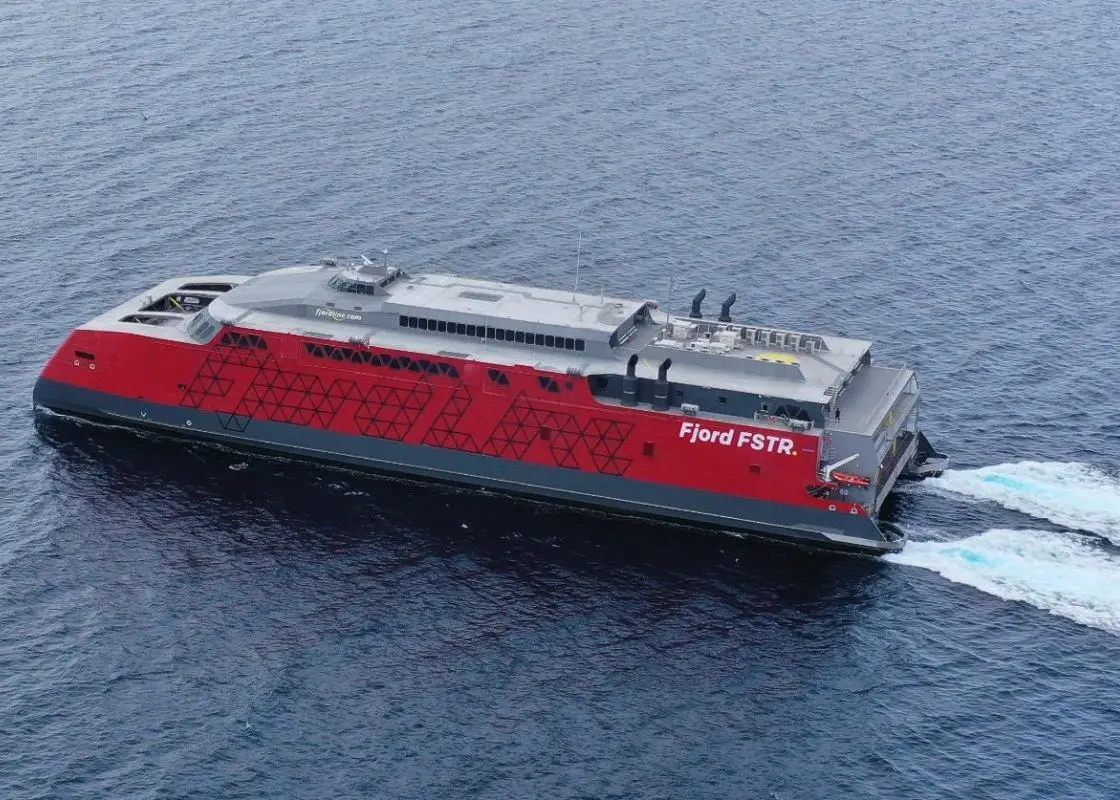
Over 12 months later than her originally scheduled commissioning date, with delays mainly attributable to the havoc wrought on production and markets by Covid-19, the 109m Fjord FASTR made her debut on the Kristiansand/Hirtshals run towards the end of June.
Powered by four medium-speed diesels to sustain a 37-knot service speed, the 11,900gt aluminium ferry brings not only an increased load capacity, but also a more diverse ro-ro capability, to a route linking southern Norway with Denmark’s northern Jutland.
Booked by Austal in August 2017 at a price of A$108m (equating at the time to EUR73m), the build was subsequently assigned by the Western Australian company to its Balamban yard in the Philippines. Fjord FSTR resultantly became the first ship to be wholly constructed at Balamban’s expanded production facilities opened in July 2019, and ranks as the largest aluminium vessel turned out to date by the Philippines’ shipbuilding industry.
The open-water route, on southern Scandinavia’s western periphery, is a seasonal service operated from March to November, and the fastest link between Norway and continental Europe. The run has hitherto been the province of the 91m wavepiercer Fjord Cat (now Skane Jet), built in 1998 by competitor Incat, and employed by Fjord Line since 2008. Fjord FSTR maintains the schedule’s crossing time of two hours 15 minutes, but with an enhanced level of onboard comfort attributable to the adoption of a ride control system, T-foils forward, trim tabs aft, and optimised hull shape.
The new entrant is a derivation of the Auto Express 109 design, which also provided the template for Molslinjen’s Express 4, delivered two years ago. Fjord FSTR is certificated for 1,200 passengers and can carry 405 cars on two decks, or alternatively load about 30 trucks on the main deck, leaving space for some 228 cars. The payload potential is substantially greater than that of the outgoing Fjord Cat’s 675 passengers and 220 cars.
The potent propulsion installation comprises four 20-cylinder, vee-type MAN 28/33D STC diesels, individually rated at 9,100kW, giving a 36,400kW power concentration acting on four drivelines. Each of the narrow catamaran hulls houses two of the main engines, arranged in staggered formation, such that outer shaftlines are longer than the immediately adjacent inner shaftlines. Drive is in each case via ZF 60000-series transmission, to a Wartsila waterjet of the LJX1500 SR1 (steering/reversing) type.
Manoeuvring of the beamy, lightweight ferry is assisted by two 300kW retractable ZF thrusters in the foreship, and the onboard electrical energy requirement is met by four gensets founded on 400kW Scania 13-litre diesels.
Austal’s Balamban shipyard on Cebu is now progressing two further, large high-speed ferry newbuild contracts. Banaderos Express is a 118m trimaran ro-pax under construction for the Canary Islands service network of Fred Olsen Express, to be followed by the 115m catamaran Express 5, ordered by Molslinjen of Denmark.
PRINCIPAL PARTICULARS – Fjord FSTR
|
Length overall |
109.09m |
|
Length bp |
104.99m |
|
Breadth, moulded |
30.49m |
|
Depth, moulded |
7.60m |
|
Draught |
3.42m |
|
Gross tonnage |
11,888t |
|
Deadweight |
1,070t |
|
Passengers |
1,200 |
|
Vehicles |
405 cars |
|
Heavy vehicles |
530 truck lane-m (+ 228 cars) |
|
Deck heights |
4.6m (main) + 2.1m (mezzanine) |
|
Main engine power |
4 x 9,100kW |
|
Speed, service |
37kts |
|
Speed, lightship |
42kts |
|
Manoeuvring thrusters |
2 x 300kW |
|
Auxiliaries |
4 x 400kW |
|
Class |
DNV |
|
Crew |
35 |
|
Flag |
Danish (DIS) |
Related Articles
 PROPULSION
 GENERAL NEWS
 HYDROGEN