



Ferry project captures spirit of resurgent Tunisia
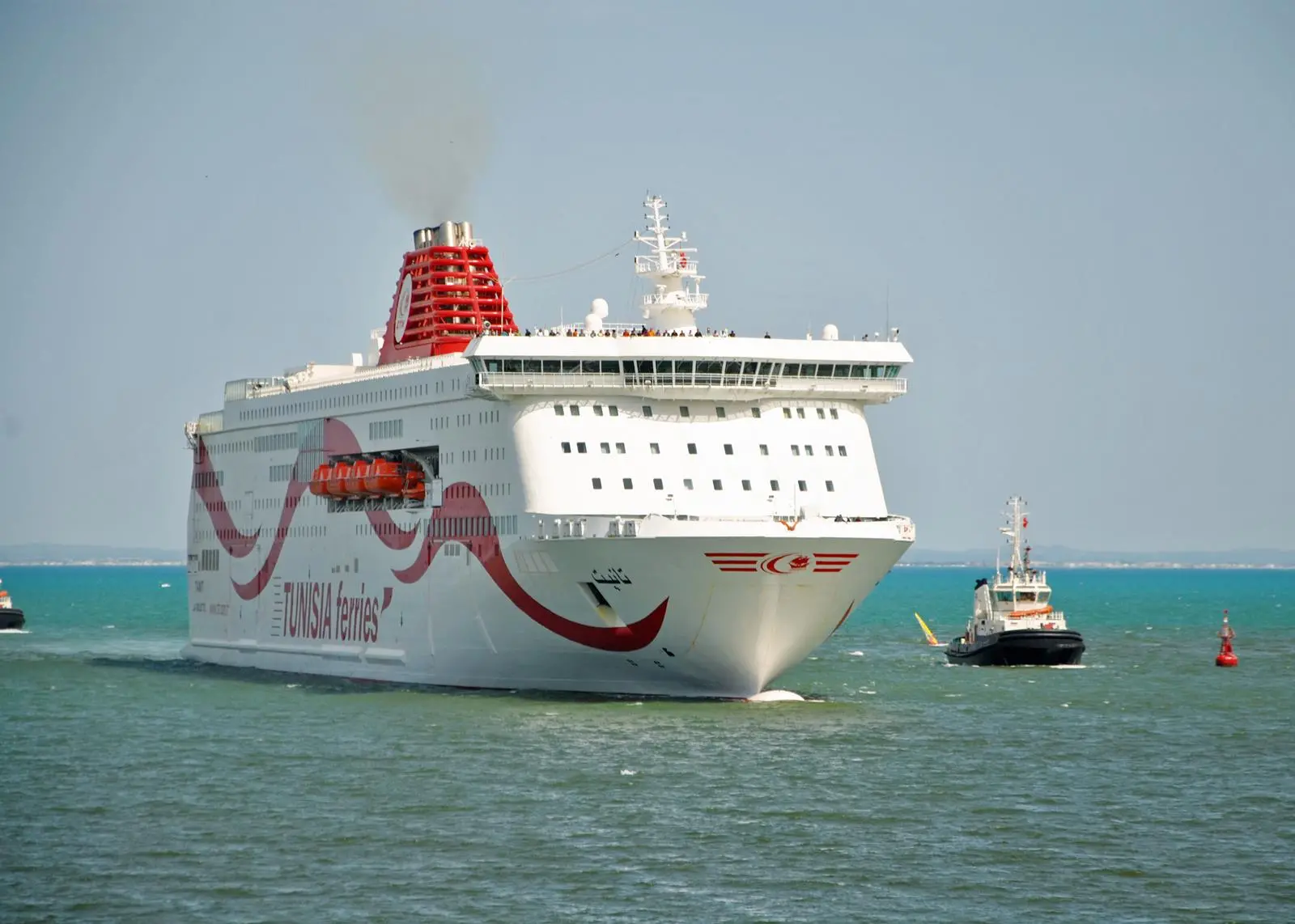
Combining an exceptionally fast service speed of 27.5 knots with a capacity for 3,200 passengers, and a level of interior facilities and comfort that ranks her in the ‘cruise’ ferry standard, the 52,645gt Tanit constitutes a prestigious new addition to the Tunisian fleet, designed to strengthen the North African country’s links with the European market. The vessel represents an investment of more than $260million.
Compagnie Tunisienne de Navigation(Cotunav) has assigned the South Korean-built Tanit to its flagship ferry services connecting Marseilles and Genoa with the modern terminal at La Goulette, 12km north of Tunis. The new vessel’s ro-ro intake, corresponding to 1,060 cars, or some 91 trailers plus 341 cars, provides the wherewithal to support the development both of the summer season holiday traffic and the year-round freight business. Cruise excursions to Marseilles and Genoa are planned for the off-season periods.
Named after the protective goddess of ancient Carthage, the ship was in its planning stages when the Tunisian revolution broke out towards the end of 2010. In many respects, the vessel is a vibrant expression of the ‘new’ Tunisia. The cabins, suites and public spaces, which have been widely acclaimed, are described by Florida-based interior design contractor Tillberg Design as “a reflection of Tunisian art and the spirit of the people.”
The nature and pure extent of the outfitting work involved in the project, together with the state-of-the-art engineering technology encapsulated in this large ferry, provide a new reference point for Daewoo Shipbuilding & Marine Engineering’s advance in the high-end categories of the ship construction market. The Okpo yard built the complex, 12-deck ‘mega’ ferry in just 18 months.
Only just eclipsed in gross tonnage terms by the 53,400gt Grimaldi Group sisters Cruise Roma and Cruise Barcelona as the largest ferry in the Mediterranean, Tanit’s capacity for 3,200 passengers is among the highest worldwide.
Tanit provides a showcase for the latest wide-bore, medium-speed marine diesel technology by way of a considerable power concentration of 57,600kW in a propulsion plant comprised of four MAN 12V48/60CR common-rail engines. As the IMO Tier II-compliant design had not been released for production to licensees, Daewoo placed the order for the engines direct with MAN in Germany.
Based on the 480mm-bore 48/60 type, the CR version employs electronic injection, variable valve timing and improved turbocharging and combustion to fulfil more stringent emission standards. The CR technology allows independent setting of injection timing, duration and pressure for each cylinder, making for optimised fuel consumption across the operating profile. The 12-cylinder vee-form models adopted in the Tunisian ferry each have an output of 14,400kW.
The machinery is divided between two separate engine rooms, and the respective pairs of propulsion engines are arranged in staggered fashion, with two auxiliaries correspondingly placed on each side of the main engines. Redundancy is a feature of all main elements of the power and propulsion installation, including the common-rail system, which employs redundant high-pressure pumps as well as twin-type pressure and speed sensors to ensure engine operation, even in the event of failures.
Each pair of main engines drives an Alpha VBS1800-ODF controllable pitch propeller through a twin-input, single-output gearbox. The 5.6m-diameter propellers are the largest produced to date by MAN, and were developed and manufactured at the group’s Frederikshavn site in northern Denmark. The entire propeller set, including the shaftlines at different lengths of well over 40m, weighs almost 300t. The propeller blade design has been hydrodynamically optimised and carefully balanced, in the interests of propulsion efficiency, low noise and reduced cavitation.
Such is the potency of the propulsion plant, in conjunction with the hydrodynamic attributes of the underwater lines and equipment, that Tanit offers a service speed of 27.5 knots. Her capability in terms of speed allows crossing times between Tunis/La Goulette and Marseilles to be cut during the summer season schedule to as little as 18 hours, saving several hours compared with transits by vessels used previously. It is understood that the delivery voyage from the builder’s yard in Korea to Tunisia was made at an average speed of 28 knots.
The Dutch company Van der Velden Marine Systems delivered two Timon-type flap rudders for the Tanit to optimise speed and course corrections and reduce cavitation and vibration. The rudder profile is based on the well-known HSVA and NACA profiles and is especially well suited for fast vessels requiring a high manoeuvring performance. By virtue of the flap, turning circles are smaller and course corrections can be made more efficiently.
The Timon rudders incorporate trademark asymmetric rudder technology (ART), developed to improve propeller flow. A special configuration modifies the profile above and below the propeller’s centreline in such a way as to counter the rotational effects of the propeller slipstream. According to Van der Velden, this expands the cavitation-free rudder angle and reduces drag, contributing to the vessel’s speed-making performance. Reduced rudder cavitation also benefits the lifespan of rudders and shaft bearings, with the added bonus of lower vibration and noise levels.
Auxiliary power is derived from four gensets driven by MAN six-cylinder L32/40 diesels of 2,895kW, built under licence in Korea by STX Engine Co.
The vessel’s considerable array of Bureau Veritas class notations includes recognition of the attention paid in the design and engineering to noise and vibration levels, and also reflects the provisions to meet SOLAS ‘Safe Return to Port’ criteria. Tanit is said by BV to be the first passenger ship worldwide to have been officially certified in accordance with the SRTP requirements that entered force with keel laying from 1 July 2010 onwards. It is understood that previous ferries voluntarily designed to comply with the STRP edict, but laid down prior to the activation date, were not certified at the time as IMO implementation guidelines were still to be published.
Tanit is fitted out with 653 passenger cabins and 30 suites, and her facilities include two large saloons with about 800 airline-type seats, a Moorish café, restaurants in various price categories, a nightclub, bars, an Internet café, a book store and various shopping outlets, a children’s play room, a mosque, and a swimming pool. The design is a mix of traditional Tunisian ambience and modern influences. The uppermost deck is open to passengers throughout, a feature which surely enhances the travel experience during summer transits of the western Mediterranean.
The two stern ramps are used for vehicular access at Marseilles and Genoa, while loading and unloading at La Goulette is across the bow ramp. The main and lower decks offer the requisite headroom for commercial vehicles and buses, and flexibility in usage of the main volume is offered by a mezzanine deck. In addition, a fixed upper deck (Deck 6) provides for cars.
While two modern ro-ro trailerships were purchased by the company in 2010, the previous ro-pax newbuild addition to Cotunav’s fleet was the 2,208-passenger/666-car capacity, 23.5-knot Carthage delivered from Norway in 1999.
Principal particulars—TANIT
Length oa 210.0m
Length bp 189.69m
Breadth 30.0m
Draught 7.30m
Gross tonnage 52,645gt
Passenger capacity 3,200
Passenger cabins/suites 653/30
Ro-ro capacity 1,060 cars / 91 trailers + 341 cars
Crew complement 285
Main engines 4 x MAN 12V48/60CR, 4 x 14,400kW
Auxiliaries 4 x MAN 6L32/40, 4 x 2,895kW
Class notations Bureau Veritas,
I+HULL, +MACH, unrestricted navigation, roro passenger ship-SRTP, +SYS-NEQ-1,Mon-Shaft, +AUT-UMS, +AUT-PORT, +REF-STORE, Ice class 1D, ALP, SDS, COMF-VIB-2, COMF-NOISE-2, Inwatersurvey
Related Articles
 PROPULSION
 GENERAL NEWS
 HYDROGEN