



First methanol fuelled towboat
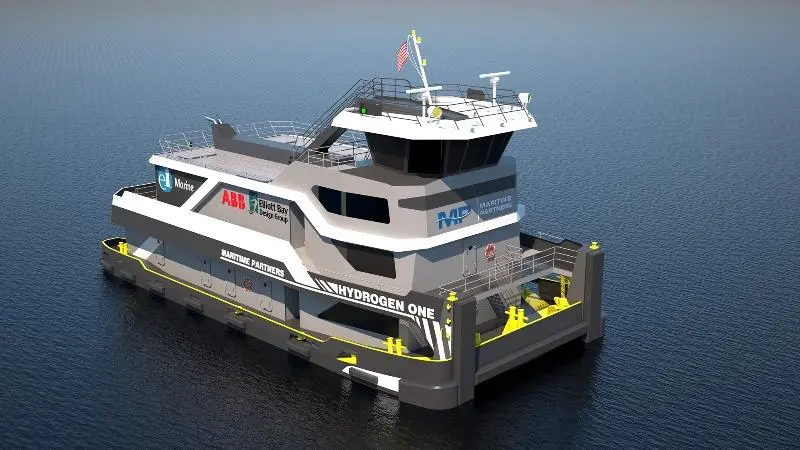
M/V Hydrogen One is being developed by Maritime Partners in cooperation with ship design from Elliott Bay Design Group and hardware from ABB and e1 Marine, to help meet the pressing demand for sustainable towboat operations.
“Shipowners have been understandably reluctant to commit to low carbon fuels until the infrastructure is available to refuel their vessels,” said Austin Sperry, co-founder and chief operating officer at Maritime Partners.
“The M/V Hydrogen One solves that problem by using methanol, which is safe and readily available worldwide. When the M/V Hydrogen One joins our fleet of 1,600 vessels, it will not only provide excellent emissions reduction capabilities but highly functional, reliable and cost-effective operations.”
Pioneering vessel
Decarbonising the towboat sector poses substantial challenges, particularly due to towboats’ inherent size, space and weight limitations. Batteries are only suitable if you operate on fixed routes and can recharge daily and a towboat’s limited storage capacity restricts the use of pressurised or cryogenically stored gases as fuels.
There are also very few dockside facilities to load such marine fuels, which severely constrains a vessel’s range and functionality.
But methanol is a common towboat cargo and it is available in 88 of the world’s top 100 ports. This availability enables you to refuel safely almost anywhere without the need for costly diversions.
The M/V Hydrogen One’s use of e1 Marine’s reformer technology generates hydrogen from methanol on-demand, which also makes it considerably safer than transferring and storing hydrogen directly, and the ship’s crew will require minimal additional training to use the technology.
M/V Hydrogen One will be IMO 2030 compliant and meet all requirements of the US Coast Guard’s Subchapter M regulations. The ship uses ABB’s electrical power distribution and automation and e1 Marine’s methanol-to-hydrogen fuel cell allowing it to perform at standard operational speeds for up to 550 miles before it needs to refuel.
Dave Lee at ABB Marine & Ports, commented: “The US towboat market is one of the most traditional in the world, so it’s important to recognise what this represents: the first step in a shift from diesel electric to methanol electric and a major advancement towards zero emissions.”
He pointed out that because the system consumes methanol fuel on-demand, it’s much more efficient than a traditional towboat, where you need both main engines as well as a generator online at all times.
”Through this design and our technology we’re enabling not only huge operational and cost efficiencies, but making the most environmentally friendly mode of transport even more sustainable,” he said.
Related Articles
 METHANOL
 METHANOL
 2-STROKE & 4-STROKE