



Following a tough act
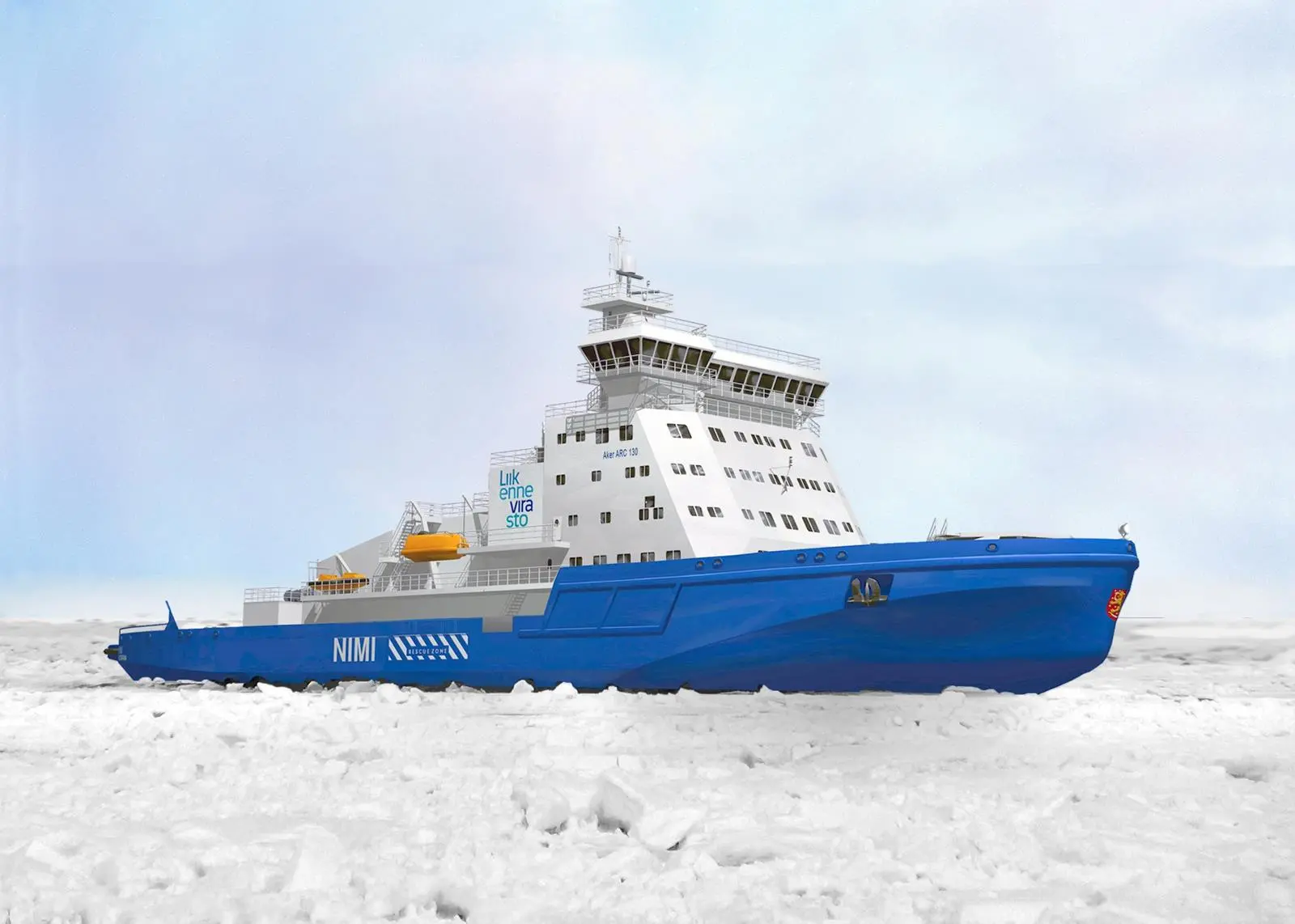
Time is of the essence when it comes to ice, and the larger icebreakers are in demand as they can keep a high assistance speed, shortening the waiting times in severe winter conditions – a necessity when the weather can close in.
But despite the conditions, these ships also have to be long lived: the new icebreaker presently being built at the Arctech Helsinki Shipyard will have an expected life of 50 years. It will be a true workhorse, although, as Arctech Helsinki’s MD Esko Mustamäki says, “it will also be unique”.
The aim of the Aker Arctic design is to push the aging Finnish icebreaker fleet into the 21st century and forestall a decrease in capacity; however, Mika Hovilainen of Aker Arctic explains that even though 40 years old, these older icebreakers (operated by Arctia Shipping) are a tough act to follow and the new design, a first for the Finnish Transport Agency, has to be “at least as capable”.
The specification for this new vessel is for a minimum 16 knots capability in open water plus the ability to break a 25m wide channel in 1.2m ice while keeping up a steady pace of 6 knots with assistance speeds still being somewhere between 9 and 11 knots.
It is easy to say, but this is quite something when you consider the conditions: Mr Hovilainen explains that the icebreaker will have to cope with the Baltic Sea and Bay of Bothnia: “Here the prevailing winds push heavy ridges of ice up against the coastline, these are often around 8m deep but they can reach up to 15m or 20m.”
So, the vessel has been designed for both stern-first and bow-first ice entry as it will often be engaged in contact towing operations. Underneath this new vessel will have not just two azimuthing propellers, but three, one in the bow and two aft which will add a great degree of manoeuvrability plus “allowing the bow-mounted propeller to act like a milling machine, drilling into the ridged ice”.
The hull also has to be strengthened against nipping and designed to minimise resistance, having a short parallel section at the sides to lower the huge friction forces inherent in ice transits.
However, while the lines of traditional icebreaker tend to make them susceptible to rolling and slamming, this vessel will be also be used for emergency tows in all kinds of open water conditions as well as oil spill response operations in up to 2m significant wave height. So, it was necessary to design the hull with a reduced flare above the water line, giving the bow a distinctive shape. This, along with passive antiroll tanks, results in much better seakeeping abilities.
Giving it the power will be around 21 MW of dual fuel engines, which diminishes the vessels emissions and operating costs. Mr Mustamäki explains it’s the very first application on an icebreaker like this – and although there is at the moment few LNG bunkering points in Finland, this vote of confidence in the ability of gas to meet the new levels of environmental concern may just help tip the argument in favour of more gas filling stations.
The draught of the vessel with full fuel tanks was also kept to a maximum 8m. Mr Mustamäki points out that this helps the vessel both with restricted channel depths and also with the ship’s ability to get in and out of some of the Finnish ports it may be called to serve.
However, although the new vessel remains a unique for now, there is a very good chance that orders for renewing the rest of the fleet of seven will follow over the next few years.
Related Articles
 PROPULSION
 GENERAL NEWS
 HYDROGEN