



Formulating answers to the industrys lubrication needs
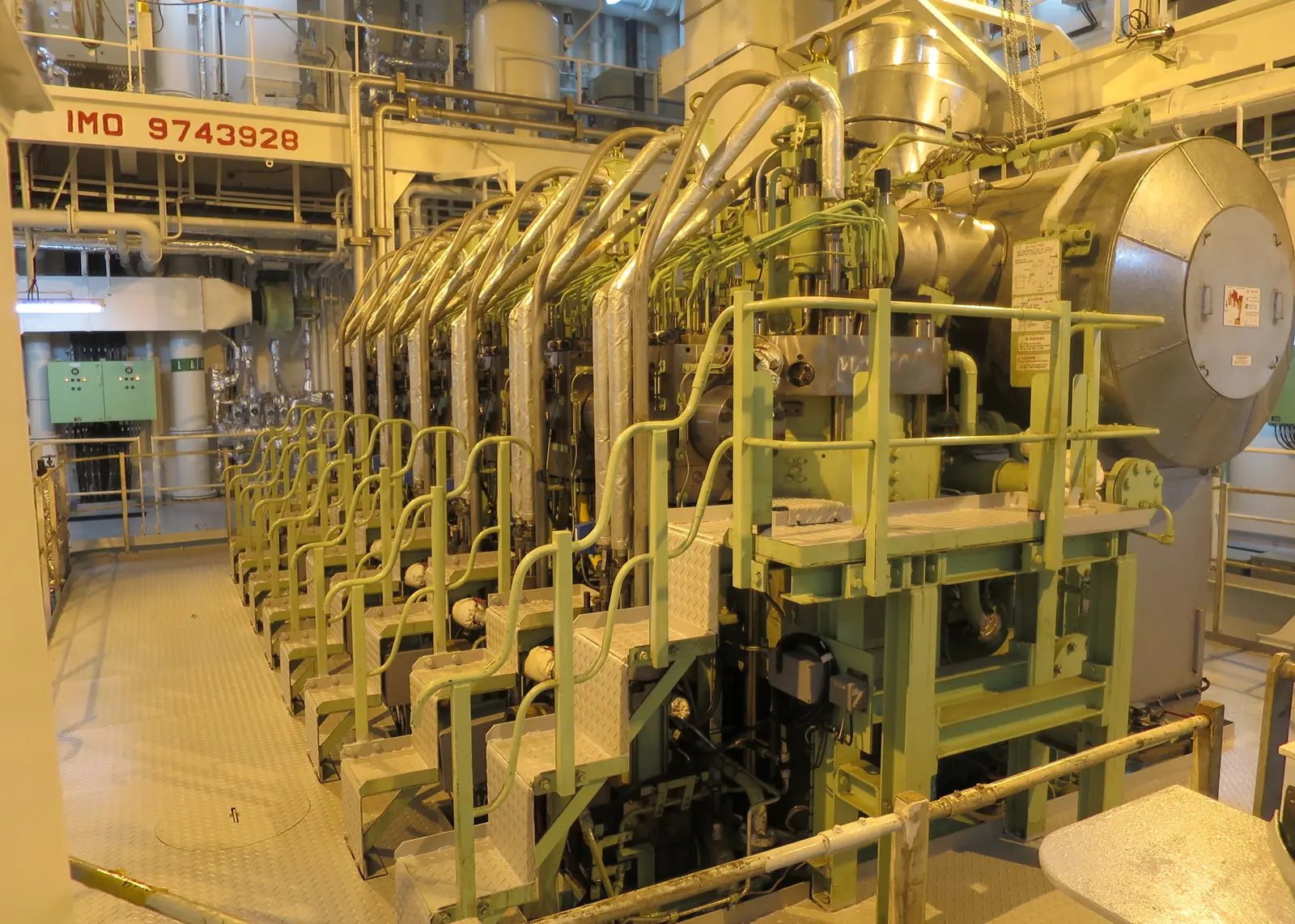
Across the Total Group we are committed to providing sustainable alternatives and we strongly believe that the new IMO regulations will be the driver for further technological evolution – not just in 2020 but in the years ahead.
The Motorship: What do you consider the most important technological innovation during your professional career?
Serge Dal-Farra: As a former dually graduated deck and engine merchant marine officer, I think satellite navigation and then ECDIS made a big change while automatization in the engine room was applied in a step by step approach. As a Lubmarine employee, I pride myself to have been part of the TALUSIA UNIVERSAL single oil story, a cylinder oil that demonstrates a unique and wide scope of use, including various fuel types, engine types, and operation profiles.
Turning to two-stroke cylinder lubricants, how do you think the emergence of premium lubricants, such as Talusia Universal you’ve just mentioned, have transformed the lubrication world?
We saw the need to develop a set of marine lubricants designed to work with a range of low and very low sulfur fuels, and we aligned our product test through engine manufacturer MAN Energy Solutions. This resulted in us successfully achieving a No Objection Letter (NOL) for the use of Talusia Universal (BN 57, SAE 50) on MAN B&W 2-stroke engines operating on fuels with less than 0.5%S Very Low Sulfur Fuel Oil (VLSFO).
We also completed a successful 1,400-hour trial of Talusia Universal on a dual-fuel MAN B&W 7G50ME-GIE engine running continuously on gas with pilot fuel oil. Thanks to its high levels of detergency, the tests revealed that Talusia Universal is able to achieve cleanliness even on the latest generation engines. It is a product that has been used in more than 100 million running hours including vessels burning low sulfur fuels and distillates.
Engine cleanliness is by no means a superficial concern. It is intrinsically linked to the ‘health’ of the engine and how it performs, and as our studies prove, it can be a costly exercise if it goes wrong. Fouling and deposits can impact engine efficiency and risk malfunction which often leads to more serious problems down the line. Even the latest generation of engines can be prone to corrosive wear, and when you factor that in with changing fuel trade and fuel availability, we believe the case strengthens for Talusia Universal. It offers ship owners and operators a solution that delivers a higher cylinder detergency to gain better engine performance and with greater safety margins on those more demanding engines which may be sensitive to deposit build up and cold corrosion. It is perfectly suitable for 2020 compliant fuels.
Turning to the current market, how do you think the different range of fuels that will be available to ship owners will affect their lubrication requirements?
90% of global trade is carried out by seas, so the type and choice of fuel to power this trade is critical. But in our view improving clean fuel supply sustainably is only one half of the equation; the other half is balancing demand-based behaviour.
Any fuel that contains some asphaltenes means our lube formulations must be able to deal with this contaminant to keep engine components clean. Unstable fuel may lead to combustion difficulties, the residues of which will need to be handled and tolerated by the lube oil.
But when it comes to today’s fuel choice, there is no single right solution. The challenge we have is that the widening marine fuel mix is adding complexity to ship operators’ lubrication choices. While we have the flexibility in our solutions to help operators navigate these challenges, we would always recommend that any ship operator works closely with a trusted bunker supplier. Total is an integrated group which provides expertise and assets in refining, trading, LNG, bunkers and of course lubricants, so whether you are looking at LNG, low sulfur fuels, marine gas oil and scrubbers – which are all routes to compliance – Total Lubmarine has a complete portfolio of compatible, OEM approved lubricants in the right locations to suit all needs.
We’ve also taken the opportunity this year to push ahead with an improved Drain Oil Analysis programme that provides operators and OEMs with insight on how their oil is handling other contaminants adequately. We’ve found this works really well for our customers and with regular monitoring of the engine oil, our experts are able to provide reliable and accurate data results to help to extend the service life of oil. We’ve taken this approach because we believe it is important to help our customers interpret and implement all OEM engine requirements, and which aids ship operators to develop crew skills as well as engine performance knowledge.
Some have said that the introduction of zero and low sulphur fuels will lead to changes in engine oil chemistry. Do you think we are entering a world of low-ash oils?
Looking ahead, this year and next, the transition to cleaner oils highlights many of the challenges in efficiently managing the fuels and lubricants necessary to ensure safe and cost effective operation of vessels. It is clear that we will continue to face changes with initiatives that deep dive further in to energy efficiency, emissions and greenhouse gas targets. But we also see possibilities for wider benefits such as LNG as a marine fuel. We believe LNG can support the shipping industry’s transition to a cleaner more sustainable option. In our view, the market, currently less than one million tonnes per year, will reach 10 million tonnes in 2025 and exceed 20 million tonnes in 2030. It is a market which is attractive at this early stage of transitioning to cleaner fuel alternatives. Unlike HSFO and scrubbers, it’s not short-term. It may not be the silver bullet on complete decarbonization but it can make a big contribution now and in the medium term.
As knowledge and experience of new fuels evolves, we will continue to develop new formulations of cylinder lubricants appropriate to the fuel and its application. For example, the amount of alkalinity needed could be set differently, where we would consider not only the sulfur content of the fuel used but also the engine characteristics, emission control and energy saving systems, and the operating conditions.
Lubricant choice therefore goes hand-in-hand with fuel choice, and low and zero sulphur fuels bring with them their own lubrication challenges. We believe that low ash chemistry can be the basis for the next generation of engine oils, particularly for dual-fuel engines or those diesel engines fitted with selective catalytic reduction systems. Total Lubmarine is also developing new lube oils designed to help reduce CO2 emissions.
Total Lubmarine has placed product research and development at the heart of its strategy for some time. Can you share any insight into what is next for you?
While the fundamentals from pre-January 2020 have changed rapidly, ahead is the start of a new industry norm and a new cycle, with undoubted change again further down the line. As a result, we want to be ahead of that curve.
We are continuing to develop high-quality lubricants, supported by investment in technical support, advanced lubrication management into a strategy that addresses customers’ most pressing operational concerns whatever their situation. We understand fully that new fuel and new engine technologies need new types of lubricants. With engine technology continually evolving, the need to remain agile and continue to understand and find efficient and cost-effective solutions to the challenges ship owners face in the post 2020 is more important than ever before. We are excited about the future and as the responsible energy major, are determined to continue to drive forward ambitious change in the way we operate to embrace new opportunities and provide quality solutions to give customers, and their supply chains, confidence that they are addressing tomorrow’s economic, legislative and corporate responsibilities, effectively, efficiently and responsibly.
Related Articles
 INTERVIEWS
 CONVENTIONAL FUELS & OILS
 GENERAL NEWS