



Four-stroke hybrid electric propulsion concept for LNGCs advances
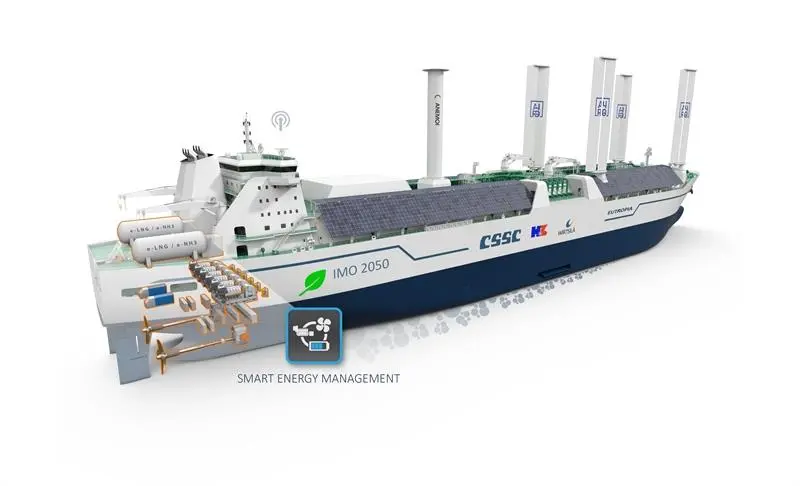
Grant Gassner, Director, Integrated Systems & Solutions at Wärtsilä introduced Wärtsilä’s new Hybrid Electric design concept for LNG carriers, which received an Approval in Principle (AiP) from ABS earlier in 2022.
The design is the result of a joint development project between technology group Wärtsilä, ABS and Hudong-Zhonghua Shipbuilding (HZS), which was initiated in September 2021.
Gassner noted that the LNG carrier design project was continuing following the award of the AiP, and that multiple silent European shipowners were now also collaborating in the project.
The Motorship notes that the design will be among the first to enable the introduction of Propulsion-as-a-Service (PaaS) type contracts for customers in the LNG transportation market, as both Wärtsilä and Accelleron (formerly ABB Turbocharging) will be able to provide at port or at sea maintenance contracts.
The highly significant design is also likely to be among the first to be developed with the intention of supplying a total full lifecycle Digital Twin. Project partner ABS has participated in the project, and the partners plan to offer the Digital Twin developed during the design phase for use during the construction of the ship and then during its operation.
Hybrid-electric system
The design integrates Wärtsilä’s most efficient modern engines with a highly advanced hybrid electrical system, including Wärtsilä’s Low Loss Concept electrical distribution system. The latter eliminates the transformers between the generators and the drive, which reduces conversion losses.
The vessel features “highly efficient” very high torque permanent magnet motors, which allows the vessel to eliminate the gearbox, which also contributes to higher system efficiency than earlier electric propulsion concepts.
One feature of the design is that energy storage and energy management software provide the power system with spinning reserve, enabling the gensets to continuously operate at very high and stable load (typically 85-95%), where the efficiency is very high and emissions are very low.
Fluctuations in engine power requirements are handled by the vessels energy storage system, which is able to provide instant energy and provide peak shaving functionality. While the benefits of ESS hybrid systems combined with 4-stroke electric propulsion is very well known in many segments, the system has not been widely used in the gas carrier market until now.
Integrated Propulsion System
Another noteworthy feature of the vessel’s innovative design is the close integration between the propulsion system and the energy storage system. The propulsion system will act as an adjunct to the energy storage system.
“The propeller RPM can be set for constant in rough weather by the EMS, and the battery will give instant energy to respond to dynamic loading. When you’re hitting the waves, the propeller keeps constant RPM you don’t have dynamic losses from dynamic loading events created by waves.” The same functionality also applies for sudden and high load fluctuation on the auxiliary power system.
“The design features a very large FPP, which can run at low rpm, because with electric propulsion there is no engine power limitation curve that one needs to follow and the PM motor provides sufficient torque at all speeds to enable a complete optimization of the FPP.” Even greater efficiency savings may be possible, as the partners are conducting research to improve the operation of propellers at low speeds in combination with the overall hull optimization and alternative design speeds which is also expected to improve the hydrodynamic efficiency of the design.
Design Performance
Gassner compared the configuration with Wartsila’s Dual-Fuel Diesel Electric (DFDE) concept, which was the industry standard in the gas carrier market for a decade in the first years of the century, likening the improvement in efficiency and emissions performance to a step change. The new design delivers a 16%+ improvement Specific Fuel Oil Consumption (SFOC) and a 21% improvement in GHG emissions.
Part of the improvement in GHG emissions reflects the step change in engine performance since 2010, including the improvement in reducing methane slip. However, the addition of energy storage and EMS also ensures that the gensets operate at close to optimal loads – greatly improving efficiency, lowering emissions and also lowering engine running hours.
Gassner noted that an additional benefit of the Hybrid-Electric LNGC design was that engine maintenance during operation was simplified.
“As the vessel typically has two or three engines in operation during steaming, there will always be at least one engine available for service. Consequently, you can always carry out service while the vessel is operating, which will ensure the availability of the ship is very high.”
By introducing the ability to service the engines during the voyage, customers will be able to carry out maintenance up to and including major overhauls while the ship is operating. Gassner suggested that the additional uptime could equate to up to 30 days over a five-year period (or one additional cargo during a five-year period).
However, the design was also expected to offer benefits beyond improved availability, and low operating costs “because the small engines are cheap to operate”.
Gassner noted that while existing two-stroke solutions have excellent performance at high vessel speed, the Hybrid-Electric solution maintained a high level of propulsion system efficiency across a far wider range of speeds and particularly in moderate to low speed and power conditions.
In fact, Gassner noted that the propulsion efficiency of Hybrid-Electric design would exceed existing low-pressure two-stroke Otto Cycle solutions at speeds below 18 knots, based on a comparison of main mover and auxiliary engine power demand.
This was particularly relevant as the average operating speed of LNG carriers is currently around 14-15 knots, which is well below optimal MCR for low-pressure two-stroke Otto Cycle solutions.
Related Articles
 2-STROKE & 4-STROKE
 2-STROKE & 4-STROKE
 2-STROKE & 4-STROKE