



French Ferry Upgrade Yields Big Fuel Saving
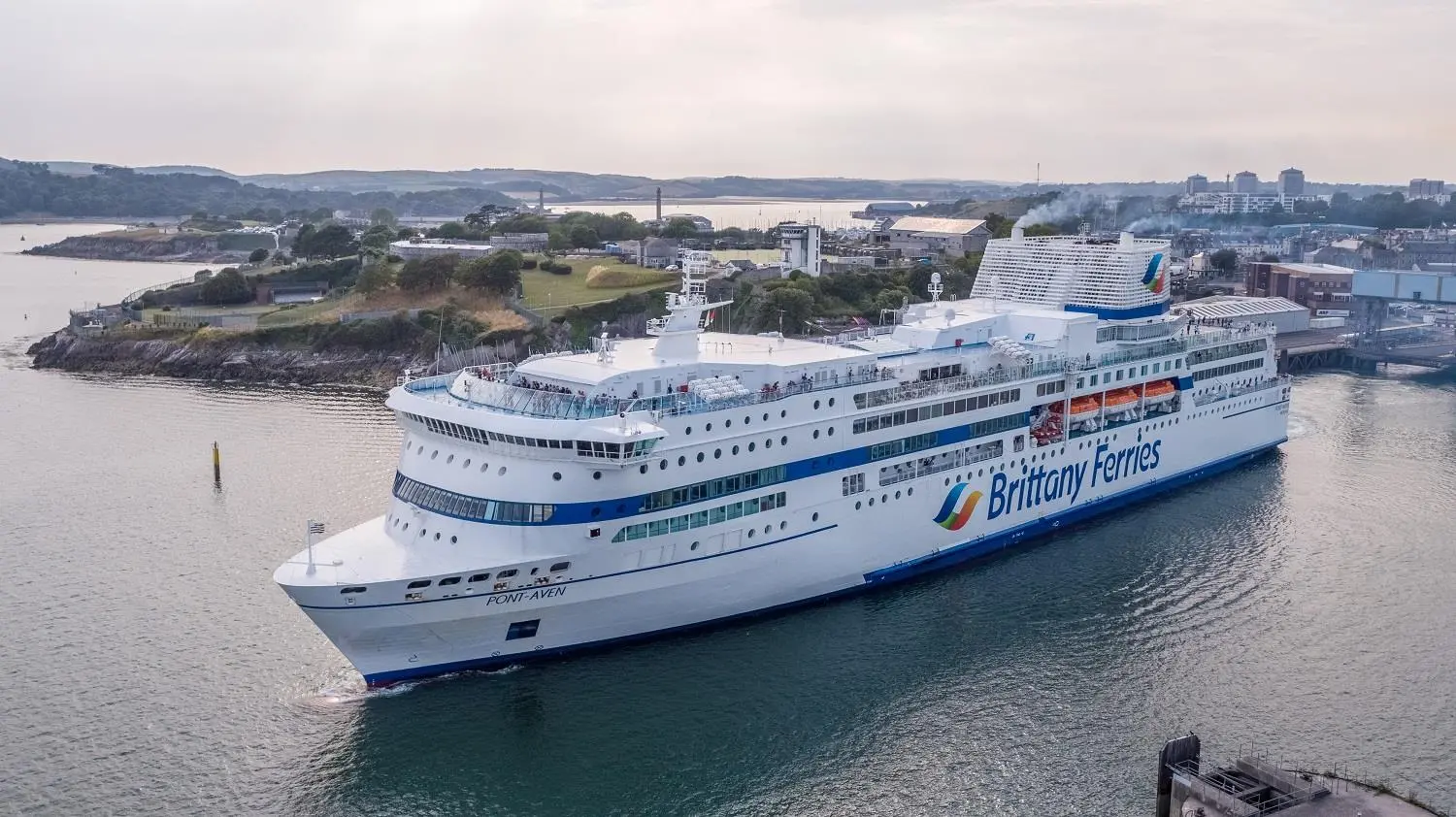
The work was carried out at Remontowa Shiprepair in Poland as part of the cruise ferry’s annual overhaul programme and has increased the hull length by some 3m, enhancing hydrodynamic performance by reducing resistance when under way. The vessel subsequently sailed from Gdansk on January 6 for Le Havre, prior to re-commissioning on Brittany Ferries’ route network.
The project to boost the German-built , 41,000gt ferry’s fuel economy had started with computational fluid dynamic (CFD) simulations developed by the design office of French shipbuilder Chantiers de l’Atlantique. Engineers had first considered the ship’s bulbous bow. Although a dozen design modifications were evaluated, all findings indicated little prospective benefit in terms of fuel savings, such that attention turned to the stern.
“When we looked at improvements in stern design, results of the CFD simulations were far more promising,” said Brittany Ferries’ research and projects manager Brice Robinson. “In fact, the data pointed to a significant reduction of around 10% with the addition of a duck tail, which was very exciting.”
Theory was then subjected to physical scrutiny whereby Mr Robinson and his team travelled to Hamburg Ship Model Basin (HSVA) for practical investigations to be carried out in the consultancy’s 300m-long test tank. Pont-Aven had been constructed by Meyer Werft at Papenburg in 2004, and the shipbuilding contractor’ technical design evaluations in 2002 had included testing the hull form at HSVA. For the upgrade project, the original design drawings for the vessel allowed a seven-metre scale model of the hull to be re-crafted, complete with stern modifications.
In total, three different duck tail shapes were tested, all of which backed-up the data from the CFD representations. “The improvement was obvious the moment the first model took to the water,” observed Brice Robinson.
“Extending the hull immediately changed the way it sat, flattening the turbulent wake behind the transom, thereby reducing drag around the stern. This should be even more significant when applied to our flagship, as it will help compensate for the additional weight of her scrubber system, fitted in 2015,” he added. Pont-Aven had been one of five ships of the fleet to have benefited from a clean ship investment strategy of around EUR90m($98m) in scrubber retrofits, supported by l’Agence de la transition ecologique (ADEME).
Having identified the most effective duck tail solution, the requisite fabrication and integration work was included in the ship’s planned winter technical break. Brittany Ferries has also been examining scope for propeller enhancements, in conjunction with Wartsila. This could yield a further 5% propulsion efficiency gain through a retrofit project, to be implemented at a future stage.
As a 185m newbuild from Meyer Werft, Pont-Aven had made her maiden voyage in March 2004, and has been deployed on various routes connecting the west of England and southern Ireland with France and Spain. The primary power installation is based on four MaK 12-cylinder M43-series medium-speed engines, driving twin screws for a speed of 27 knots.
In a further initiative, Brittany Ferries recently approached Bureau Veritas Solutions for support in forecasting performance, fuel consumption and greenhouse gas (GHG) emissions across the fleet.
The shipowner’s key aim was to ensure the ability throughout its organisation to meet Carbon Intensity Indicator (CII) and EU Emissions Trading System requirements and, in the longer-term, to map out the most efficient vessel utilisation, capacity and route planning, retrofit scheduling, timetabling and voyage management.
Focused on the key metrics of vessel speed and fuel consumption, BV Solutions developed and has now delivered the web-based Fleet Energy and Emissions Forecast tool. Ship-specific energy models, combined with ports and route data, enable forecasting adapted to the decision-making process. Brittany Ferries can use the application independently, adjusting parameters to develop detailed scenarios that allow for operational planning that ultimately cuts fuel usage, emissions and costs.
Related Articles
 ENERGY SAVING DEVICES
 ENERGY SAVING DEVICES
 AMMONIA