



FUEL CELL SYSTEM DEVELOPED FOR FUEL FLEXIBILITY
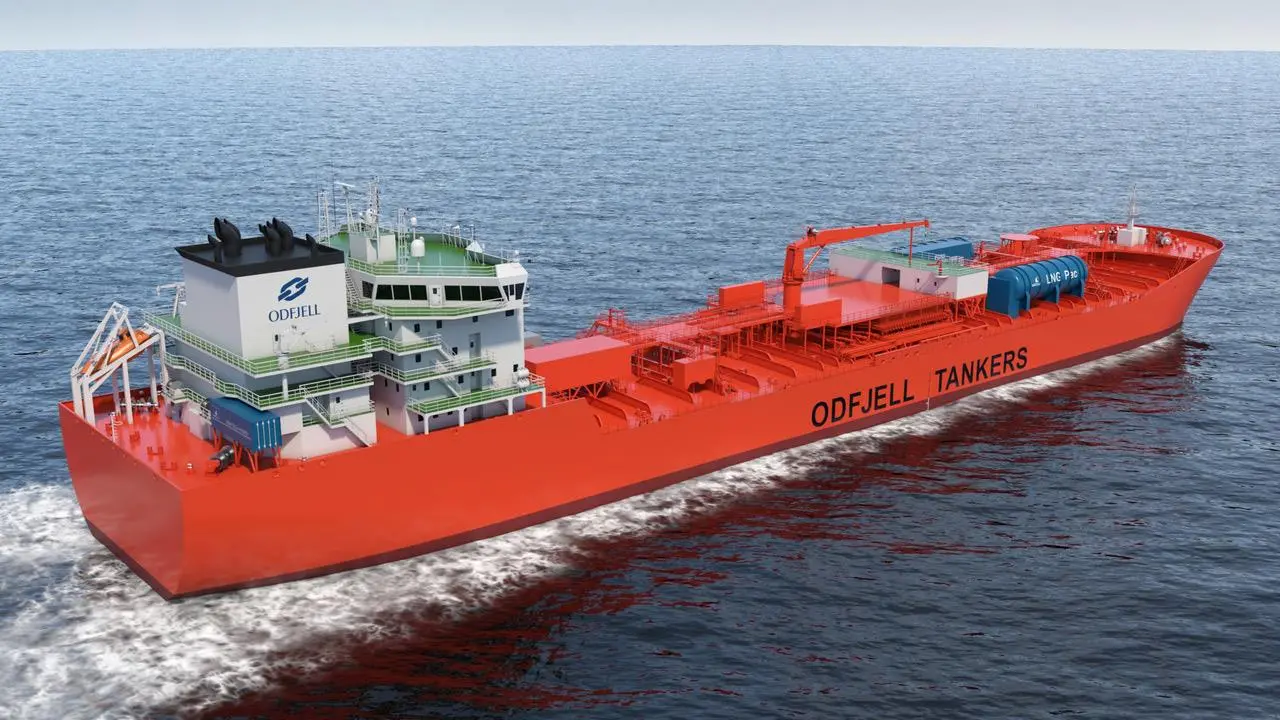
The fuel cell system is being developed by fuel cell manufacturer Prototech, and project partners Odfjell, Wärtsilä and Lundin Energy Norway are constructing a 1.2MW prototype that will first be tested at the Sustainable Energy catapult centre in Norway then onboard one of Odfjell’s newest chemical tankers.
The system will be able to run on fuels like ammonia, methane and methanol, but not hydrogen. Different re-fuelling systems will be used for the different fuels.
“We don’t foresee operating on a mixture of fuels, so the tanks must be emptied before refuelling with a different fuel,” says Tjalve Magnusson Svendsen, Researcher at Prototech.
Fuel-flexible storage tanks will be located on deck and will have a capacity of around 40 days. The fuel will be stored in liquid form, then transferred to a fuel treatment unit where, through temperature and pressure control, it will be converted into gas form before being transferred to the fuel cell system. The system and the fuel cell modules will include safety functions such as ventilation and fuel cut-off functionality, adapted for the different fuels, to maintain safe operation at all times.
SOFC technology
In fuel cells, fuel and air is electro-chemically converted to water and electricity, without any combustion. Fuel cells are therefore not bound by the efficiency limits of combustion processes and are in general more energy efficient. “Our fuel cell modules are based on the Solid Oxide Fuel Cell (SOFC) technology. These fuel cells operate at high temperature which enables utilisation of heat for fuel treatment (NH3 decomposition) inside the system as well as for other purposes onboard,” says Magnusson. The systems will also be optimised for high fuel utilisation, which he says is important for the overall efficiency.
Fuel cells, as batteries, consists of electrodes and an electrolyte. Positive ions are transferred through the electrolyte between the electrodes, at the same time as electrons travels through an external circuit available for electrical loads. In Proton Exchange Membrane (PEM) fuel cells protons goes through the membrane electrolyte, while oxygen ions are transferred through a solid electrolyte in Solid Oxide Fuel Cells. “Although PEM fuel cells have other benefits such as low size and weight, they require pure hydrogen for operation and do not provide the fuel flexibility that we aim for with our systems,” says Magnusson.
“For us as shipowner, this [fuel flexibility] will be essential moving forward, as we can focus our efforts on engines instead of what the next commercially available fuel type will be,” says Erik Hjortland, Vice President, Technology at Odfjell Management. “Remember that when we order a new ship, we make a 30 year commitment, and therefore we need to think zero-emission today. However, deciding today what fuel our ships will burn over the next 30 years comes with a high risk these days. With this fuel cell project, we keep a lot of fuel-options open, both the mid-term low-emissions fuels and the long term zero-emission fuels.”
Wärtsilä system integrator
The system will replace and run in parallel with auxiliary gensets. Wärtsilä will provide the overall inverter systems, energy management systems, storage and re-fuelling systems and the complete system integration.
“This pilot installation is a 1.2 MW unit, and as such it can cover our electricity requirements for most sea voyages and around 80% of our port operations, but the ultimate target for the technology is to scale it up to cover the full power requirements for a vessel,” says Hjortland. “As such, this is one of the pathways we follow to ultimately get a zero emission capable ship on the water.”
Protech’s tests show a CO2 reduction of as much as 40-45% when using LNG, compared to current solutions. The technology also enables direct capture of CO2, which will be another alternative for emission-free operation when logistics for CO2 management become available.
The on-shore testing of the fuel cell is planned to be completed in 2021. Odfjell expects to be able to retrofit it onboard one of its newest deep sea chemical tankers sometime after 2022.
Related Articles
 ALTERNATIVE FUELS & LUBRICANTS
 ALTERNATIVE FUELS & LUBRICANTS
 ALTERNATIVE FUELS & LUBRICANTS