



Fuel-Flexible Coastal Tanker Series
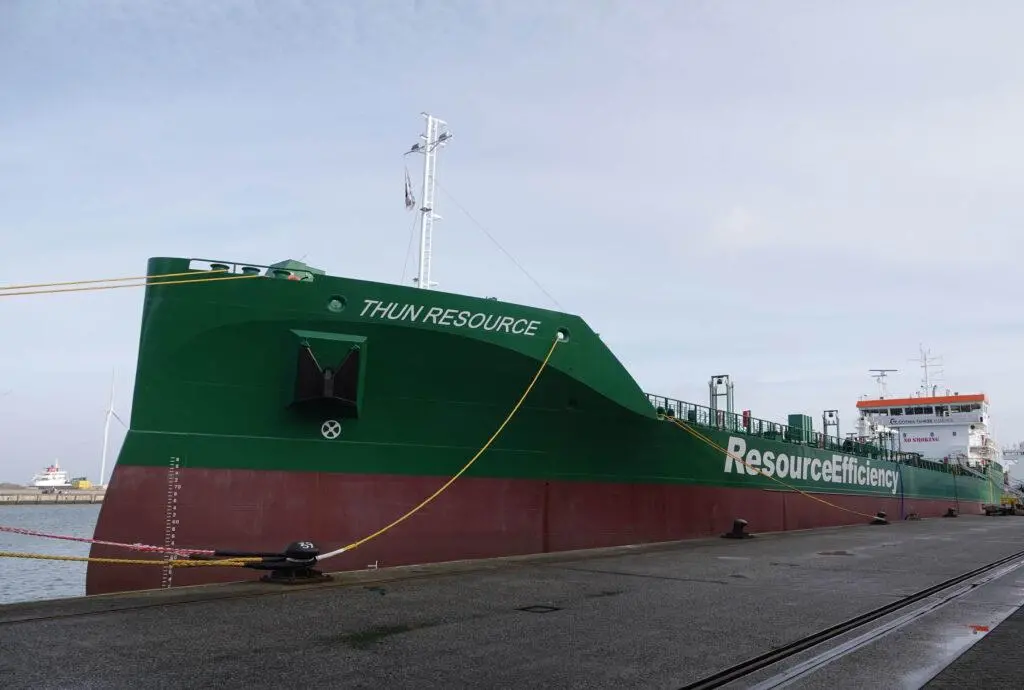
Leading a programme placed in several contractual tranches with Dutch shipbuilder Ferus Smit, the R-class is seen by the parent Erik Thun Group as raising the bar in resource efficiency in the short-sea tanker business, shaped not simply by its own goals but also by the corporate agendas of clients. Preparedness for operation on methanol is one facet of the design planning for future use of alternative fuels.
Registered under the Dutch flag, Thun Resource has been by secured on five-year charter by Swedish oil refiner Nynas, and duly took up revenue-earning service in early February, sailing from the company’s Nynashamn terminal, near Stockholm, for coastwise passage to Kalmar and thence on to Antwerp.
The new, 115m entrant will supersede the 2007-built Thun Gothenburg in Nynas’ employment, and has been customised to the latter’s particular requirements, input having come from the user at the early design stage. This has resulted in optimisation to the logistic criteria set by the refiner’s strong market presence in naphthenic speciality products (NSP), coupled with a trading profile in the often challenging conditions of Scandinavia, the North Sea, and Europe’s Atlantic fringe.
Customisation has resulted in the cargo space being divided into 16 tanks, rather than the 13-tank configuration in the subsequent newbuilds. Transportation volume amounts to 9,572m3. Each tank has been treated with a Jotun epoxy coating and is fitted with an individual cargo pump, making for a high degree of cargo carrying versatility as to product and parcel size, and promoting turnaround efficiency. The expectation is that the engagement in the Nynas trade will come to extend beyond the initial five-year commitment.
Of particular significance from a charterer’s standpoint, the overall fuel efficiency of the new vessel is reckoned to denote a 35% improvement over existing tankers in the trade. The scale economy factor is influential, as the Thun Resource embodies a cargo capacity increase of some 1,500m3 in relation to the Thun Gothenburg, and within smaller length and breadth measurements. Hull reinforcement is to Swedish/Finnish 1A ice class standard.
The R-class affords a showcase for the 2022-launched, small-bore four-stroke Wartsila 25 engine series. The W25 melds efficiency with a very high degree of fuel flexibility, allowing operators to reach beyond current emission reduction targets. On its release, Wartsila drew particular attention to the engine’s readiness for running on carbon-free ammonia as well as other, alternative low-carbon or carbon-neutral fuels, thanks to an easily upgradable modular structure.
In the case of the adoption by Thun Tankers, the Swedish group views the W25 platform’s multi-fuel properties as especially beneficial in vesting the new generation of coastal tankers with a methanol-ready capability. The choice of machinery fits with Thun’s long-term strategy of ensuring that the ships can be switched relatively easily, if required, to operation on methanol as an alternative to MGO or gas oil with bio-blend. Ammonia usage, however, does not figure in its plans for the R-class.
The six-cylinder model fitted in Thun Resource is rated at 1,950kW, delivering power through reduction gearing to a nozzled, controllable pitch propeller, for thrust maximisation and a speed of 14 knots.
The compact nature of the 250mm-bore design, whereby the comparatively high output per cylinder means fewer cylinders are needed for a specific rating, was also an attraction for the shipowner. Moreover, and given the critically competitive requirement for service dependability and ship availability in the short-sea distributive traffic, the W25 offers increased uptime through an extended TBO interval of at least 30% compared to previous machinery.
Upgrading for a chosen future fuel will simply entail replacement of selected engine components, obviating the time and costs associated with a long, complex overhaul or re-powering. The engineering policy of the contractual owner goes beyond all the key performance and economic conditions, to a regulatory oversight founded on the bid to ensure that the vessels do not become ‘stranded assets’ as the industry transitions to carbon-neutral fuels. The project provides continuity of recent years’ strong working relationship between Wartsila and both Erik Thun and Ferus Smit.
Substantial fuel savings are expected to ensue from the adoption of Berg Propulsion control technology, including Dynamic Drive functionality. The latter is an adaptive thrust and fuel optimisation software, available for inclusion with the Berg MPC800 control system. The software automatically and dynamically identifies the most energy efficient settings for propulsion pitch/rpm to produce the thrust to maintain the required speed.
The vessel also incorporates a UPS (uninterruptible power system) battery pack, to render increased reliability and reduced emissions, and has been readied to draw electricity from the shoreside grid at suitably equipped berths.
Thun Resource has been entered into the Gothia Tanker Alliance, the Gothenburg-domiciled cooperative venture which holds shipment contracts with oil majors and traders, primarily across northwest Europe. Technical management has been entrusted to MF Shipping Group of Farmsum, near Delfzijl, in the north Netherlands.
MF also provided construction supervision on the owner’s behalf at Ferus Smit’s German yard at Leer, where the vessel was side-launched into the River Ems during November. Following completion, the tanker was towed down the Ems estuary to the Dutch port of Eemshaven, from where trials were conducted in mid January.
Production of the R-class series extends into the autumn of 2027, and it is understood that this involves delivery slots for the ensuing seven vessels from both Leer and the Ferus Smit headquarters yard at Waterhuizen, on the northern Dutch inland waterway network near Groningen.
MAIN PARTICULARS – Thun Resource
| Length overall | 114.95m |
|---|---|
|
Length bp |
112.34m |
|
Breadth |
15.87m |
|
Depth |
10.10m |
|
Draught |
6.95m |
|
Deadweight |
7,999t |
|
Gross tonnage |
4,923t |
|
Cargo capacity |
9,572m3 |
|
Cargo tanks |
16 |
|
Ice class |
Swedish/Finnish 1A |
|
Main engine power |
1,950kW |
|
Speed |
14kn |
|
Flag |
Dutch |
Related Articles
 METHANOL
 METHANOL
 2-STROKE & 4-STROKE