



Future of Hydrogen looks to North Sea
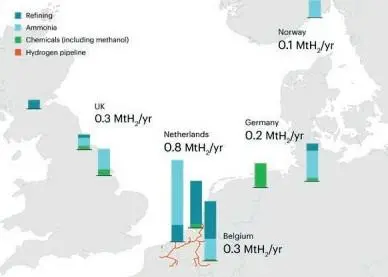
The Future of Hydrogen reports that the region is a contender thanks to it being a strong base with nine key industrial hubs and having a proximity to CO2 storage potential and with hydrogen pipelines in place. Moreover there is a strong political will for both ambitious climate policies such as offshore wind power and hydrogen as fuel.
The nine industrial hubs around the North Sea currently consume a total of 1.7 MtH2 annually, nearly half of which is for ammonia (0.8 Mt), and most of the rest for refining (0.6 Mt) and chemicals (0.2 Mt).
The North Sea has some of the best-developed CO2 storage resources in the European Union. Since 1996 CO2 has been injected into the Norwegian continental shelf at a rate of 1 MtCO2 per year. While progress has slowed, North Sea projects to capture and store CO2 from natural gas-based hydrogen production are now among the leading candidates for CCUS in Europe.
The North Sea already hosts 13 GW of offshore wind, and national targets for 2030 could take this above 50 GW. If 5% of the targeted North Sea offshore wind output in 2030 were used to produce hydrogen, around 0.2 MtH2 per year of low-carbon hydrogen could be supplied satisfying more than 10% of the today’s industrial hydrogen demand around the North Sea.
Related Articles
 ALTERNATIVE FUELS & LUBRICANTS
 ALTERNATIVE FUELS & LUBRICANTS
 ALTERNATIVE FUELS & LUBRICANTS