



German cruise newbuilding expands
Authorities in Mecklenburg-Vorpommern (MV) in the old GDR and in its shipyards in Wismar, Rostock, Warnemünde, Stralsund and Wolgast certainly think so and they anticipate wide-ranging benefits for the sector.
Shipbuilding on the German Baltic coast has taken a lot of knocks since political union in 1990. The expensive reconstruction of obsolete GDR facilities after union, the imposition of restrictive yard production quotas and a string of not always successful yard ownerships and alliances have all seen to that.
Work forces and yards have dwindled and the collapse, 20 years ago this year, of the giant Bremer Vulkan Verbund didn’t help matters either – dragging down MV shipyards and putting 23,000 people out of work.
So the creation this summer in Wismar of the cruise ship newbuilding group MV Werften by well-heeled Malaysian investor Genting Hong Kong (GHK) makes a refreshing change. All agree that much hard work lies ahead in the three partner yards affected, but the potential rewards have to be great – new jobs, work for suppliers and orders running into the billions of Euros.
It’s only little more than a year since GHK appeared on the German shipbuilding scene to take over Lloyd Werft Bremerhaven (LWB) and sign a letter of intent for big ocean-going cruise ships and for a new class of river cruise ships.
The prospect of building new ships again after a ten year gap, rather than converting them, was welcomed by LWB and the state of Bremen which announced €30 million investment in quay renovation to support LWB and the yard itself bought a new quayside crane.
The LWB acquisition was followed in April this year by Genting buying the three German Baltic yards of Wismar-based Nordic Yards in Wismar, Stralsund and Warnemuende for €230.6 million.
That came at a good time for Nordic – facing job losses because of offshore business decline and other problems. It also brought into the Genting fold the facilities the owner needed to produce a string of big new cruise ships, too numerous to build in Bremerhaven alone.
In May GHK said “the newly acquired yards, together with the previously purchased Lloyd Werft shipyard in Bremerhaven will be managed as the Lloyd Werft Group, optimizing the strengths of each yard for design, fabrication, outfitting and final assembly”. LWB said work would be shared out between the four.
However, less than two months later GHK changed tack. It announced the creation of MV Werften – grouping the three former Nordic Yards facilities on the Baltic and not involving LWB at all. It also said the new group would be managed from Wismar not Bremerhaven.
LWB, it announced, would continue to “focus on its previous business of repair and conversion”. It would also use its giant new Design Centre, opened by GHK officials at LWB in May and staffed by 250 design personnel, to “strengthen its ability to build mega yachts”, it declared.
A source in Bremerhaven told The Motorship LWB would also continue to build specialist ships of the type it has completed in the past. Other than that however, the source acknowledged that as far as Genting’s new ships were concerned, they would now all be built at MV Werften – including the 201,000gt cruise newbuildings for GHK subsidiary Star Cruises and also the river cruise ships which LWB had been expecting to build.
Throwing light on the reasons for Genting’s sudden change of plans the source said the planned newbuildings were “just too big to be built in Bremerhaven and that is one of the reasons for the concentration now on the Baltic shipyards”. Another consideration of course is that LWB has no covered newbuilding facilities.
News of the exclusion of LWB from newbuilding in the east met with surprise on the Weser. Bremen State’s Economics and Ports Senator Martin Günther expressed “complete incomprehension” at the move and cast doubt on the state’s planned local quay renovation investment. In Mecklenburg-Vorpommern, however, State Economics Minister Harry Glawe understandably described the creation of MV Werften as a big chance for local yards to assert themselves on the global market.
Perhaps the last word for now rests with a source at MV Werften who told The Motorship “These are exciting times for the north German shipbuilding industry. Lloyd Werft and MV Werften will remain autonomous concerns even though we will continue to co-operate closely on some projects”.
Genting said MV Werften will become “one of the world’s most modern and efficient cruise shipyards” and announced investment of €100 million. It said it would be spent on “a thin plate laser welding line, a cabin module factory, a new covered section block building hall, in modernised manufacturing control systems and in new executive and employee offices and facilities”.
It will be tough going for the new MV Werften to meet the scheduled exhaustive newbuilding demands of Genting’s three cruise shipping subsidiaries. Up-front state financial help appeared unavoidable but forthcoming. GHK wants to deliver the first in a series of luxury Crystal River ships as early as 2017, the first of a series of 20,000 gross tonnage Crystal Endeavor Class polar expedition vessels in 2018 and the first of the giant 201,000gt Star Cruises Global Class cruise ships by 2020. ABB has already announced Azipod XO orders for the polar expedition newbuildings.
The planned annual output of MV Werften will be stepped up in future years until yards are building two Neo-Panamax cruise ships of over 200,000 gross tonnage each and one Panamax cruise vessel a year, Genting declared. It noted MV Werften had docks, fabrication halls and painting shops which are all covered and, as a result, is able to produce cruise ships of the highest quality and workmanship.
Genting’s purpose in creating MV Werften is to be independent of yards with full order books and long delivery times. Like leading cruise ship builder Meyer Werft in Papenburg which reflects the problem perfectly with a bulging order book into the next decade.
Two ships were booked by Genting some time ago. The first of the 151,000gt, 335m long sisters for the new Dream Cruises brand – Genting Dream – is for delivery about now and aimed at the fast-growing Chinese market. Work started in February on sister ship World Dream, for delivery in a year’s time. Meyer built the 76,800gt Super Star Virgo and Super Star Leo for Genting’s Star Cruises in 1998 and 1999.
The latest ships have four MAN B&W medium-speed Diesels – two 12V 48/60CR and two 16V 48/6 units – developing more than 23 knots.
Nearly identical engine configurations are reported on the 167,800gt Norwegian Joy, the fourth of six ships for delivery up to 2019 to NCL and the biggest of twelve built to date for the owner. The latest ship will also have MAN B&W main Diesels and a pair of ABB Azipod XO propulsion units.
The Meyer order book also includes two further newbuildings for Disney for delivery in 2021 and 2023. Of about 135,000gt they will bring to five the number of ships for Disney from Meyer. Industry insiders say they are likely to cost around €600 million apiece.
Being delivered to AIDA Cruises in 2018 and 2020 are two “revolutionary” new-generation ships of more than 180,000gt. They will be not only the biggest ever for the German owner but also the first in the cruise industry to use LNG in hybrid engines both in port and at sea. LNG will be stored onboard and a major part of the design involves making much more efficient use of on-board space – meaning the largest passenger capacity ever on a cruise ship – 6,600!
The new ships mark the resumption of AIDA’s long-standing partnership with Meyer after ordering AIDAprima and AIDAperla at Japan’s MHI.
The Meyer newbuildings are part of a “multi-billion Euro” order for four LNG-driven ships for the Costa Group, which groups AIDA and Costa Cruises. Two further ships of the same type are being built at Meyer Turku.
The first newbuilding ever for Saga Cruises has also been added to the Meyer order book for delivery in Summer 2019 with Saga securing an option for a second in Spring 2021. At 55,900gt the Saga ship will be smaller than most of those built at Meyer in recent years so the yard is reactivating its Building Dock 1, which is used for block construction. Meyer said three new cruise ships can now be delivered in 2019 instead of the currently planned two ships.
In April Meyer delivered the 168,660gt Ovation of the Seas – the third of five Quantum Class RCC ships for delivery by autumn 2020. Billed as some of the most eco-friendly newbuildings to date, those ships are powered by two Wärtsilä 16V46F and two 12V46F Diesels engines and also have two CAT 3516C HD units. Propulsion is via two ABB Azipod XO thrusters providing 22 knots and there are four Brunvoll FU115 bow thrusters to hand.
For handover later this year by the Flensburger Schiffbau-Gesellschaft (FSG) after launch in June and trials is the 182m LNG-fuelled Searoad Mersey 11, second of two for Australia’s Searoad.
The ships each have two MaK M46DF engines of 14,400kw combined and operate on LNG with 1% MDO secondary fuel for pilot injection. Of 8,500dwt, they operate at 20.5 knots and also have two MaK M34DF medium speed auxiliaries.
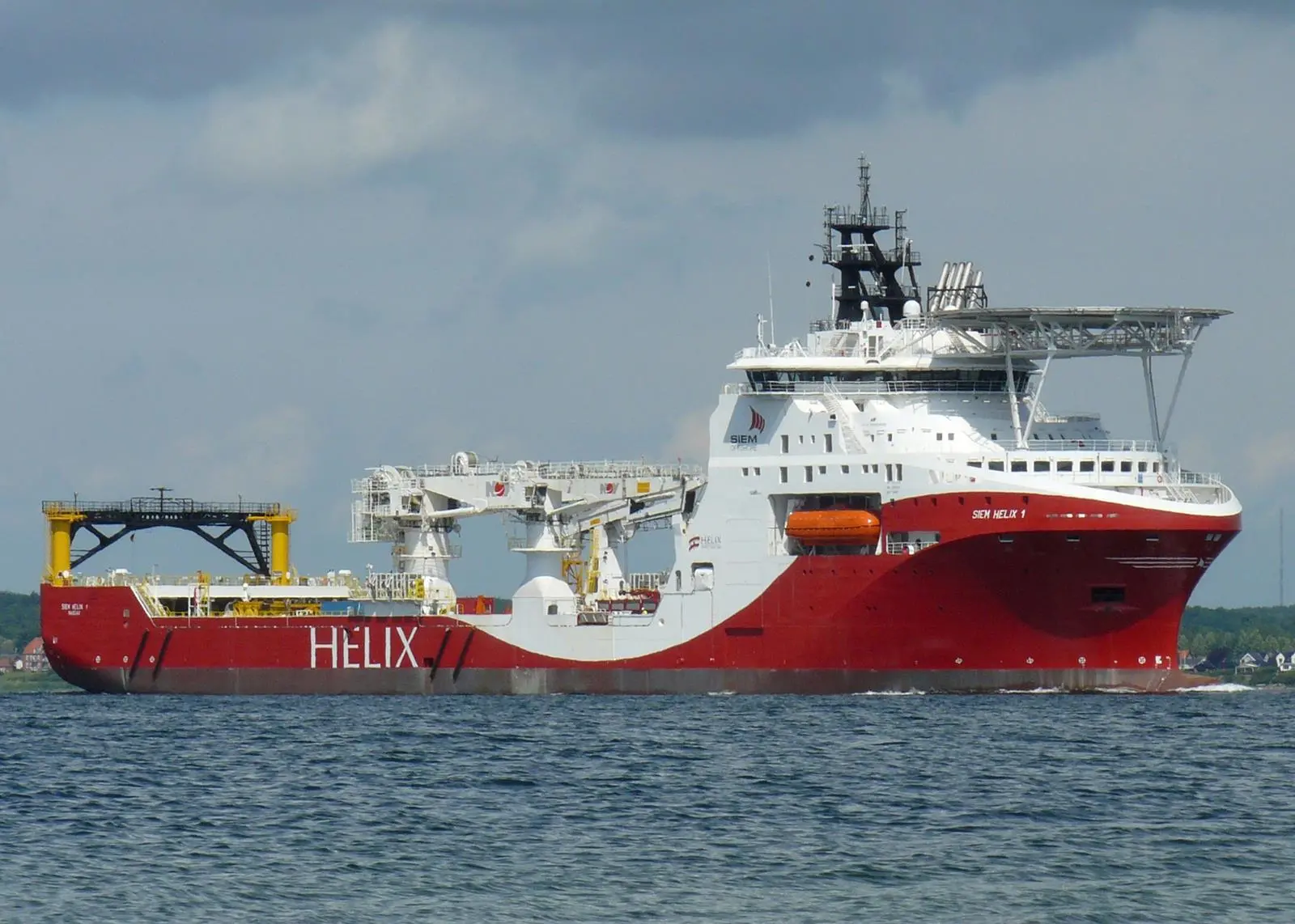
FSG handed over the 158.65m well intervention ship Siem Helix 1, billed as one of the most complex ships of its kind in the world. The SALT 307 WIV design vessel of 21,500gt accommodates 150 and has a 3,100 m2 cargo deck area and three cranes of 250/60/20 tons. Of DP Class 3 it has Diesel-electric propulsion comprising eight Wärtsilä Type 6L 32 engines of total 24,000 kW provide a service speed of 15 knots. There are two CPPs of 2.8m diameter, two 2,200kW bow thrusters, 3 3,000kW stern thrusters and two 2,000kw retractable thrusters as well as two flap type rudders.
Siem Helix 1 is the first of two for Siem Offshore, part of Norway’s Siem Group which owns FSG. Siem has also just ordered four further newbuildings from the yard ensuring work there to mid 2018.
Two are 209.79m RoRo newbuildings of 4,100 lm for charter to Turkey’s EKOL Group and for delivery in 2017 and 2018. The other two are listed as 209.6m long and for long-term charter to DFDS after delivery in May and September 2017. There were no initial engine details.
Hot on the heels of the Siem orders came a €144 million contract with ICG Irish Ferries for a 194.8m RoPax cruise ferry of 2,800 lm for delivery in May 2018. It will be powered by four main engines of total 33,600KW providing 22.5 knots and boast 2,800 lm.
Elsewhere, Meyer’s inland cruise ship subsidiary Neptun Rostock is building a 161m LNG gas tanker for Veder in Holland for delivery late next year – its second for Veder since 2012. Neptun is also building another 75.9m island ferry for German owners WDR, identical to their Schleswig-Holstein, built in 2011. For delivery in 2018 it will also be to Germany’s Blauer Engel eco-standard.
Meyer has meanwhile also decided to make Neptun the future production site for engine room modules and blocks for ships built in Papenburg and at Meyer Turku in Finland.
Ferus Smit’s German newbuilding yard in Leer continues to build 10,500dwt general cargo, flexible loading ECOBOX ships. It completed Symphony Sun in summer – the fourth of six of the 122.5m ECO bulbless canoe bow vessels. The last two are for delivery in 2017 and 2018 from Leer or the parent Dutch yard. In February the Leer facility delivered Nordana Sea since renamed Symphony Sea – the third in the ECOBOX newbuilding series.
Related Articles
 PROPULSION
 GENERAL NEWS
 HYDROGEN