



GERMAN KNOW-HOW FOR US FLEET OILERS
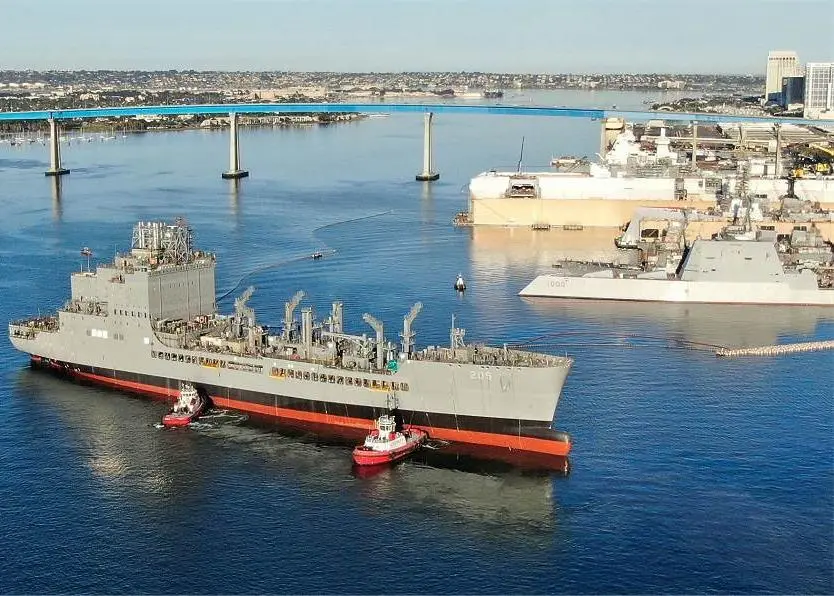
The US Navy plans to procure a series of 20, twin-engined vessels to take over the role of an earlier generation of ships in providing at-sea, underway transfers of fuel and other supplies. Six 227m newbuilds have been ordered to date, from General Dynamics’ NASSCO yard in San Diego, California, where the first was formally christened as the USNS John Lewis on 17 July. Service entry, under the aegis of Military Sealift Command (MSC), is scheduled next March.
The twin-screw propulsion installation is based on a pair of 12-cylinder, vee-form models of the MAN 48/60CR common-rail, four-stroke diesel, driving twin propellers through reduction gearing. Each engine delivers a maximum continuous output of 14,400kW at 500rpm, for a total power concentration of 28,800kW to ensure a speed of 20 knots. The plant incorporates exhaust aftertreatment technology.
In March 2017, Fairbanks Morse was awarded a contract covering 34 examples of the 12V48/60CR engine and associated equipment for 17 of the planned ‘oilers’.
While NASSCO has secured the first six newbuilds under a block buy contract, requiring 12 engines in total, a further eight of the planned replenishment tankers are expected to be ordered in the period up to 2023, necessitating 16 more power units. Roll-out of contracts for the final six ships in the 20-tanker programme would take the active engine requirement to 40.
The John Lewis(T-AO-205) fleet oilers are of 227.4m x 37.4m main dimensions, and are based on commercial vessel design standards and technology. They will supersede, and are design derivatives of, the T-AO-187 Henry J.Kaiser class, 16 of which were introduced between 1986 and 1996. Constructed at the former Avondale Shipyard, near New Orleans, each of the earlier generation is of 206.3m x 29.7m, and fitted with two Fairbanks Morse Colt-Pielstick PC4.2-series diesels to deliver a combined, maximum 25,000kW on two shaftlines for a speed of 20 knots.
The longer, beamier, higher capacity and more powerful John Lewis type has a full-load displacement of 49,850t, with the capability to provide underway support of naval ships at sea, transferring oil fuel, and also ammunition, consumables and stores, plus fuel for aircraft embarked on carriers. Tank capacity equates to 157,000 barrels of oil, and provision has additionally been made for biofuel transportation and delivery. The above-decks layout features five refuelling stations and two dry cargo transfer rigs, plus a flight deck with the means of refuelling helicopters.
The double-hull configuration affords protection against damage to the inner hull, and the ships have also been specified with anti-torpedo defence and degaussing systems, and prepared so as to allow armaments to be carried if required.
Using rail transport, the Fairbanks Morse factory at Beloit, Wisconsin, recently despatched the fifth and sixth engines under the block supply contract. The machinery is destined for the third of the replenishment tankers taking shape at San Diego.
During 2019, Fairbanks Morse extended its licence agreement with MAN Energy Solutions for another 10 years. The business relationship started in 1968, when the US firm signed up to manufacture medium-speed engines from the SEMT Pielstick range. A licence agreement for production of engines from the MAN Augsburg portfolio followed in 1995. Pielstick has been wholly-owned by MAN since 2006, after it purchased the MTU shareholding.
Fairbanks Morse was bought from EnPro Industries by private equity firm Arcline in January 2020. In May this year, the US engine maker expanded its scope of power and propulsion equipment and aftermarket services by acquiring the electric motor and control system specialist Ward Leonard.
Related Articles
 PROPULSION
 GENERAL NEWS
 HYDROGEN