



Getting a head for heights?
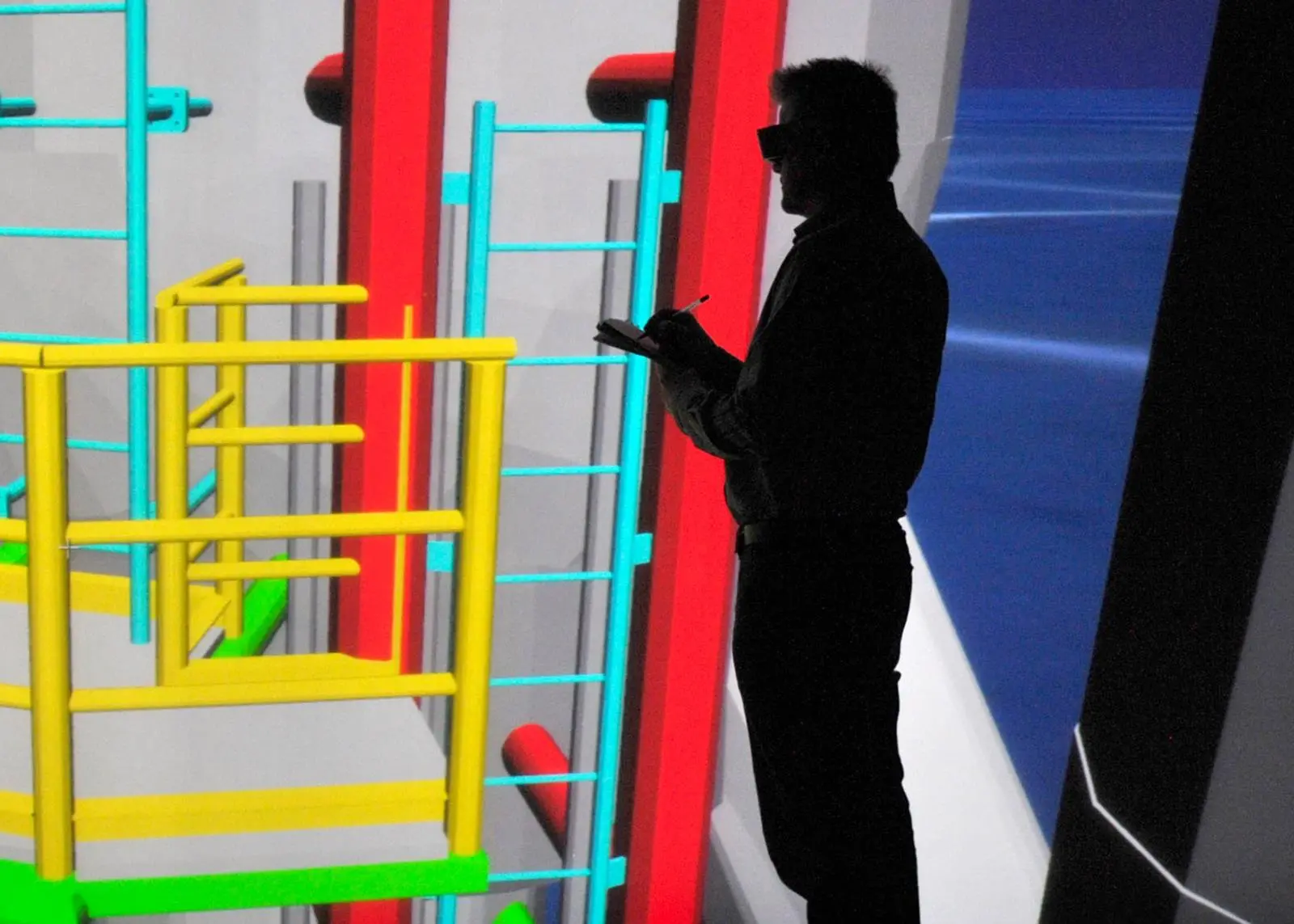
It’s less like a cave than a big, 2.5m cube, explains coordinator Emma-Jane Alexander of the Hull Immersive Visualisation Environment (HIVE). However to give people a real sense of the environment, it’s not just the walls which benefit from the imagery but the floor too. “This means you can look ahead to the horizon and also look down into the water.” For extra realism the images are rear projected so there’s no shadows to speak of, and while the cave’s dimensions means you are somewhat constrained, this constraint mirrors the real world working situation.
The 3D cave will be located in at the University’s Department of Computer Science, and is being developed by a team of specialist software engineers led by the University’s Simulation and Visualisation Research Group.
HIVE has been awarded £240,000 Higher Education Funding Council for England cash through CASS to develop the two-year project, which will also see the strengthening of the partnerships between the University and industry with a view to commercialisation and generating income.
Ms Alexander adds: “The key thing is sector engagement. We have to make it our business to engage not just with what we think we can fix, but listening to what costs the sector money and what the challenges really are.” For example working at height training has already been flagged up as an issue. While this simulation won’t replace real world experience, Ms Alexander says: “If you can induce a memory to assist a trainee, it will help when they get there. You don’t actually need many virtual indicators – triggers – to induce appropriate feelings.”
“This virtual space allows us to simulate the journey to an offshore platform via specialist vessel for instance, or prepare people for the feeling of standing on an offshore facility in the open sea and experience what can be a very hostile environment. We will also be able to simulate the different weather conditions and sea states that engineers and transport operators will face.”
The training, with industry input, could be quite specific. For example HIVE could immerse trainees in an environment where they face the specific kinds of engines or gearing they would come up against. “For renewables work we could put them inside the turbine nacelle itself and instruct them on the various kinds of drive used in these applications,” says Ms Alexander.
As well as using a 3D cave, the project will also seek to simulate the winching experience by helicopter, using a head mounted display.“We will have a gantry and this will allow us to suspend a trainee in a real offshore harness wearing a head mounted display; they’ll be able to see their legs dangling in the harness, the helicopter above and the facility ahead.”
Ms Alexander concludes: “This is exciting technology and it will be an inspiring experience.”
Related Articles
 PROPULSION
 GENERAL NEWS
 HYDROGEN