GHG discussions dominate but consensus still out of reach
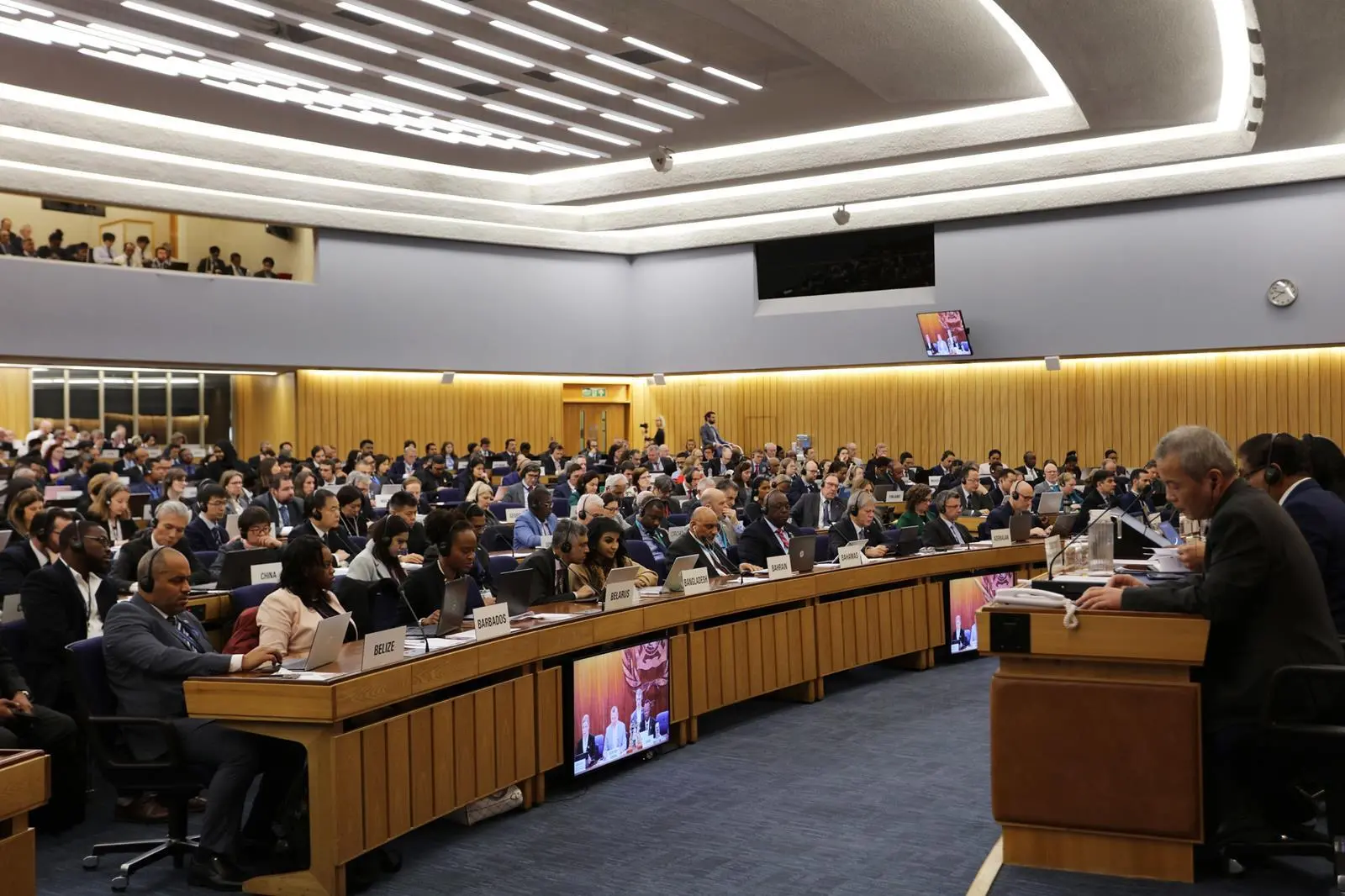
Building on the initial 2018 strategy, the 2023 revised strategy’s more ambitious targets include a 20% reduction in emissions by 2030, a 70% reduction by 2040 (compared to 2008 levels), and the ultimate goal of achieving net-zero emissions by 2050. The figures would be calculated on a well to wake basis and not the tank to wake method that has been used up to date.
However, the target dates were not set in stone with actual wordings saying ‘close to’ which could indicate a measure of drift is being prepared for. In addition, provisos such as the targets would apply for transport work as an average across international shipping suggesting that different ship types or regions would have different levels. There was also a commitment to ensure an uptake of alternative zero and near-zero GHG fuels by 2030, as well as indicative checkpoints for 2030 and 2040.
These targets were to be met by introduction of so-called mid-term measures (the short term measures of a revised EEDI and the introduction of the EEXI and CII having already been agreed and introduced by the beginning of 2023). The strategy envisages the mid-term measures to be in place by 2027 and effective in 2028 in advance of the adoption of the next revision of the GHG strategy scheduled for MEPC 88 in 2028.
MEPC 81 was therefore focussing on identifying the candidate mid-term measures as well as considering how to address industry concerns over identified flaws in the CII. It was also taking forward the work of the Intersessional Working Group on Reduction of greenhouse gas (GHG) Emissions from Ships (ISWG-GHG 16) which took place the week before.
Following MEPC 81, there were many reports from various industry and NGO bodies welcoming what was said to be a gathering consensus on candidate measures for the Net Zero framework although the statement from the IMO was seemingly less confident. It said, “MEPC 81 agreed on an illustration of a possible draft outline of an “IMO net-zero framework” and went on to say that “The possible draft outline for the IMO net-zero framework will be used as a starting point to consolidate the different proposals into a possible common structure, to support further discussions, with the understanding that this outline would not prejudge any possible future changes to it as deliberations progress”.
At this juncture, there is agreement that there would be two elements to the framework’ a technical goal-based marine fuel standard regulating the phased reduction of the marine fuel’s GHG intensity commonly referred to as GFI; and an economic element to incentivise the transition to net-zero. However, there are various opposing views as to what the final outcome would be in either measure.
In a recent DNV podcast, Eirik Nyhus, Director Environment for Maritime set out that there are numerous proposals on the table and while two of the technical measures seem to enjoy more support there is no overall consensus.
Interestingly both of these proposals allow for pooling arrangements for fleet operators. That is a position also supported by industry bodies such as the World Shipping Council which included it in its own paper submitted to MEPC 81. WCS’s argument is that pooling will allow companies to invest in innovative zero emission technologies and count the GHG impact across a fleet of ships. It said in its paper, “A flexible approach to pooling will enable investments that would not be feasible if each and every vessel must perform at the same level at the same time and will help smaller carriers transition more efficiently”.
On economic measures, Nyhus noted in his podcast that views are divergent and there are deep splits. One proposal that would put a price of $150 per tonne of CO2 emitted would effectively add $450 per tonne to the price of bunker fuel. The argument that this allows for a level playing field is countered by those that say it would penalise developing countries.
Support for the $150 levy has grown especially among smaller states and Caribbean countries but a number of other states led by China believe the pooling will provide both a technical and economic measure and that there is therefore no need for a fixed levy. The question of how any levy should be used is another contentious issue. For some states it is simply a revenue generating exercise, others believe its purpose is to advance technologies while some see it as a means to compensate early movers on alternative fuels .
With such divergent views it is clear further work is needed before an agreement can be reached. Detractors of the IMO often colour it as a cumbersome body but that is inevitable as the ultimate decision depends upon almost 200 individual member states reaching an agreement that all can support. Governments of those states will have their own issues to contend with, not least the impact increasing transport costs will have on consumer prices.
There is of course nothing to prevent individual states or even groupings of states from introducing their own rules on GHG and other emissions with regards to ships calling at their ports or flying their flags. The EU has already gone down this route and Norway was the first country to take action against NOx emissions with its NOx levy and NOx fund to incentivise reduction measures for individual ships. If more nations were to do this, it would complicate matters for operators but that would not be unique in the history of maritime trade.
Two related agenda items were discussed, and both will feature strongly in the debates over the adoption of technical and financial elements. These include the relatively new development of onboard carbon capture and the fuel Life Cycle Analysis (LCA) whereby the emissions from well to tank will be determined.
Onboard carbon capture systems (CCS) were initially proposed to the industry some years ago but at the time thought impractical due to the impact of weight of captured gases on ships’ cargo capacity. Since conventional oil fuels produce 3.5 times the weight of CO2 compared to fuel burned, every tonne of bunkers would mean the sacrifice of 2.5 tonnes cargo carrying capacity.
Nevertheless, some CCS have been developed and are already in operation. Depending on how the captured emissions are handled after discharge, credit should be given for emissions saved. It was agreed to establish a Correspondence Group that will further consider issues related to onboard carbon capture and develop a work plan on the development of a regulatory framework for the use of onboard carbon capture systems with the exception of matters related to accounting of CO2 captured onboard ships and submit a written report to MEPC 83.
There has been much discussion on the GHG intensity of different fuels in recent years. The focus concerns that while some fuels produce higher amounts of GHG than others when used on a ship, the production, storage and delivery processes of other fuels means the overall GHG emissions of those fuels could actually be higher.
Initial guidelines on lifecycle analysis (LCA) of GHG intensity of fuels LCA were adopted at MEPC 80. MEPC 81 adopted Resolution MEPC.391(81), 2024 Guidelines on life cycle GHG intensity of marine fuels (2024 LCA Guidelines), which incorporates draft amendments proposed by an LCA Correspondence Group. Furthermore, as the issues investigated at the Correspondence Group were diverse and required expertise, it was agreed to newly establish a Working Group on the Life Cycle GHG Intensity of Marine Fuels under GESAMP to pursue discussions along with its Terms of Reference.
To progress the issues going forward MEPC 81 established a number of intersessional working groups including:
• A GESAMP Working Group on Life Cycle GHG Intensity of Marine Fuels (GESAMP-LCA WG);
• Fifth GHG Expert Workshop on the further development of the basket of mid-term measures (GHG-EW 5) which will hold a two-day expert workshop in July;
• ISWG-GHG 17 (23-27 September 2024);
• Correspondence group on LCA (to submit a report to MEPC 83 in April 2025).
New ECAs and more
Discussions on GHG and related measures were extensive but not the only items on the agenda which also included new NOx ECAs, shortcomings of NOx control technologies, further work on the Life Cycle Analysis of marine fuel GHG intensity, Ballast Water Convention review, ballast water treatment systems approvals and issues around challenging water quality, use of ballast tanks for grey water storage, amendments to MARPOL amongst others.
There were two new ECAs (emission control areas) approved one in Canada and one in Norway. Since the initial applications were submitted at previous MEPC meetings there was little question of these not being approved. The Canadian Arctic ECA will impose a fuel sulphur limit of 0.1% and Tier III NOx limits will apply to ships constructed (keel laying date) on or after 1 January 2025, and which will be operating in the Canadian Arctic ECA. This new ECA would have the added benefit of partially addressing concerns around black carbon emission in the Arctic region.
Also approved was Norway’s proposal for a Norwegian Sea ECA which, if adopted by MEPC 82 would become effective on 1 March 2026. For NOx Tier III to apply to a ship the building contract would need to be placed after 1 March 2026, or if no building contract a keel laying date on or after 1 September 2026. For other newbuildings already ordered the ECA would apply if delivery occurs after 1 March 2030.
Ballast and other developments
The BWT convention is now being monitored in what is called the ‘experience building phase’ where identified weaknesses and contradictions are addressed. MEPC 81 accepted the recommendations of the Correspondence Group with regard to changes already identified as needed and re-established the Correspondence Group on Review of the BWM Convention to prepare draft text for amendments to provisions of the Convention and to associated instruments, and for new provisions and/or instruments with a view to submit a report to MEPC 83.
Interim guidance on ballast management for ships operating in challenging water quality was adopted and work continues on developing a comprehensive set of guidelines to apply to ships, administration and ports. Guidance for temporary storage of treated sewage and grey water in ballast tanks, necessary when reception facilities at ports is inadequate, was approved. The guidance sets out the standards such as for flushing tanks after temporary storage and for implementing the relevant procedures in Ballast Water Management Plans. Discussion on ballast water treatment (BWT) saw four systems given new type approval and one using an active substance granted Basic Approval.