



GREEN INVESTMENT UNDER THE TRICOLORE
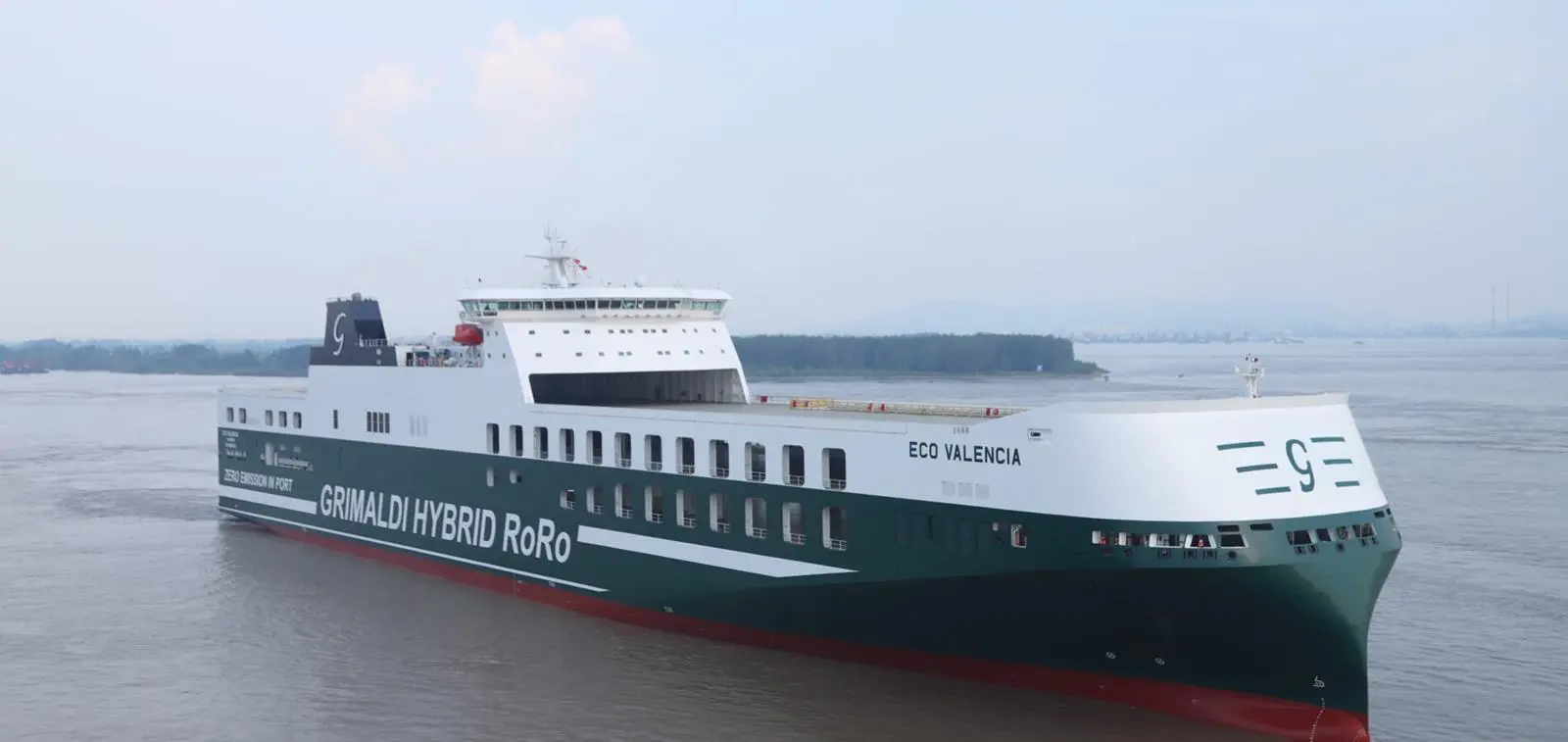
From its Naples headquarters, the Grimaldi Group has steered continual modernisation and expansion of a versatile fleet built around the ro-ro system, and has concurrently championed the cause of short-sea shipping, backing national and EU endeavours to achieve a modal shift in favour of waterborne transportation.
The latest stage of Grimaldi investment gives an added edge to its long-term strategic intent by marrying a considerable uplift in cargo carrying scale with a raft of energy saving and environmental protection as yet new to the intra-Mediterranean trading arena. Commissioned during October as the first unit in a 12-ship programme, the 238m ro-ro trailership Eco Valencia is distinguished not only by capacity for 7,800 linear metres of rolling cargo but also by a hybrid propulsion arrangement, solar panels and an under-hull air lubrication system.
Introduced into coastwise service between Italy and Spain on a Livorno/Savona/Barcelona/Valencia rotation, the new vessel brings to realisation the Grimaldi Green 5th Generation (GG5G) design conceived by the owner’s technical department in cooperation with Copenhagen consultancy Knud E. Hansen.
Such is the extent of the ‘sustainability’ measures embodied in the design and specification that classification authority Registro Italiano Navale (RINA) has seen fit to award its Green Plus notation. The grading signifies that the design solutions, onboard systems and operational procedures voluntarily put in place enhance environmental performance beyond the minimum levels set by legislation.
Construction of the 12-ship Grimaldi series was entrusted in two tranches to Nanjing Jinling Shipyard (formerly CSC Jinling), part of the China Merchants Group, and commanded an overall order value of US$800 million-plus.
The Italian trailership leads nine identical newbuilds for Grimaldi Euromed’s Mediterranean route network. The three other vessels in the contract will embody a modified version adapted to the needs of Grimaldi-owned Finnlines and its year-round Baltic traffic. While retaining all the ‘green’ features of the GG5G type, the Finnish ro-ros will have a reduced trailer intake of 5,800 lane-metres, 600-car capacity on dedicated decks, 300TEU slots on the weatherdeck, and 1A ice class.
Eco Valencia has two 500mm-bore two-stroke propulsion engines, complemented by an exceptionally large outfit of lithium batteries to deliver carbon-free electrical power during the ship’s frequent port stays. On passage, the RINA-certified under-hull bubbling system reduces resistance, contributing to energy savings and lessened environmental impact.
Direct drive to twin controllable-pitch propellers is effected by a pair of nine-cylinder S50ME-C9.6 engines built by MAN licensee Hyundai Heavy Industries. Each diesel is rated in this application for an output of 12,780kW, and is fitted with an MAN model TCA66 axial turbocharger.
Through the nomination of the Promas Lite system, each propeller and rudder forms an integrated whole to optimise hydrodynamic efficiency. A hub cap on the propeller streamlines the flow on to a bulb appended to the rudder, reducing flow separation immediately abaft the screw. The 25,560kW primary power concentration, in conjunction with the underbody lines and specific nature of the propulsors, provides for schedule-keeping and recovery at speeds up to nearly 21 knots.
Ecospray in-line, open-loop scrubbers ensure the requisite SOx and PM reduction from heavy fuel oil combustion during navigation. To avoid exhaust and noise emissions when alongside in port, electrical energy for the shipboard grid can be delivered by the substantial battery installation, which has a power-equivalent rating of 5,000kW. At sea, the batteries will be recharged through shaft generators and with the aid of a 600m2 solar panel array on the uppermost deck.
In-port zero-emission durations of up to eight hours are promised by the energy storage system, and the batteries will also yield benefits to engine running at sea through the practice of peak-shaving.
Kongsberg Maritime was engaged to deliver the hybrid propulsion elements including the supply and integration of shaft generators, frequency drives, and energy management system together with the Leclanché energy storage installation. The Leclanché system was manufactured at its factory in Switzerland, drawing on cells produced by the company’s German plant.
The newbuild class provides a further showcase for the air lubrication solution developed by London-based Silverstream Technologies. The system produces a thin layer of micro bubbles to create an air carpet along the flat bottom, reducing frictional resistance between the water and the hull, and thereby improving energy efficiency with a corresponding environmental gain. Simplicity of maintenance and a lifespan that is said to correspond with the vessel’s service lifetime are claimed for Silverstream’s proprietary technology.
Depending on ship type and design, Silverstream reckons that its system yields fuel savings in the order of 6-10%. The hull has been optimised with a ‘reverse bulb’ design, and treated with a non-toxic, low-friction silicon coating.
The 7,800 lane-metre or 500-trailer load capacity of Eco Valencia is double that of Grimaldi’s Eurocargo Genova-class ro-ros built by Hyundai Mipo Dockyard (HMD) a decade ago. At equivalent speed, the GG5G type will burn the same quantity of fuel as the earlier ships, inferring a 100% increase in efficiency calculated on the basis of consumption per lane metre of freight transported.
The entire cargo reception and despatch process is effected across the stern, by way of two ramps enabling simultaneous handling of vehicles and rolling cargo. In conjunction with the configuration of the decks and internal ramps, the arrangements provide for expeditious turnaround with all manner of wheeled freight on Mediterranean itineraries. The forward half of the 6.8m-high, No3 main deck is equipped with two hoistable car decks, each just under 900m2 in area, to give added load versatility in a five-level cargo layout.
The Jinling yard has a well-established reputation among European and other foreign shipowners for ro-ro and vehicle carrier construction, underpinned by Chinese price competitiveness.
PRINCIPAL PARTICULARS – GG5G class Eco Valencia
|
Length overall |
238.00m |
|
Length bp |
229.75m |
|
Breadth, moulded |
34.00m |
|
Depth, to main deck |
9.30m |
|
Draught, summer |
7.20m |
|
Gross tonnage |
67,311t |
|
Deadweight |
18,128t |
|
Ro-ro decks |
5 |
|
Ro-ro laneage |
7,800m |
|
Trailer capacity |
c.500 |
|
Main engines |
2 x 12,780kW |
|
Service speed |
20.8kts |
|
Main generators |
3 x 1,540kW |
|
Battery pack power |
5,033kW |
|
Crew + passenger berths |
45 |
|
Class |
RINA |
|
Class notations |
+AUT-UMS, Battery-powered, BWM-T, Dangerous goods, DMS, Green Plus, InWaterSurvey, Star-Hull-NB, +SYS-IBS, +SYS-NEQ-1 |
|
Flag |
Italian |
Related Articles
 PROPULSION
 GENERAL NEWS
 HYDROGEN