



Grimaldi Shows Faith In Con-Ro Concept
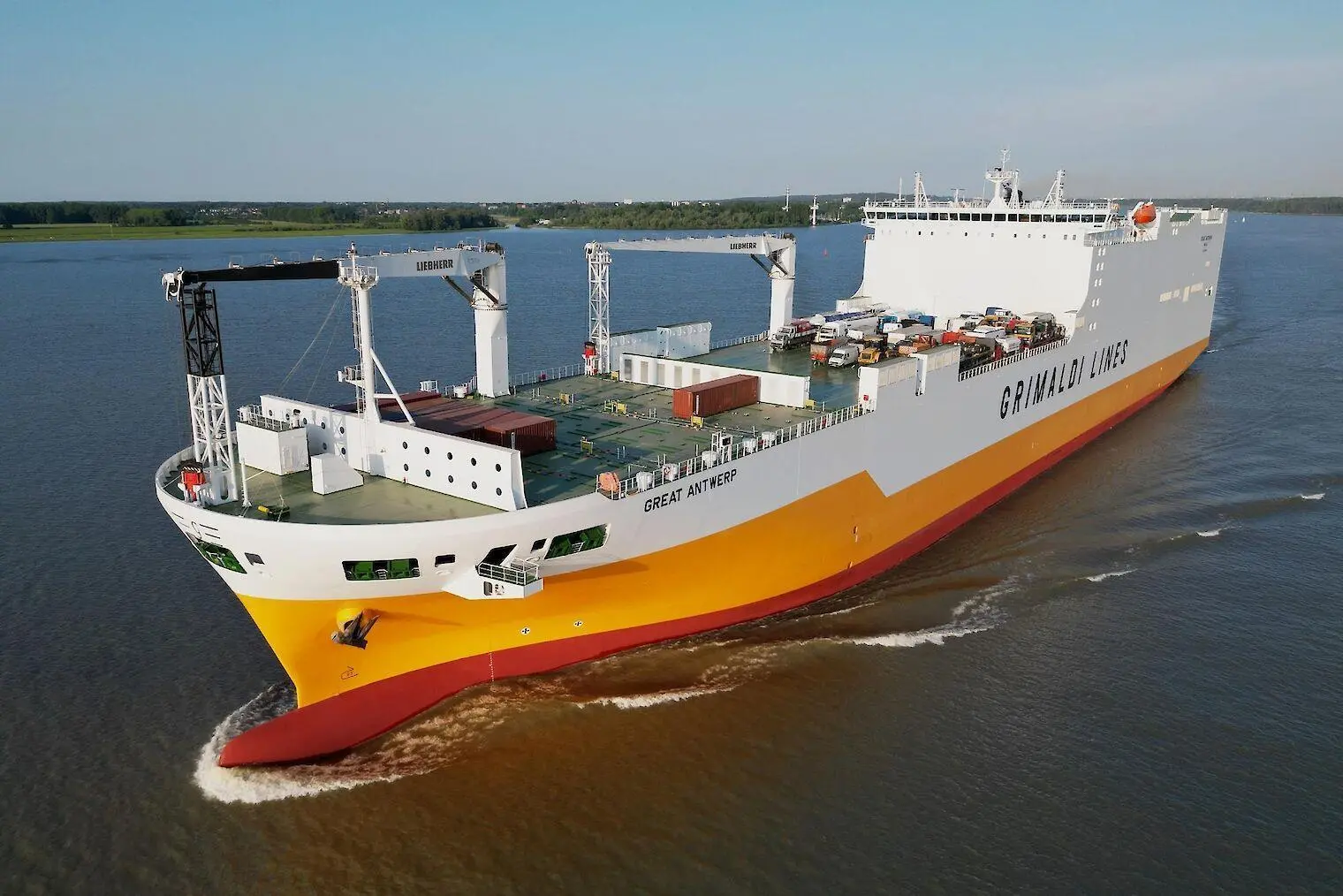
As a rare example of recent industry investment in what may otherwise be categorised as the con-ro concept, the Great Antwerp class constitutes a higher container-capacity, more environmentally-considerate evolution of the versatile G4 type dating from 2014/2015.
The 249m, geared and quarter-ramped Great Antwerp leads a series of six booked with Hyundai Mipo Dockyard (HMD), the last of which is due to be completed by the end of 2024, and which will strengthen the Naples-based owner’s standing as the world’s largest operator of con-ro tonnage.
The $500m contract has cemented a business relationship with HMD that has previously encompassed not only the G4 sextet, but also the preceding, five-vessel G3 programme, and the 10 Eurocargo-class ro-ro freight carriers.
Although only 13m longer and 2.5m beamier than the G4 design, the G5 offers double the box capacity while retaining the same intake of ro-ro cargo. The much increased box rating derives from the optimisation of the internal configuration, and is to a large extent attributable to the incorporation of a cellular hold forward.
A multitude of load permutations is possible with such a vessel, embodying as it does heavy ro-ro decks, dedicated car storage, and above- and below-deck container stowage, on a deadweight of around 47,000t. From the outset, Grimaldi has exemplified the capability by way of one possible mix as 4,700 linear metres of rolling freight, 2,500 car-equivalent units (CEU), and 2,000 TEU containers. Relative to other ro-ro multipurpose/con-ro units operated by the company, the newbuilds will realise reductions of up to 43% in CO2 emissions per tonne transported.
Two 50t capacity, deck-mounted Liebherr cranes on the starboard side provide the lo-lo wherewithal, complementing aftship ro-ro access across the heavy-duty MacGregor starboard quarter ramp, and render a fully self-sustaining status and ability to work into ports with limited handling facilities.
The dedicated hold space plus the above-deck stow on the pontoon hatch covers, together with the provision for a four-tier stack on the contiguous, open deck area up to the aft ro-ro garage, account for a total of 1,330 TEU slots. A further 762 TEU can be loaded as an alternative to vehicular cargo on the tank top (No1) deck and No2 heavy freight deck, to realise an all-up, near-2,100 TEU container component to the manifest if required.
The six-deck aft garage, laid out and structured for light vehicles, provides for some 2,570 CEU, while the lower ro-ro freight decks extending along to the No1 hold bulkhead offer higher car shipment volumes if required to supplement all types of vehicles, trailer-borne cargo, break-bulk and project consignments.
Whereas each of the G4s is powered by a Wartsila-Sulzer 8RT-flex58-series main engine, the MAN marque has been favoured for the G5 generation, in the shape of a 7G60ME-C10.5-EGRBP model, producing 19,880kW at 103rpm.
Notwithstanding one cylinder less, the wider-bore engine for the latest ships is longer and substantially heavier than the installation in the G4s. As denoted by the EGRBP suffix, the unit in the Great Antwerp class employs exhaust gas recirculation, using bypass matching, enhancing fuel consumption performance and rendering the engine Tier III NOx-compliant. SOx abatement is addressed through the fitting within the engine casing of a hybrid scrubber supplied by Wartsila.
Direct drive in the G5 design is to a 7.5m-diameter controllable pitch propeller, incorporating a cone on the hub and integrated with the rudder bulb to maximise propulsive efficiency. Although attributed with a service speed of 18 knots, Great Antwerp is understood to have shown capability for 20 knots or more.
Economy in delivering electrical energy for the ship’s net while under way is achieved through the adoption of a 2,300kW Nishishiba shaft alternator, complementing an auxiliary outfit comprised of three main gensets driven by Hyundai HiMSEN medium-speed engines. Each 7H25/33 prime mover is rated for 2,100kW at 900rpm and is equipped with NOx abatement to Tier III level by way of selective catalytic reduction(SCR).
Key elements for independent, precision manoeuvring on port call-intensive schedules are three 1,350kW tunnel thrusters, two in the bow and one at the stern.
The G5 vessels have been designed for ‘cold-ironing’, allowing electricity to be drawn from the landside grid when available, and onboard unit energy consumption by pumps, fans and other equipment has been reduced through the use of variable-frequency drives.
Contributory to the design’s hydrodynamic efficiency, Great Antwerp and each of her sisterships were specified with an under-hull air lubrication system. The solution adopted is drawn from within the shipbuilder’s parent group, being the Hi-ALS system, using TMC compressors for pressurisation of the air injected along the flat bottom of the hull, resulting in a significant reduction of skin friction. Grimaldi has experience of ALS technology by way of Silverstream installations on the GG5G ro-ro trailership class built in China by CSC Jinling.
The G5s will supersede vessels in the 20-25 year age range on the West Africa run. Great Antwerp was followed in September by second-of-class Great Lagos.
MAIN PARTICULARS
Great Antwerp
| Length overall | 249.0m |
|---|---|
|
Length bp |
237.0m |
|
Breadth, moulded |
38.7m |
|
Depth |
16.0m |
|
Draught |
11.2m |
|
Gross tonnage |
89,797t |
|
Deadweight |
47,528t |
|
Cargo capacity—possible mix |
4,700 lane-m ro-ro + 2,500CEU + 2,000TEU |
|
Main engine power |
19,880kW |
|
Speed, eco/max |
18/20kn |
|
Shaft alternator power |
2,300kW |
|
Main gensets |
3 x 2,100kW |
|
Manoeuvring thrusters |
2 x 1,350kW(bow); 1 x 1,350kW(stern) |
|
Class |
RINA |
|
Class notations |
C+, +AUT-UMS, BWM-T, COAT-WBT, COMF-NOISE-PORT 63, EGCS-NOX, EGCS-SOX, Green Plus, HVSC-NB, Inwatersurvey, MON-SHAFT, Star-Hull |
|
Flag/Registry |
Italy/Naples |
Related Articles
 ENERGY SAVING DEVICES
 ENERGY SAVING DEVICES
 AMMONIA