



GTT bunkering ship receives dual approval
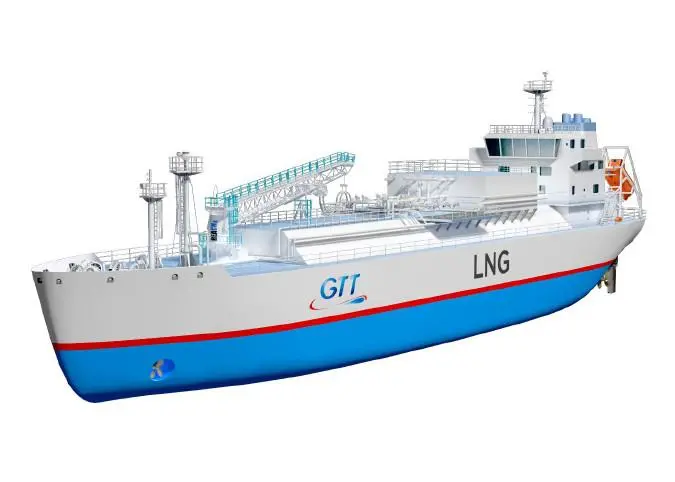
The 4,000m3 bunkering ship features GTT’s Mark III Flex cargo containment system. The vapour pressure of two bar allows for more flexible management of boil-off gas during loading and bunkering. Increased loading rates also shorten bunkering times, while the time before boil-off gas reaches its upper allowable limit during voyages or stand-by is lengthened.
Philippe Berterottière, chairman and CEO of GTT, said: “We have demonstrated the reliability of our systems to operate beyond atmospheric pressure applications. I believe this new development by GTT, in response to the market requirements, will contribute positively to an efficient supply chain for LNG a marine fuel, and therefore to the growth of the market.”
GTT noted that the concept improved holding time when there is no boil-off gas consumption and reduces the need for using reliquefaction equipment, reducing costs. The company is working on similar studies using its NO 96 cryogenic liner technology and also for applications on LNG-fuelled vessels.
The design was initially developed as a specific project for an undisclosed project in the Mediterranean region, GTT said, while noting that ,it had ‘several prospects’ for the system. The ship uses the standard membrane insulation system MarkIII Flex already extensively used on large scale LNG carriers. The biggest change on the ship to increase the vapour pressure is on the ship structure that supports the insulation system of the tank and that could potentially be exposed to higher stresses.
“Only the steel structure scantling of the hull has been increased,” a spokesperson said. “This leads to an additional steel weight of 155 tonnes compared to the 0.7 bar design, or an increase of 10% on the steel weight of the ship (or 7% on the lightship weight).”
The approval by class societies is made possible by the provisions in the new IGC code (and in the IGF code for application to LNG-fuelled ships) which requires technical and rational justification – following structural finite element analysis described in the “limit state design” methodology applicable for novel configuration – instead of applying the limit of 0.7 bar introduced in the first issue of the IGC code in the early 1980s.
Commenting on plans for building the vessel, the company added: “It belongs to the ship owner to decide in which shipyard this ship should be built. A network of qualified licensed outfitters is currently being developed who could work as sub-contractors to any shipyard to install the GTT membrane system onboard. There are shipyards in South Korea, China, Singapore, Russia and Europe which have shown great interest in building such bunker ships.”
The original design is for a ship with 90m loa and deadweight of 2,820 tonnes at design draft. Boil off rate from the two membrane tanks is forecast at around 0.31% a day, while a smaller two tanks will have capacity for 940m3 of marine diesel oil. Speed at design draft will be around 15.5 knots, with a range of roughly 1,200 nautical miles.
The vessel will be powered by two dual-fuel engines of Wärtsilä 8L20 or equivalent, with two controllable pitch propellers of around 2.5m. It will also house a genset of around 250kW, and a 400kW bow thruster. The vessel will accommodate up to 12 people in ten cabins.
PRINCIPAL PARTICULARS
Length overall 90m
Length between perpendiculars 86.8m
Breath, moulded 15.7m
Depth, at main deck 9.4m
Depth, at trunk deck 12.1m
Draft, design approx. 4.72m
Draft, ballast approx. 2.96m
Deadweight, at design draft 2,820 tonnes
Gross tonnage approx. 3,870 tonnes
Cargo tanks: Two GTT Mk III Flex LNG membrane cargo tanks (total capacity 4,080m³), two MDO tanks (total capacity 940m³)
Other tanks: Ballast water (2,320m³), marine diesel oil (87m³), fresh water (40m³)
Classification: BV, LR, DNV, ABS, CCS or equivalent; +1A1 Tanker for Liquefied Gas,
Ship type 2G, Clean Design, Gas Fuelled
Related Articles
 PROPULSION
 GENERAL NEWS
 HYDROGEN