



HOLLAND SHIPYARDS GROUP TO RETROFIT HYDROGEN SYSTEM ON INLAND CONTAINER SHIP
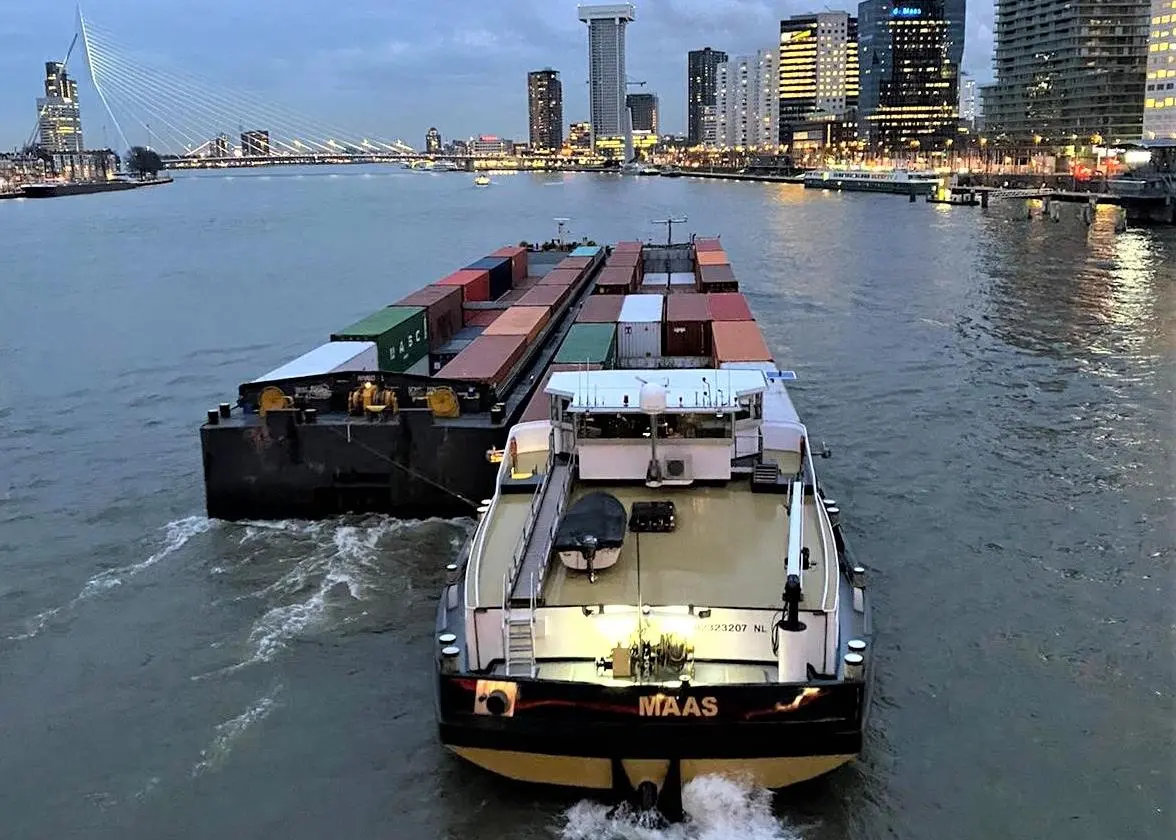
The 110m x 11.45m inland container vessel will be retrofitted at the Holland Shipyards Group’s yard in Hardinxveld and is expected to be continuously sailing on hydrogen by December of this year. The Motorship reported on the project in October 2020.
The vessel’s main engine and gearbox will be replaced with a new modular hydrogen propulsion system consisting of electric motors, hydrogen tanks, a PEM fuel cell system and a battery system. The compressed hydrogen tanks, the fuel cells and the battery system are separate units that can be removed for maintenance or replacement purposes.
The new systems will be installed in the cargo space of the vessel, with the hydrogen being placed above the fuel cell system in two 40-foot containers which are together capable of storing approximately 1,000kg at 300 bar.
The fuel cell system will be triple redundant with 825kW capacity to supply propulsion and auxiliary power, and a 504kWh lithium-ion battery pack will be used for peak shaving, secondary and bridging power. The system will contain a 750V DC bus bar and an e-motor for propulsion.
“Based on the operational profile, readiness and price, we chose PEM fuel cells and compressed hydrogen,” said a spokesperson for Future Proof Shipping. “We are in final stages of negotiations with a green hydrogen supplier to secure our fuel supply.”
Hazard identification analysis has been conducted with Lloyd’s Register. Hydrogen has low volumetric energy density and therefore requires more storage space than diesel fuel. It is also highly flammable, and in combination with high pressures has the potential to explode. This has called for additional safety measures in the design of ventilation, leakage detection, fire detection and fire suppression systems. Natural ventilation is being used where possible, but, for example, while the vessel’s old diesel engines required one air inlet and one exhaust, three separate inlets and three separate outlets are required for the fuel cell room. The battery system also needs additional routes for ventilation and air conditioning.
The new power system is anticipated to reduce greenhouse gas emissions by 2,000 CO2e tonnes annually when the vessel returns to service shipping containers between Rotterdam and Antwerp.
The project is supported by funding from the Dutch RVO (Subsidie Duurzaam Scheepvaart scheme), Interreg North Sea Program (via the ZEM Ports NS project) and a stimulation scheme for sustainable inland shipping from the Port of Rotterdam, which is executed by the Expertise en InnovatieCentrum Binnenvaart (EICB).
Holland Shipyards Group has gained experience in building vessels with sustainable propulsion methods over the past few years, with battery technology becoming increasingly standard for the yard’s projects.
Future Proof Shipping is working towards developing a fleet of zero-emissions vessels, starting with inland vessels and then venturing into short-sea. The company is currently looking at the technical and commercial feasibility of zero-emissions short-sea container and bulk vessels.
Earlier this year, Future Proof Shipping joined StasHH, an initiative to develop an open standard for heavy-duty fuel-cell modules in terms of size, interfaces, control and test protocols to support their adoption in road, off-road, rail and maritime industries.
Related Articles
 ALTERNATIVE FUELS & LUBRICANTS
 ALTERNATIVE FUELS & LUBRICANTS
 ALTERNATIVE FUELS & LUBRICANTS