



Hybrid-Electric LNGC Design Presents Net-Zero Pathways
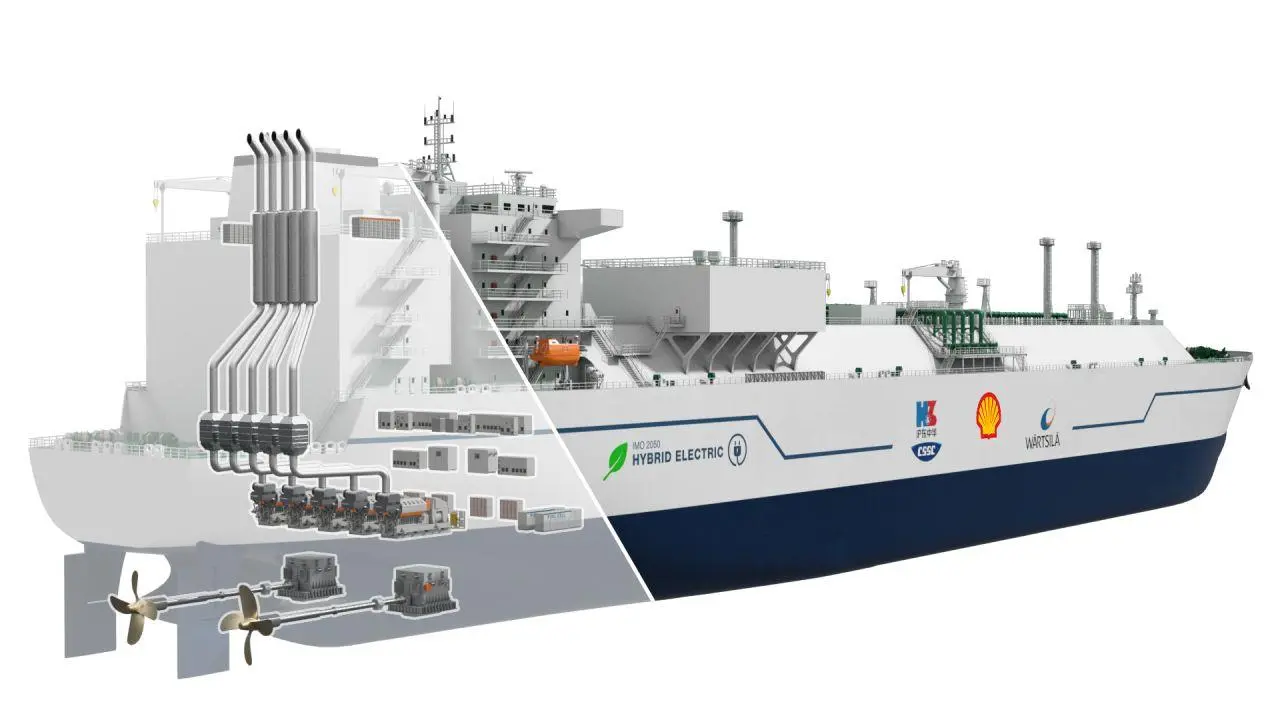
For partners Shell, Wärtsilä, and Hudong-Zhonghua Shipbuilding, the release of a new modular hybrid electric LNG carrier is the culmination of a multi-year cooperation effort. The design provides an increase of 9,000cbm of cargo capacity below deck, enabled by a highly compact and fully electrified propulsion power system. A reduction in equipment weight of over 40% compared to today’s standard LNG propulsion system, meaning the extra capacity can be accommodated without affecting the vessel’s displacement, draft or hull performance and ensures it is suited to standard large LNG terminals.
For Shell, the immediate benefits are higher trading revenue, lower unit freight costs and reduced emissions per ton mile. In presenting the Gastech paper, Leonidas Koulouridis, Project Manager for Decarbonisation in Shell Shipping & Maritime, said: “The design will allow reduction in engine room space and increase in cargo capacity up to 185,000m3 for the same principal dimension and similar vessel displacement based on current 174,000m3 LNG carriers. This will support a reduction in unit freight cost and CO2 intensity today.”
Key to the design is the specification of five fuel-flexible Wärtsilä 31 4-stroke gensets: three pure gas engines for maximum efficiency and two dual-fuel engines for the option of liquid fuel operation. The modular Wärtsilä 31 engine platform is designed to easily incorporate a broad range of future fuels including bio-LNG, synthetic LNG, liquid bio fuels, hydrogen, and methanol.
Current LNG carriers are designed for a speed of 19.5 kn, although several sources indicate the current average sailing speed of the global LNG fleet to be around 15 kn. As a result, LNG carriers featuring 2-stroke dual-fuel propulsion are operating sub-optimally with average load factors below 50% – and therefore, their emissions are higher. While the new design maintains the capability of the vessel to achieve speeds exceeding 19 kn, the modular hybrid electric design provides a more efficient overall solution based on the actual operating profile of LNG carriers trading today. This results in a drop in fuel consumption while reducing GHG emissions and methane slip. The vessel also maintains its capability to operate in gas mode in all vessel conditions, from idle to top speed.
Future flexibility
Going forward, the hybrid electric design also provides the flexibility needed for adopting new electrical power sources such as fuel cells, solar and heat to power. Emerging energy saving technologies such as hull air lubrication, wind assisted propulsion, and continuous optimization of hull lines, propulsion solutions and hydrodynamics are being developed to improve vessel efficiency. These technologies, together with slow steaming will further reduce power demand from engines in the future and will benefit further from a modular power system that maintains high efficiency in all power conditions.
“A modular electrified design provides the foundation for an upgradable powering platform, ready for the forthcoming challenges and changes. Upgradability is critical to avoid stranded assets. The modular design ensures that the asset will be upgradable and commercially relevant regardless of which fuel emerges and prevailing technologies. Shell’s Powering Progress strategy is to accelerate the transition of its business to net-zero emissions by 2050,” added Koulouridis.
Improved availability
The flexibility provided by five gensets (normal vessel operations only require four to be operational) enables service to be completed while the vessel is in operation, leading to an increase in uptime and availability. The vessel contains only one common engine family, meaning spare parts handling and inventory is also very simple. The addition of 2MWh battery pack as energy storage enables the generating sets to run at high and also stable load factors, meaning running hours and also general wear and tear is reduced.
“The addition of energy storage also leads to a reduction of engine running hours of 20-30% and also enables the gensets to operate at steady state loads, resulting in much lower maintenance costs than traditional dual-fuel diesel electric systems without batteries along with the reduction of methane slip seen in transient loads,” Grant Gassner, Director, Integrated Systems & Solutions at Wärtsilä told The Motorship.
Furthermore, when new decarbonisation technologies are added into the system the modular design will be able to turn off generating sets, enabling the maintenance cost to reduce further as new powering and energy saving technologies are added into the system and vessel speeds reduce further.
“The approval in principle of the initial design has been awarded and our senior engineers will further optimize the basic design to enable the new design to be ready in the near future in strong cooperation with our partners,” Mr Song Wei, Chief Technical Officer of Hudong-Zhonghua Shipbuilding concluded.
Related Articles
 2-STROKE & 4-STROKE
 2-STROKE & 4-STROKE
 2-STROKE & 4-STROKE